Before Friday, if you had asked me what the video game hubs of the U.S. were, I would have responded with San Francisco, Los Angeles, Seattle, and Austin. Chicago would have been 6th or 7th on my list. I had never thought about Chicago in relation to video games. Of course, some game designers live among the city’s nearly three million residents. However, I never considered the rich history of games in this city before going to the symposium’s first panel, Games + Chicago: Then & Now.
Arcades in Chicago
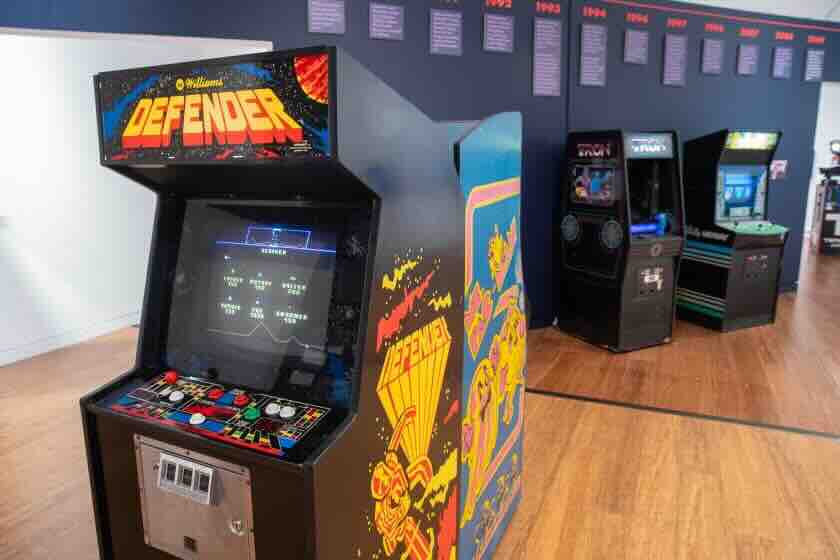
Chicago was once the pinball manufacturing capital of the world and home to former giants like Midway and Chicago Coin. Panelists Chris Ganner and Josh Tsui were both involved in the Chicago arcade industry, working for former arcade giant Midway Games. I was surprised to learn about Chicago’s central role in playtesting pinball and other arcade games. As a city, Chicago is a good cross section of America, both cosmopolitan and parochial, and its central location made it ideal for testing how games would perform nationally. Additionally, Chicago had a strong arcade culture, with numerous arcades and huge gamerooms. Many arcade owners and operators wanted to be part of the playtesting process and play an active role in shaping the future development of arcade games.
Transition from arcade to long form games
I was most intrigued by the discussion about the evolution of video games. With the transition in the late 20th century from coin operated arcade arcade game to home video game consoles, traditional manufacturers like Midway struggled. Agility is key in an industry that’s constantly disrupted. The people who preferred developing short-form arcade games often moved into mobile game development or gambling games.
When I think of video games, I only think of long-form console or PC games that requires tens or hundreds of hours to finish. Growing up, I always preferred short-form games, which felt different from what a “real gamer” would like. Hearing this panel reminded me that short-form games are an essential part of gaming history and that play takes many forms. I hadn’t really made the connection between the microtransaction-based design of many arcade and mobile games before. Understandably, games that focus too much on getting players to spend money can lose some of the qualities that make a game “good.” Still, the way some gamers write off all mobile games makes me less likely to find the more “legitimate” games that share characteristics with the mobile games I enjoy.
I get bored easily, which probably explains why I am drawn to games that can give me satisfaction in just a few minutes. I don’t want to sink dozens of hours into a game to feel like I’ve achieved something. If I can get that same sense of progress or joy in one sitting, that’s enough for me.


The similarities between arcade games and mobile games also became very clear with Tsui’s remarks. I think that, unlike most console games, mobile games actually can stay relevant longer by keeping their player base invested in a specific game. Yearly-release games like Call of Duty lose most of their player base halfway through the game’s cycle, especially older titles that were not cross-platform, and are basically on life support. Meanwhile, Clash Royale, a game I started playing in 7th grade, is now at its all-time peak. I think what makes people go back to mobile games is the easy access and quickness of matches. However, I think the big difference between arcade games and mobile games is that money gives you advantages in mobile games, while it gives you the ability to play arcade games. Both are predatory, but they are different. Pay-to-play just seems like such an unattractive model nowadays for quick games.
As a Chicago local, I can tell you that arcades are very much still alive in the city. I highly recommend the CatCade (an arcade and cat rescue) and Nickel City (a coin-operated arcade like the ones you mentioned). The irony is not lost on me that both are pay-to-play, as you pointed out, but the CatCade is an animal shelter first and foremost and Nickel City (if it hasn’t changed since before covid) has a section of free to play games.
On another note, I think your connection between arcade games and micro-transaction could be used in conversation with Switch Ports specifically. I’ve noticed that a lot of games that are free to play on mobile or are old arcade games end up costing close to $10. You get the entire game ad free, but the cost of it is more than paying for ad free on mobile.