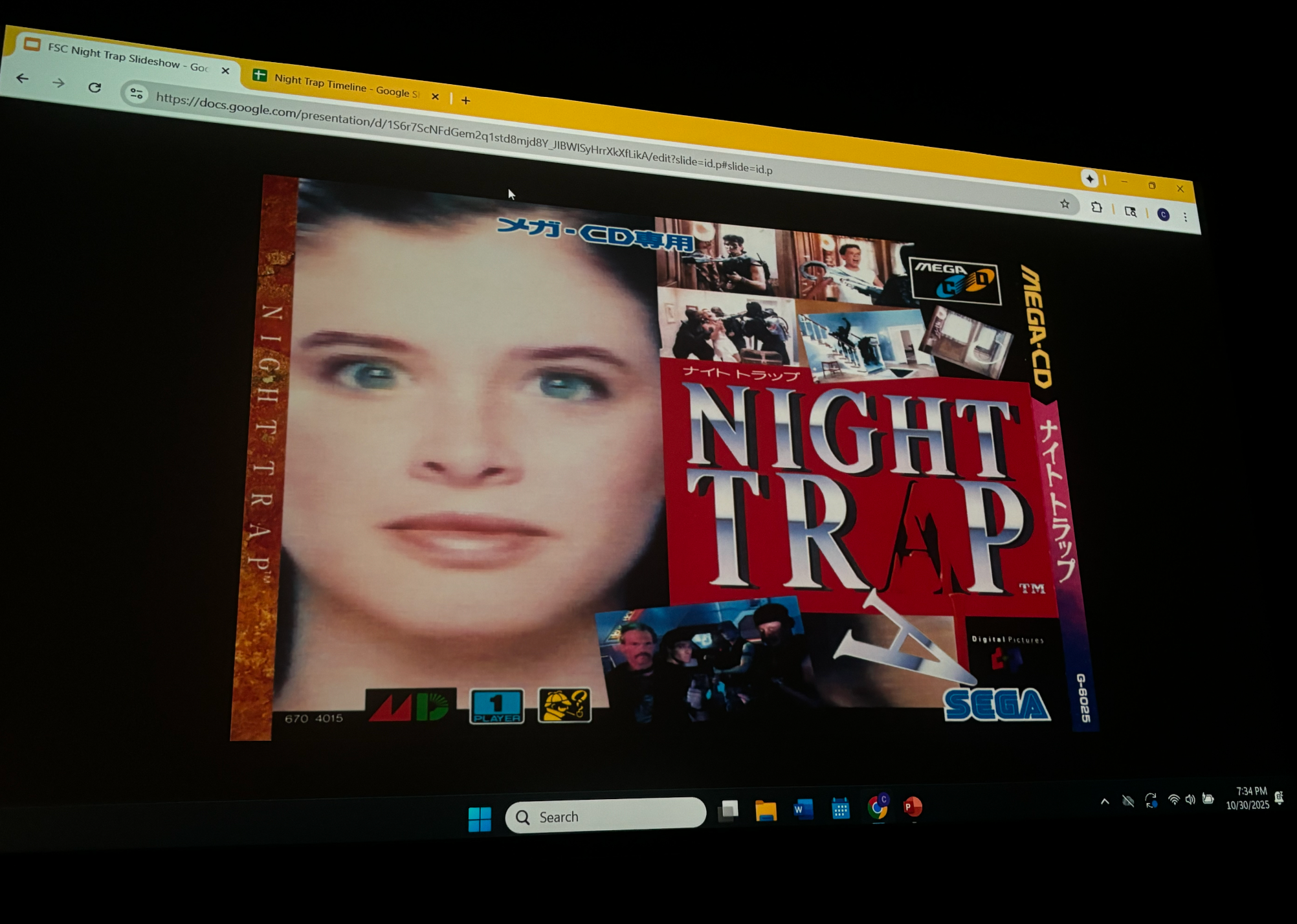
Night Trap is not a difficult game to play. Essentially, the player just has to use the stick to alternate between the different rooms, clicking a on the room they want to see. To activate a trap, the player presses b. There is no penalty for clicking the trap button while it is in the green or yellow. Similarly, there are no limits to how many traps a player can activate. Finally, to switch the code color, the player uses the back LR buttons to cycle between all the color options.
In terms of how to play, the game has a low barrier to entry. Difficulty and failure do not come from being unable to execute specific mechanics. Instead, it comes from how well a player is able to maximize executing those mechanics. Specifically, it comes down to how well a player knows when and where events will happen.
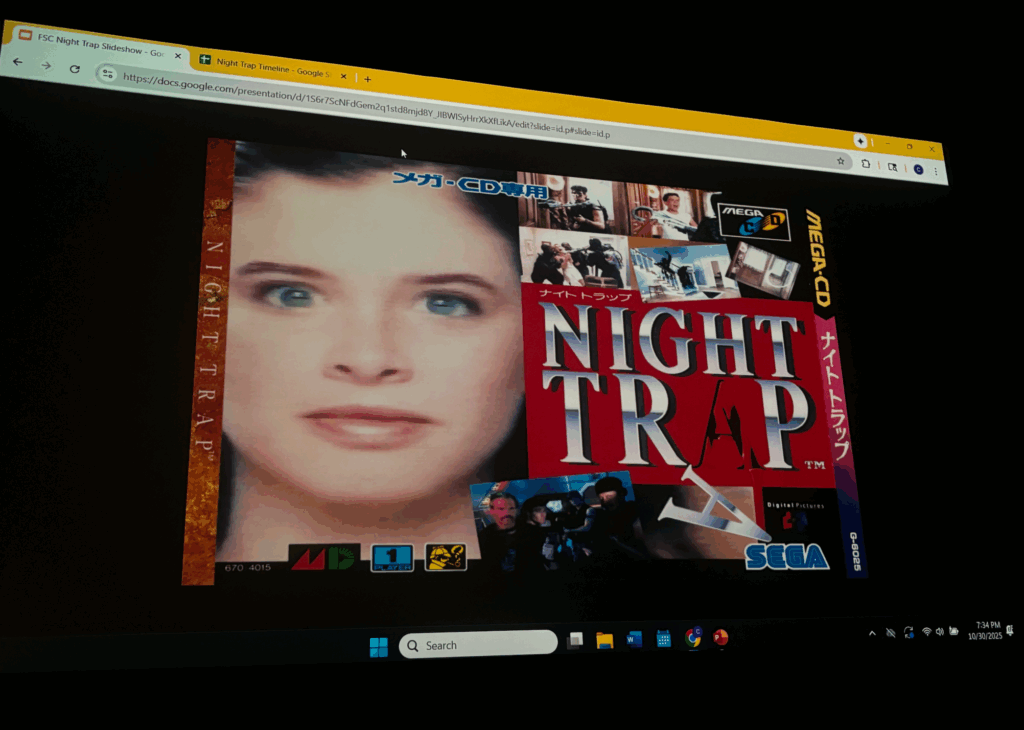
I was given the opportunity to be one of the audience players in this session (thank you for letting me participate!).
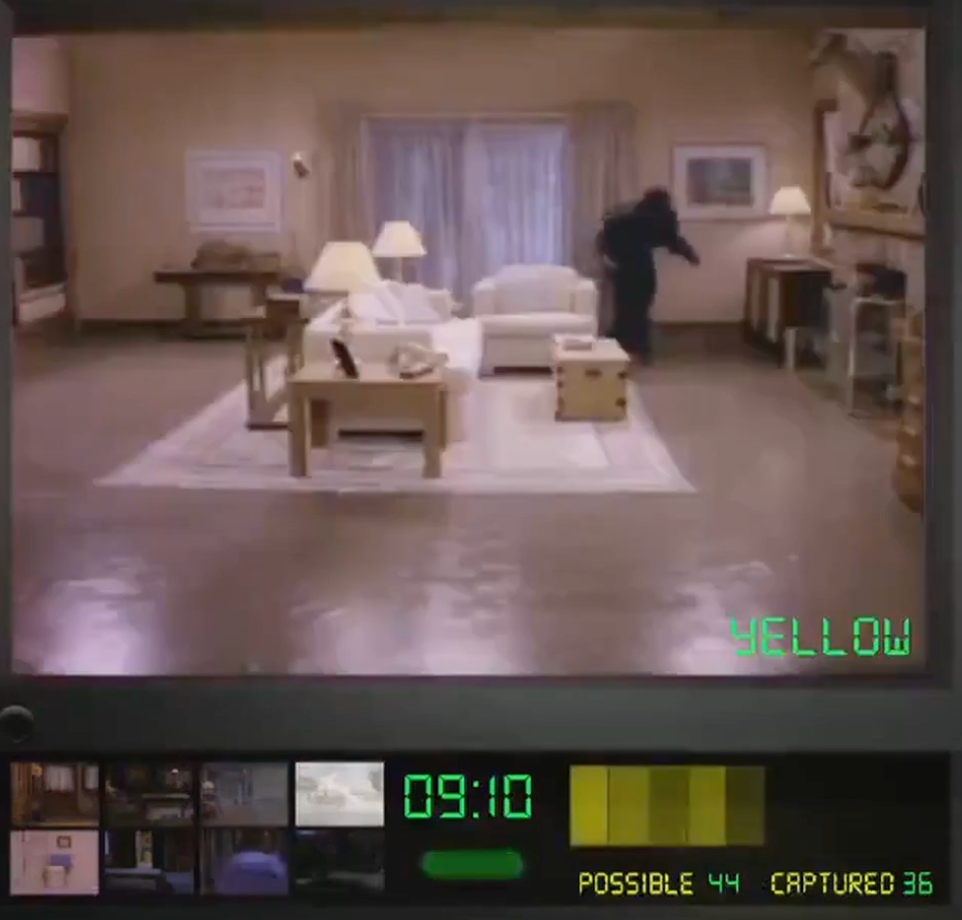
I took the strategy of switching the camera immediately if the suspenseful music associated with the augers was not playing — taking exception to that rule only when a single new scene we the audience hadn’t seen was playing out. Personally, I wasn’t under the impression that I was doing poorly. I caught a couple of augers and, thanks to Mack, accidentally stumbled across the access code color that I just barely missed the scene for (it was yellow). However, the game immediately ended because I apparently hadn’t caught enough augers. My cycling strategy was fine, but not good enough.
Failure occurs at many points in Night Trap, and as the game progresses, it uses a player’s settled knowledge against them. The first and, I would guess to be the most common, would be a failure to catch enough augers. Because the gameplay is not technically difficult, difficulty comes instead from a player’s ability to know. At 1:25, where can I find augers? At 3:45, do I need to switch from hall 1 immediately to the kitchen and then back to hall 1? While randomly switching between the rooms can help a player figure out where augers are at what time, this method inherently relies on random chance. This trial and error method hopes that a player happens to be at the right place at the right time. And, because augers can show up in two places at once, it relies on players testing multiple paths even if they think they know the “right” order of events. On a first blind playthrough, I doubt that a player will succeed in their first attempt at the game. Notably, the plot is happening simultaneously with these possible encounters. If a player wants to know what is happening, they ultimately will miss out on necessary events to complete for the win-state. Following the plot necessarily sets a player up for failure, and thus a player is unlikely to watch scenes they already saw another time and are instead encouraged to not watch those scenes.
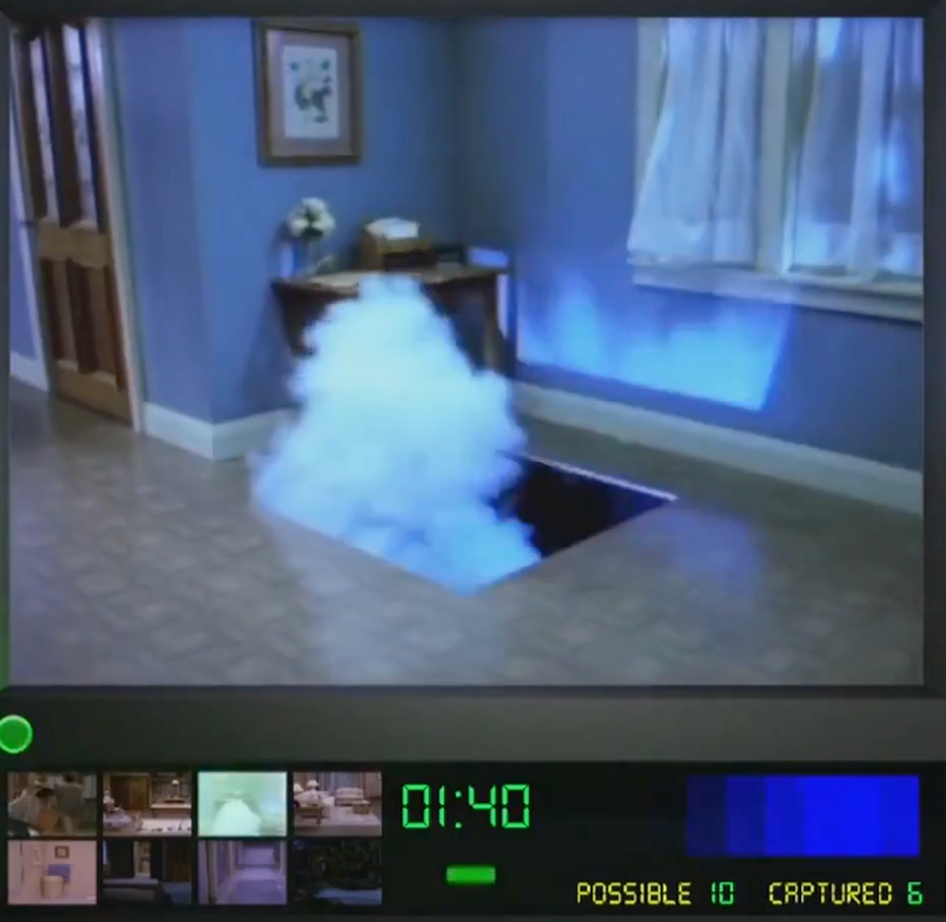
Another way to fail is to not watch scenes where the changed access code is mentioned. In order to activate traps, the player must ensure that they get on the right color when it is changed by the vampires. Notably, because the player has to catch a certain amount of augers to avoid a fail condition, and in the first half of the game no capturing occurs in the cutscenes, a player is subconsciously conditioned into avoiding scenes. Thus, the player may accidentally miss the needed code change even if they catch the right amount of augers. And, while switching from room to room will probably have you eventually run into some augers, the code-switching scenes happen only once (with the color itself being said only once). There is therefore a higher degree of difficulty around knowing when and where they occur.
The other way to fail that I will discuss occurs when key characters are not saved. These scenes operate as cutscenes, but unlike earlier in the game, there are now interactions between augers and the characters in cutscenes that the player can assist in. Again, like the code-switching scenes, there is a higher degree of difficulty with these scenes since the player does not know where or when these scenes will occur — and failing to save key characters leads to an immediate game over. What is interesting about these moments is that, up until now, the player has always immediately trapped augers once the bar at the bottom turns red and have always been immediately rewarded for doing so. Thus, it is ingrained in the player to trap the second they can (especially since a player has never been punished for pressing the trap button early). In one scene in particular, Kelly tells the player to trap the augers attacking one of the girls, the red bar eventually appears, allowing the player to save her. However, clicking the red bar the first time accidentally traps the girl as well. Thus, the game takes a player’s established associations with the trapping mechanic (and listening to Kelly) and breaks that connection with an automatic game over. For the rest of the game, the player becomes concerned with accidentally trapping at the wrong time (notably there is no indication of when is the right or wrong time to trap) — which can lead to them hesitating for too long, or accidentally trapping when they are not supposed to.
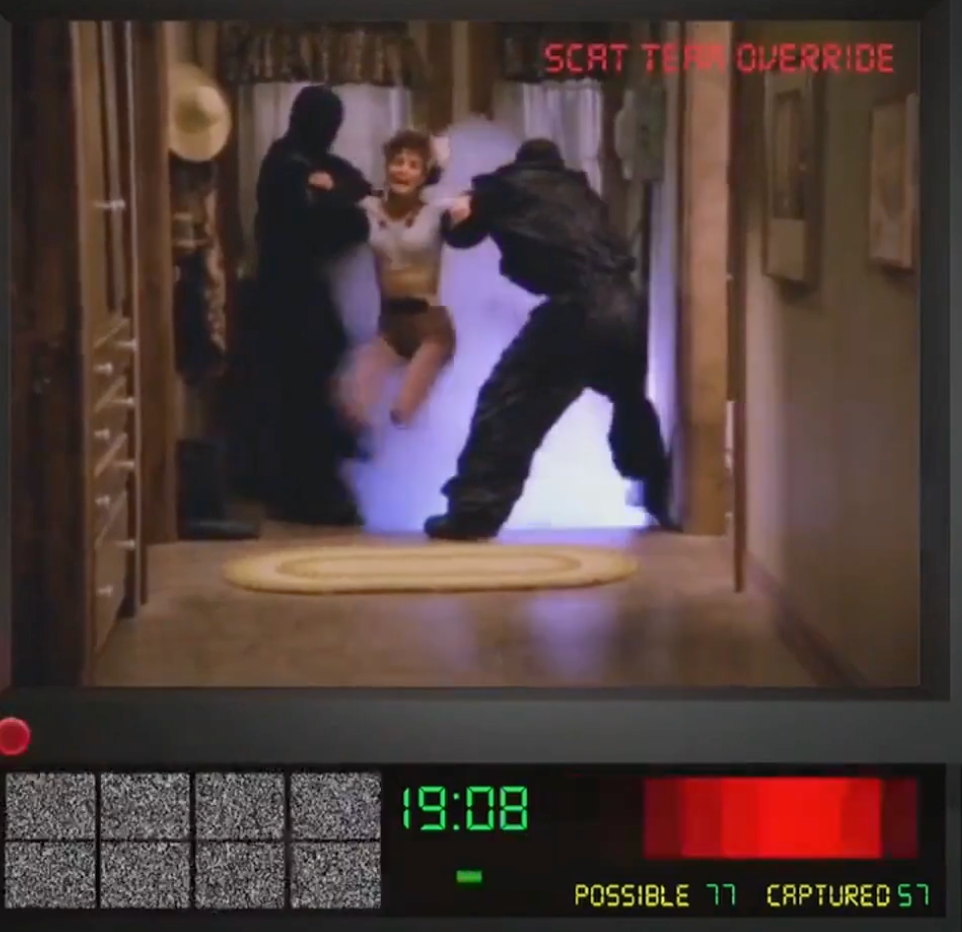
Knowledge (in terms of quite literal knowledge on where and when events occur) becomes a mechanic that allows the player to successfully navigate the various events of Night Trap. However, learned knowledge (avoiding scenes in order to trap augers, or associating the red bar with the immediate need to trap) is used against a player to make their ability to navigate the game more complex, and increase difficulty as the game progresses.
A player is ultimately going to fail in Night Trap. Whether it is not catching enough augers, not switching the code, or not saving key characters. Failure in Night Trap thus invites a player to think systematically. Do you the player keep flipping randomly, engaging in a trial and error method? Do you watch each room in its entirety, taking note of where and when events occur, and then use that knowledge to plan a successful route? Or, is there another way of going about this game? Night Trap asks a player not just to play the game, but to consider how they choose to engage with play.
“The wall trap! Aaaaaah!”
Thank you so much Ashlyn Sparrow and Chris Carloy for the wonderful Night Trap game discussion!! And, thank you for the phenomenal execution of a successful run!!


I’m not going to lie, the game doesn’t really sound like fun. You avoid cutscenes, which I think are half the fun in games that contain them, and are plagued with inconsistent vague mechanics (from the trapping). Nonetheless, I appreciate the strategic elements to this game, requiring that game knowledge is built up over various sessions. As you mentioned, it challenges the player to thoughtful play. Some strategy needs to be enacted or else failure is guarenteed. However, not all strategies are made equal. Watching every room in its entirity to then plan a perfect run seems highly effective to me, but I wonder if it’s the most fun way to play. Assuming that games are empty for a significant amount of the time, this strategy becomes a bit of a chore, ala grinding. There’s a common saying that “players will maximize the fun out of a game” if given the chance, and I very much think this applies here. Games in general should be cautious that what is most fun is also the most optimal.