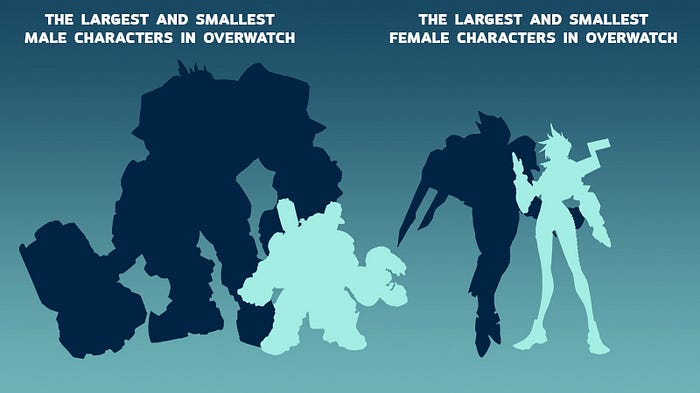
Source of Header: http://supercargautier.tumblr.com/post/102075248478/weve-heard-from-our-female-employees-and
“Realistic Female First-Person Shooter” by Anna Anthropy, despite the name, is not actually from the point of view of a woman. It is true that the game is from the perspective of a woman who participates in a battlefield. By definition, the player is playing from the first person point of view of the female protagonist: the player is able to control her actions, see through her eyes, choose her dialogue options, etc.. However, every feature of that female character is meant to mock her as a woman or make her appealing to a male gaze:
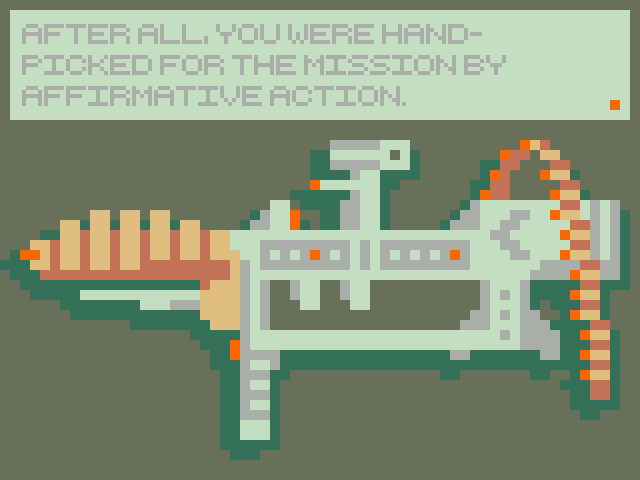
Her name is Lieutenant Labia (meant to poke fun at female genitalia), she makes unnecessary moaning noises as she runs, she is unable to properly do anything without a man (i.e. shooting the aliens, reloading her own bullets), etc. These are not the realistic traits of a human woman, but rather, the traits featured in female characters within many video games.
“Realistic Female First-Person Shooter” is a satire on those female characters in the video game industries, meant to show how a female game character is perceived from a male point of view. It brings to attention a problem of female representation in video games. The problem being that in many video games, especially those from the early era, the female characters are treated as objects: a prize–or goal–to be won, a lover for the male protagonist, acting as sex appeal, but never her own character.
For example, Princess Peach from the early Mario games is a non-playable character that only exists to play as the “damsel in distress” and as the end goal for Mario to achieve.

However, unlike those games, “Realistic Female First-Person Shooter” portrays those female characters from the first person point of view. The viewer does not know what Lieutenant Labia looks like, yet immediately they can tell she is being hypersexualized from the running sound effects and stereotypes her when she acts incompetent without a man around.

But because the game is in first POV, the most “personal” point of view, it is able to showcase the objectification of women in a way that lets the viewer experience what video games put women through, and what they see from her perspective should make them uncomfortable. The aiming mechanic itself is against the player, erratically moving around the screen and making it impossible to stop and aim, and it shows the game system itself is against the player. It forces the viewer to empathize with the female characters of the game industry and realize that the system is against women.
Male characters in video games never face the same issue; they always have their own personality or complicating factors that make them much more complex, whereas there are many instances that female characters are simply there to be objectified.


Of course, this is not the same for every single game. There are plenty of video games out there that produce interesting, three-dimensional female characters.
But the truth of the matter is, these games are much more rare in the industry. How many video games can you name that only showcase female characters that are skinny and have large boobs vs games that showcase a variety of female body types? Games in the former category are a dime a dozen, but the latter are much more rare in comparison.
“Realistic Female First-Person Shooter” is not the first to point out this problem in the game industry, but it does so in a way that makes it very understandable, forcing the viewers to put themselves in women’s shoes.


I think it’s interesting that you say the first-person POV is the most “personal” one, acting as such to put the player in someone else’s shoes and to showcase something from a new perspective. I don’t disagree with this reading, but Anna Anthropy uses it in an almost insincere way. The main character, “Lieutenant Labia,” or “you,” is so exaggeratedly played up to reflect female stereotypes in video games that the first-person perspective seems to be removed from the player. We can laugh and poke fun at the character and her extreme actions or breathy over-the-top moans because we don’t identify with her. We get annoyed at the slow mechanics, the impossible aiming functions, and the loud, obnoxious noises. There’s a lack of immersion that many other FPS games provide, and it almost pushes the first-person perspective’s personal identification aspect so far that it becomes a meta commentary on how it’s truly not a realistic way for a real person to act – and certainly not a way that the person playing the game would like to be identified as. To me, it seems like Anthropy is doing this so that a male audience who may be unused to this kind of prejudice can understand how outrageous it is. When I first played, my thoughts were that it felt like the system was built against me. Reflecting on this, it is Anthropy’s way of conveying that, yes, in fact, the system is built against you (in a video game or not). I find it hard to imagine a male audience not feeling the same way after playing, especially when they are unused to dealing with such circumstances.