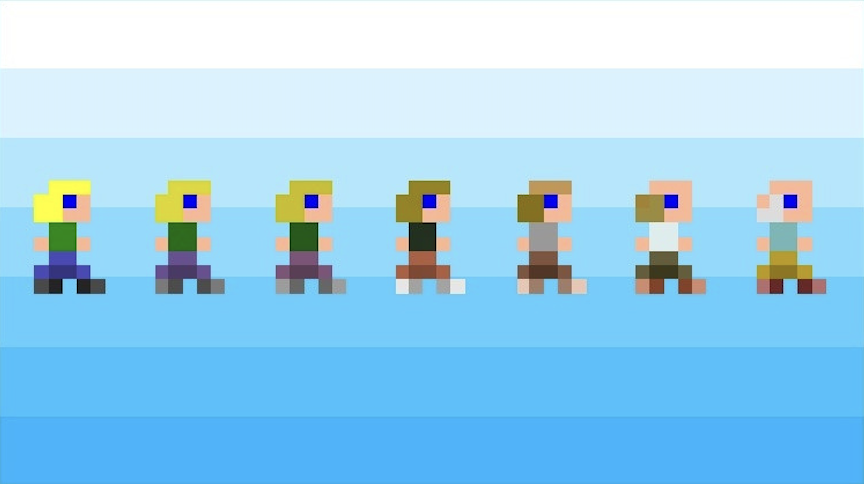
I didn’t expect much from Passage. It’s five minutes long, looks like something from a forgotten console, and doesn’t even have a title screen. But somehow, in those five minutes, I ended up feeling the weight of an entire life. You just walk to the right. That’s it. No dialogue, no instructions. Just movement, aging, and the quiet awareness that every step makes the past blur behind you.
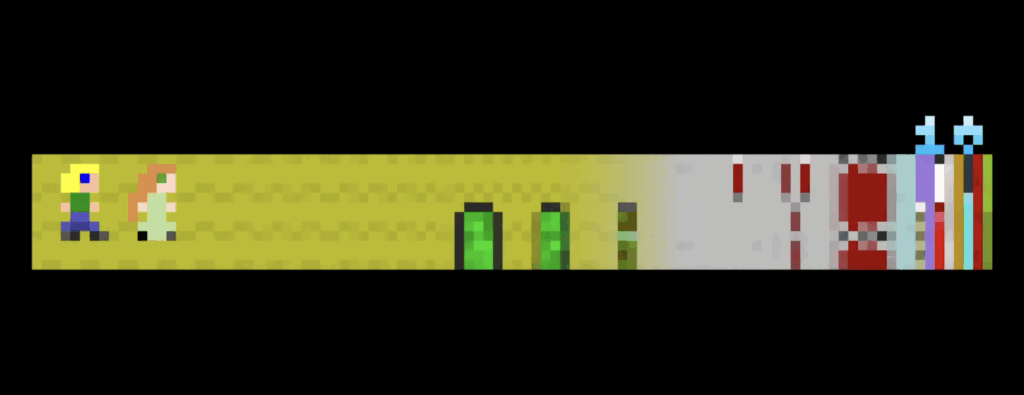
The world of Passage begins in vibrant color before fading into muted grays as time passes.
What caught me wasn’t the story (it’s barely there) but the structure. Ian Bogost calls this procedural rhetoric: the idea that games make arguments through their rules and systems rather than through words. Passage doesn’t tell you that time moves forward; it makes you feel it. You can’t turn back. The left side of the screen dissolves into abstraction, turning memory itself into a mechanic. In Half-Real, Juul talks about how games compress time. In Passage, the five minutes you play are the character’s entire life. Progress isn’t optional. It’s inevitable.
The first time I played, I met the woman early on. Once we paired up, the space around us literally shrank. The screen got narrower, and I suddenly couldn’t explore the same way. I remember feeling oddly claustrophobic, like the game was quietly telling me that intimacy comes with limits. The second time, I avoided her. I wandered freely, found treasure chests, earned a higher score, and yet it felt empty. Miguel Sicart describes play as an act of appropriation: players create meaning by how they inhabit systems. Both of my playthroughs were valid, but neither felt complete. That’s the tension the game keeps circling. You can have freedom or connection, but either way something’s missing.
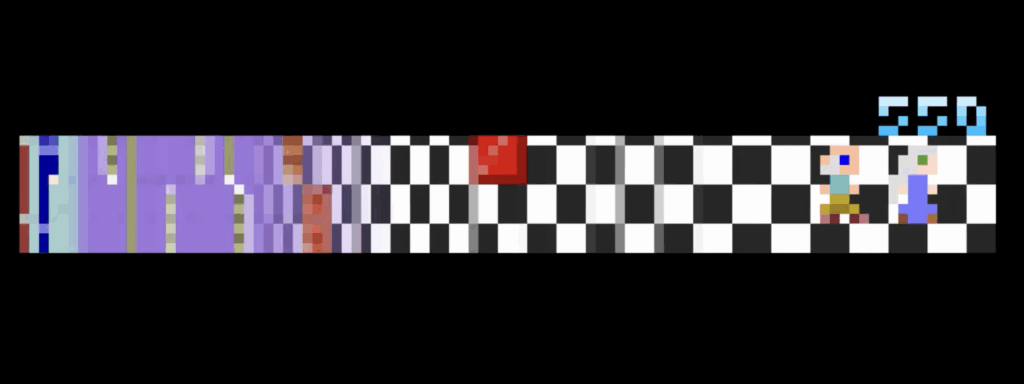
The past literally becomes a blur, a visual metaphor for memory and irreversibility.
There’s also something subtle happening with representation. The sprites are simple, but they’re unmistakably gendered, echoing early video game archetypes. As the game goes on, though, those distinctions dissolve. The pixels blur, colors fade, and individuality gets absorbed into the slow march of time. Foucault once wrote that power doesn’t always act by force; sometimes it’s the quiet process of learning to live within a system’s limits. Passage forces you to internalize this. Instead of resisting the rules, you accept and keep moving right because there’s nothing else to do.
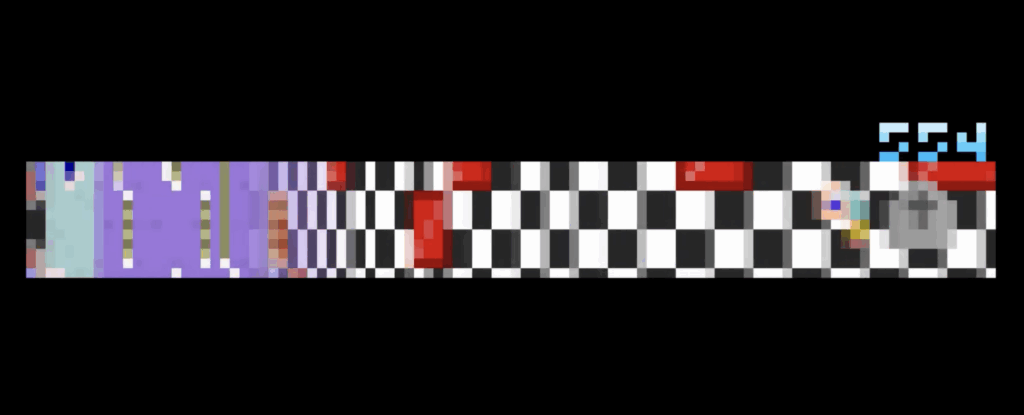
The partner becomes a gravestone, a small but devastating shift from companionship to memory.
By the end, when your partner is gone and your character slows almost to a crawl, the game stops being about winning or scoring. It becomes about endurance. You feel the system tightening around you, the way time itself does. Rohrer doesn’t tell you what to feel; he builds a world that makes you confront it yourself. It’s not a metaphor about life’s brevity—it’s an experience of it.
The game feels less like a story and more like what I’d call a procedural elegy. It mourns through mechanics, not through dialogue or plot. Every player moves right, grows old, and disappears, but what happens in between is yours to interpret. In Passage, meaning isn’t something you uncover. It’s something you live, moment by moment, until the screen fades to blue.
Works Cited
Bogost, Ian. Persuasive Games: The Expressive Power of Videogames. MIT Press, 2007.
Juul, Jesper. Half-Real: Video Games between Real Rules and Fictional Worlds. MIT Press, 2005.
Sicart, Miguel. “Against Procedurality.” Game Studies 11.3 (2011).
Rohrer, Jason. Passage. 2007.
Foucault, Michel. Discipline and Punish: The Birth of the Prison. Vintage Books, 1977.
Featured image: Jason Rohrer, Passage (2007). Screenshot courtesy of the Museum of Modern Art (MoMA).
In-game screenshots captured from “Jason Rohrer – Passage (Full Gameplay),” YouTube, uploaded by Darius Kazemi, 2011. https://youtu.be/M_FGsYBR8pw.