
Although I am the only person in my friend group who is taking this class, I have found great pleasure in sharing what I am learning/ playing with them. (I know, I know, it’s very UChicago student of me to talk to my friends outside of class about life in the classroom.) Anyway, while talking about The Stanley Parable last week and attempting to explain the game’s intricacies to my friends, I had an interesting thought: why is it set in an office?

This thought returned to me after playing Every Day the Same Dream over the weekend. Another game that relies heavily on the cycling of time, EDTSD also revolves around going to work. In fact, both games are set at a typical 9-to-5 office space. As I thought about it more, I was curious about the connection between time and capitalism.
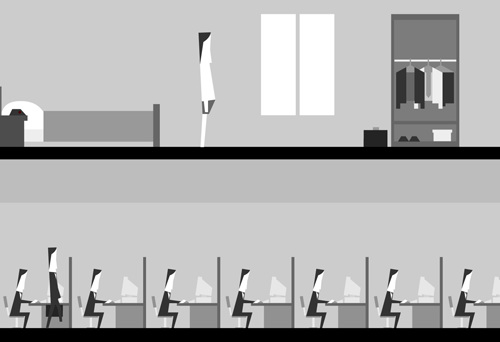
Now, to be fair, the workplace isn’t the only setting for a time loop. In fact, a lot of the media that uses the time loop are romance related, using time as an opportunity for realization for the protagonists (think Palm Springs (2020) or Save The Date). However, there is something different about that usage of the time loop and what is seen in TSP and EDTSD. In the face of capitalism, the time loop serves as a source of monotony and isolation.
In “Time, Work-Discipline, and Industrial Capitalism,” E.P Thompson describes how the invention of the clock was pivotal in Industrial Revolution. By allowing us to keep precise records of time and make schedules accordingly, time because something commodifiable: we could relate the amount of product made to the amount of time it took to make it, allowing us to give both the product and time value. Time became synonymous with money, something that can be gained or lost/spent.
Through this mindset, business owners began finding ways to optimize economic value, which meant optimizing time: assembly lines/ division of labor, which required workers to be highly specialized in one specific task within a greater production cycle (promoted by Adam Smith, the father of capitalism) became common. Work became repetitive and minute. This form of capitalism was critiqued by thinkers like Marx, who saw the division of labor as alienating (separating people from the products they produce AND themselves) and a form of theft (workers get paid less than the products the make aka surplus value).
Timeloops serve as an ideal location for critiques of capitalism because they both rely on the very mechanisms. By being forced to repeat the same actions “every day” in the same place while playing a game, you are experiencing the capitalist system first hand. Because of this, I do not think that the messaging of EDTSD or TSP would have been as successful without their plots being set in the office.


I think you are correct in your connection between capitalism and time loops in these games, especially in EDTSD, where the experiences of being outside the workplace are still related to work. Your character’s wife reminds you to hurry up because you are late (not even a “good morning, honey”). The drive to the workplace also mirrors the cubicles, as all cars are the same, and you can assume the drivers are living a similar fate to yours. There is uniformity in the society, but there is no unity, and that becomes apparent by the lack of emotions or socialization in EDTSD.
This was a very eloquent reflection on the role of time in capitalism. I am still a bit confused as to why specifically the Stanley Parable needs to be set in an office and would have loved to see you draw that connection a bit tighter. But overall, very interesting to think about time loop games and how they aim to parallel the monotonies of the world. One thing that I wanted to expand on is how time is the one finite resource that we have. It is possible to have meaninglessly large amounts of money or really anything else (as pretty much everything can be bought), but the thing that makes us all human is the limited time that we have. There is no current method beyond living healthy that we can use to extend our lifespan. And yet, it is exactly this finite resource, possibly what we should regard as the most precious, that is exploited in the system of capitalism. It’s no mistake that game critiques of capitalism commonly include the timeloop. It highlights the worst and most costly element of the system: its rapid consumption of our time.
I slightly disagree with your statement that the time-loop repetition of the games makes us experience capitalism “in real time,” since, arguably, our real lives are us experiencing capitalism in real time. But, I do think time-loops abstracts capitalism in an interesting way, in the sense that they make apparent the monotonous repetition that hyper-capitalist societies engender, in some ways making us more conscious of the ways we have been led to become productivity-oriented and comfortable with dead-end routines. These games, with their exaggeration of mundane, familiar corporate settings, force us to pay attention to the system itself, by making capitalist ideals of freedom, agency, and choice the primary mechanics through which the players engage with them. For this reason I agree with your closing point that the games wouldn’t be as successful had they not been set in the office context.