For many people, the main reason why we interact with games is for their mechanics. For me, a game can be carried by the “funness” or “snappiness” of its mechanics, its “game feel”, even if its story or message is awful (e.g. Metaphor ReFantazio). However, when it comes to artgames, it would undoubtedly be in poor taste to judge them based purely on the enjoyability of its mechanics.
“When we think of systems in games, it is usually in the context of modeling phenomena from the physical and social world—a game of tennis, in the case of Pong. But in artgames, the systems are more likely to model ideas and concepts: the journey of life, the ethical complicity of the people involved in carrying out atrocities, the helplessness of depression. Artgames are usually highly stylized systems, using abstraction, allegory, and metaphor to create an idea space that the player can explore by engaging with the system through its game mechanics” (John Sharp, Works of Game).
The important takeaway from Sharp’s definition of an artgame is that the first priority of these games is to model ideas and concepts; however, the game’s mechanics should still be playing a part in this goal. That is, after all, what separates games from other mediums of art — the ability for the consumer to directly and immediately interact with the art space. The goal of an artgame’s mechanics must then be to somehow convey the idea or concept it is trying to model through its game design and rules. But is judging an artgame’s mechanics even feasible? Is is even something which one should do? Would this not be akin to objectifying art, akin to putting a score on someone’s artistic vision? In some ways yes, and I do realize the ignorance of trying to do this. So I will approach from a different angle. Instead of saying that an artgame is “bad” because it has bad mechanics, I will instead only use it in the affirmative. And so I say: not all good artgames need to have “good” mechanics, but an artgame with “good” mechanics — mechanics that convey the message of the game — is undoubtedly a fantastic artgame. This is why I think Problem Attic is an amazing piece of art.
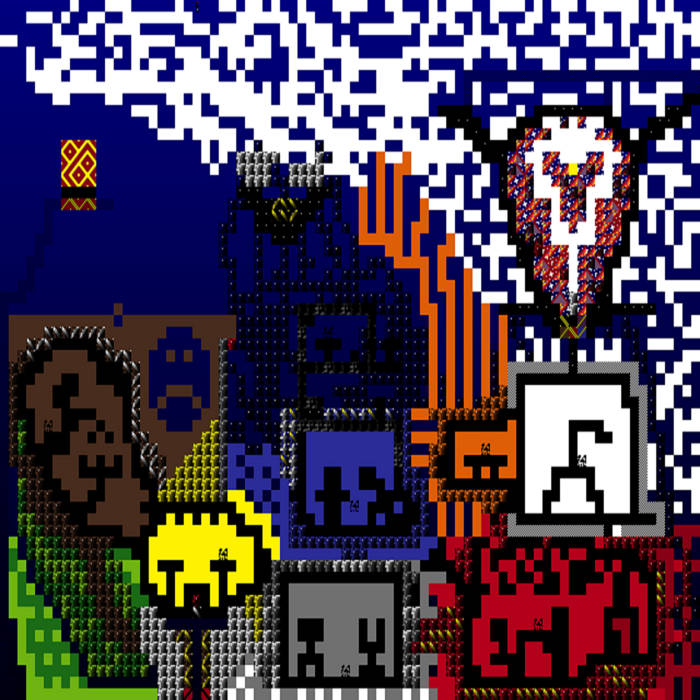
How does Problem Attic’s mechanics convey its ideas or concepts? (For the sake of this blog post, I will assume that Problem Attic’s main ideas are the emotions of trauma, anger, helplessness, and unwantedness) Well for starters, the entire game has no tutorial, no guide on what to do. You are dropped into an empty, desolate world without any help. Then, the game transports the player into different rooms. These rooms are essentially the levels of a platformer, but they don’t feel like any other platformer. These rooms are hostile, both in their imagery, sound, and enemies (which take the form of plus signs and squares). You are trapped in each world, with all of its enmity, almost like it is a prison, and you are left to struggle your way out.

The level which highlights this the best is the Red Room. Immediately upon entering this room, you get the feeling that your presence in the room is unwanted. The walls evoke imagery of guts and organs, while the room sounds like it is almost in pain from your being there. These aesthetics all immediately establish a feeling of tension in the player. Then, the plus sign enemy arrives, only this time it shows unprecedented hostility. The same sound and screen shake which the game has established as the consequence of touching the plus sign is still there, but the enemy is faster and more annoying than it’s ever been. This level also introduces a new feature, which I will call the “subversion of expected mechanics.” The usual restart mechanic, which the player has relied on to quickly try a level from the beginning, now kicks you completely out of the level instead of just restarting, adding even more to the feeling of “unwantedness” that the level’s aesthetics created. Your jump button, which has worked perfectly until now, will randomly not work. Also, instead of coyote time, Problem Attic employs the exact opposite: the player character will actively climb off of platforms if you are standing too close. All of these mechanics inevitably lead to the player continuously failing their usual platforming actions. Not only do you have to outmaneuver the plus sign, not only do you have to avoid standing too close to edges, not only do you have to pray that your jump button works, but you also have to avoid vibrating blocks purposely placed in the most obtrusive areas.
While playing the Red Room, I felt helpless and annoyed. By the time I finished the Red Room, I felt angry and traumatized. Fuck this game. It’s incredible.


I agree with your ideas on what Problem Attic deals with, especially trauma and helplessness. Regarding trauma, the levels do not feel as if they are completed, but instead, escaped. What makes me lean into the idea of trauma is that the character returns to the “hub” to take on new levels, which ultimately feel more like challenges than video game levels. The hub in both parts of the game is drastically different from other locations, as there are no hostile entities nor eerie sounds meant to unsettle you. To me, the “hubs” serve as the representation of life, while the levels act as traumatic memories. The red room creeped tf out of me during my midnight session since I was wearing headphones, so I’m glad you brought it up.
I really enjoyed your discussion of Problem Attic’s mechanisms make navigating the red room difficult, as I also had an incredibly annoying time trying to escape the red room. In my opinion, another important aspect of why the red room is so annoying is the way in which its visuals interact with the game mechanics. While you already pointed out the eerie music and imagery of the walls, to me the most distinctive thing of the red room’s design was the fact that it would periodically receive a flash of light. While this flash contributed to the eerie feel for me by being evocative of lightning, further reinforcing the idea that the room is hostile and dangerous, the flash also reveals which of the shaded blocks are solid ground and which you would fall through. Paying close attention to what blocks were real and fake, as well as timing my jumps to be after the flashes, were key to my navigation of the room. However, the game’s mechanics make trying to navigate the room this way particularly frustrating. Specifically, your jumps having a large delay, or sometimes just straight up not working, made it very difficult to me to time my jumps after the flash, and oftentimes I was so focused on trying to have the character stay on the platform without slipping and jumping when I wanted them to jump that I would have a hard time remembering what safes were space and what weren’t. In this way, because Problem Attic is so incredibly good at using all the tools in its arsenal in conjunction with one another, such as its visuals and mechanics, I’m inclined to agree with you that it is an amazing piece of art. Even if I do hate it and never want to play it again.
I also remember the red room for the same reasons as you; the colors and imagery of the background lend itself to a violent, bloody scene, the sounds were painful to listen to, and the immediate foreboding feeling as the player loads into the level. We discussed in length in class how this game does not want the player to play it, and every mechanic of this level clearly demonstrates that purpose. The enemy is persistent in chasing you down, resetting takes you all the way back to before the level, and it is difficult to see the blocks you can jump on because it blends into the background. All of those mechanics are very annoying and left me very frustrated, and I was not enjoying the game: and that is exactly the point of this game. Your argument that mechanics don’t have to be good to tell the game’s message is displayed very well in this level.
This game and this post has made me reflect on something we have touched upon continuously in class: what makes a game ‘good’. “And so I say: not all good artgames need to have “good” mechanics, but an artgame with “good” mechanics — mechanics that convey the message of the game — is undoubtedly a fantastic artgame”. An interesting perspective, but I don’t think I agree with one hundred percent. I think that having mechanics that manage to convey the message is not wholistic enough of a qualifier to be able to categorize a whole game as fantastic.
This post touches on how actively hostile ‘Problem Attic’ is towards the player, and how meaning is derived from the game from that difficulty. The game is also extremely abstract, outside of the explicit text and the male/female symbols. Because of this, it has raised a question for me: does ‘Problem Attic’ arguably go too far in fighting the player? It is extremely effective at creating its intended feelings in the player, but between its difficulty (preventing many players from making it far in the game), abstractness, and the feelings it conveys, I could easily see a player who knows little about the game walking away with only those feelings and no outlet or ability to interpret any meaning from the game. That was essentially my experience after playing for an hour, honestly walking away more baffled than anything. Or is that just baked into what ‘Problem Attic’ is trying to do? Does it, in a sense, have to turn some players away so that others can derive meaning from it in the very specific way the game conveys its message, like you mentioned you do?