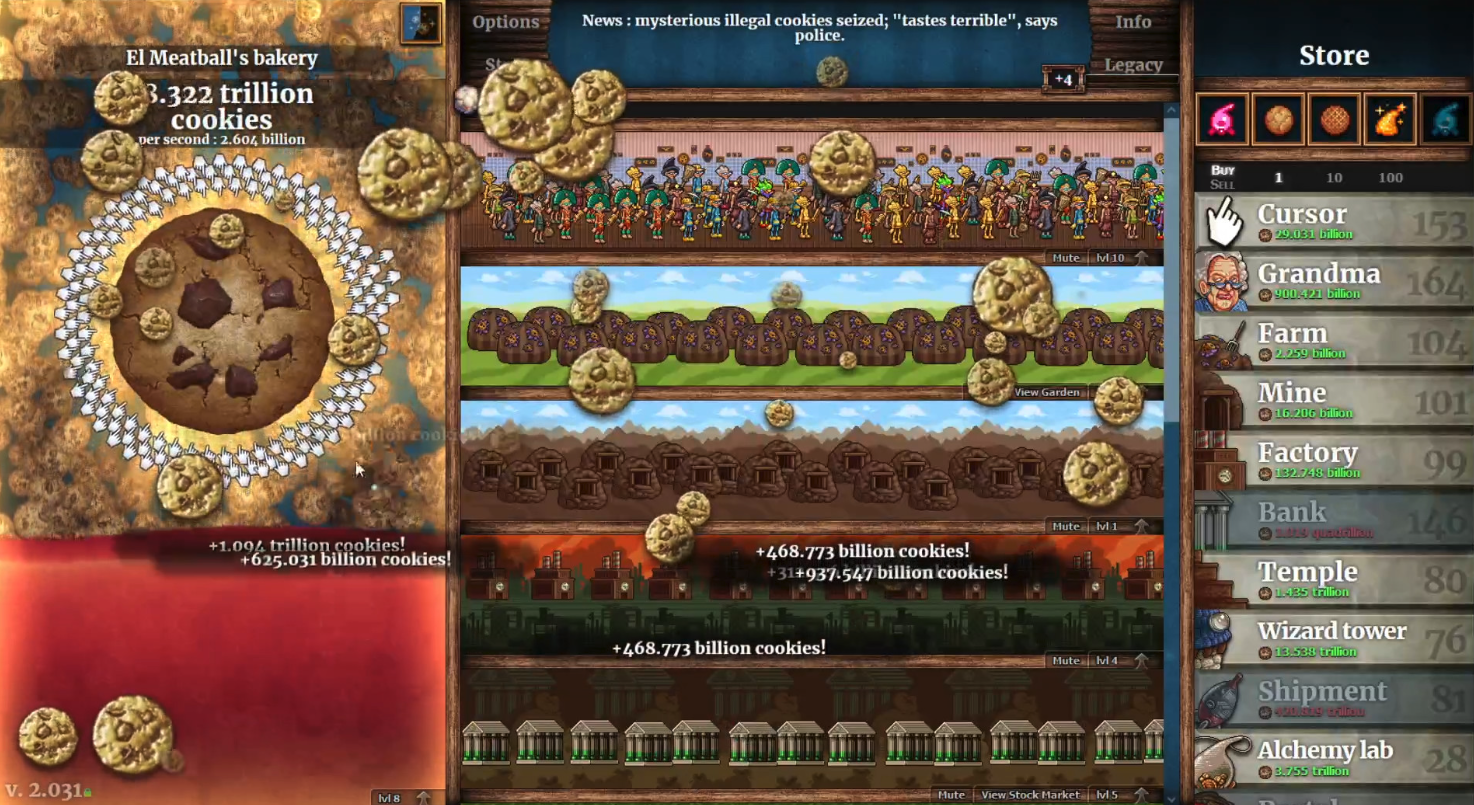
I opened Cookie Clicker just to see what it was about. Three hours later my screen was overflowing with grandmas, cursors, farms, factories, and a golden cookie I apparently had to click every thirty seconds or risk falling behind. Nothing was happening, and somehow everything was happening.
The weird part is that the longer I stared at the numbers going up, the more I felt like I was working (except I couldn’t tell if I was working in the game or if the game was working on me).
That’s when our lecture finally clicked in my head: idle games are the perfect microcosm of modern labor. They ask us to do almost nothing yet shape how we think about productivity, efficiency, and success.
When Clicking Becomes a Job
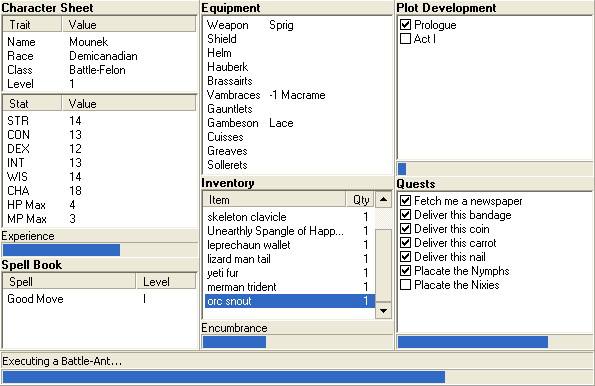
Screenshot from Progress Quest (Eric Fredricksen, 2002).
The mechanics barely vary in Progress Quest, Cookie Clicker, and AdVenture Capitalist. You click, the number rises, you buy upgrades, the number rises faster. They’re almost aggressively minimalistic. But these games turn waiting into a task which is something more uncomfortable underneath that simplicity. They make you feel responsible for progress that would’ve happened without you.
It reminds me of what Professor Spagoda said: idle games are addictive not because they reward you for playing, but because they reward you for being present. They produce a kind of micro-labor: monitoring, optimizing, checking in, never fully logging off. It’s the logic of the notification, the inbox, the progress bar, a form of gamified restlessness.
At a certain point, I wasn’t clicking for cookies anymore but just to avoid falling behind.
Gamification and the Work of Self-Management
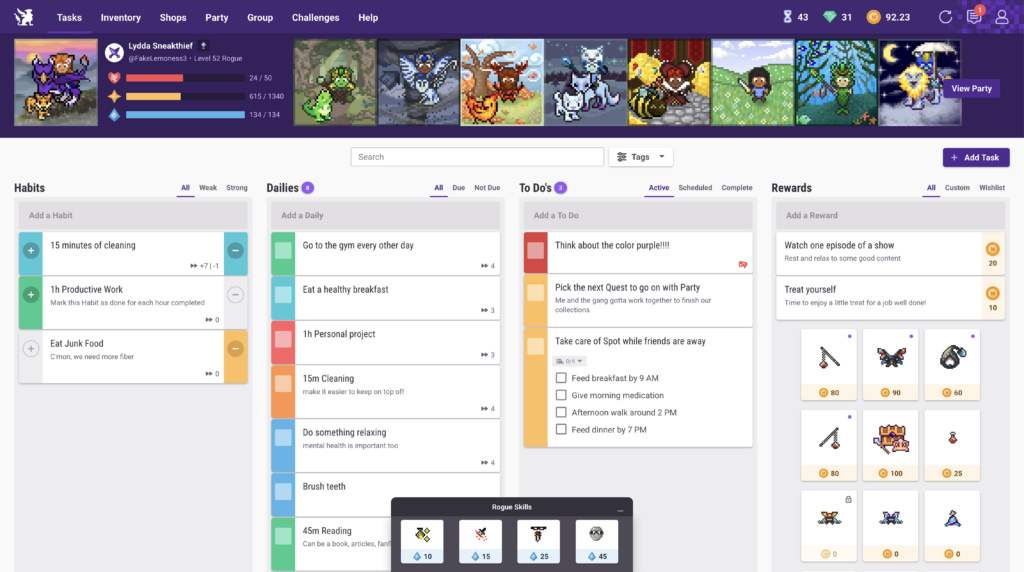
Screenshot from Habitica (HabitRPG, 2024).
We also studied gamification (Chore Wars, Habitica, Nike+, Khan Academy). All of them take non-game activities and wrap them in levels, badges, and streaks. The message is subtle but familiar.
You improve yourself by managing yourself.
You become a better worker by treating yourself like a character to optimize.
It matches perfectly with what Michel Foucault describes as the “entrepreneur of the self” in neoliberal societies. You are your own project, your own investment, your own responsibility.
Idle games make that logic absurdly visible.
Why do I feel proud of upgrading a fictional factory that produces imaginary cookies?
Why do I feel guilty when production slows even though it happens on a tab I forgot to close?
Because… the system trains me to.
Waiting as Productivity
One of the lecture slides defined neoliberalism as a political and economic model that turns everything, including individuals, into competitive economic actors. What struck me is how idle games simulate this worldview almost too well.
You’re not asked to fight monsters or solve puzzles.
You’re asked to wait efficiently.
Every choice becomes an investment decision. Every upgrade is a calculated trade-off. AdVenture Capitalist doesn’t even try to hide its satire. The game literally congratulates you for treating capitalism like a clicking contest.
But satire stops feeling like satire once you start optimizing the spreadsheets.
Do Not Feed the Monkeys: A Different Kind of Labor
We contrasted idle games with Do Not Feed the Monkeys during one of our lectures and this comparison lodged itself uncomfortably in my mind.
If idle games are about automation, DNFTM is about attention, a surveillance job masquerading as a management sim. You watch people through hidden cameras, track their routines, gather information, and struggle to pay your rent. It’s stressful because you can’t automate the emotional labor of monitoring strangers.
Idle games soothe you by making labor frictionless.
DNFTM unsettles you by making labor visible.
But both ask you to perform a version of work, and both reward you for complying with the system’s logic.
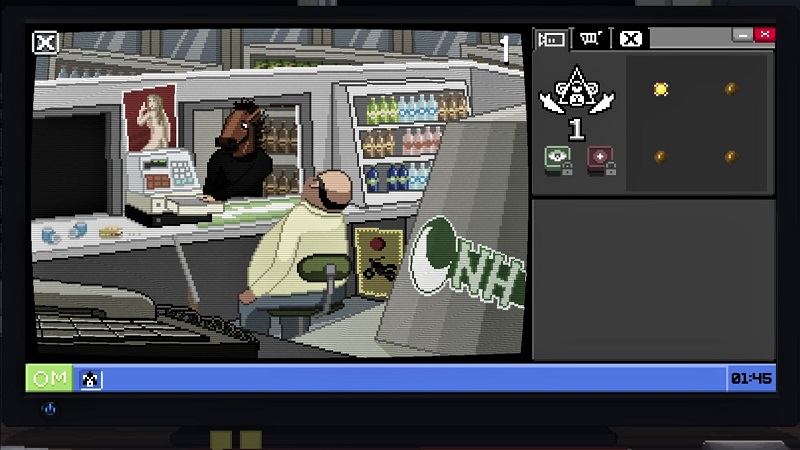
Screenshot from Do Not Feed the Monkeys (Fictiorama Studios, 2018).
The Grandmapocalypse and the Fantasy of Infinite Growth
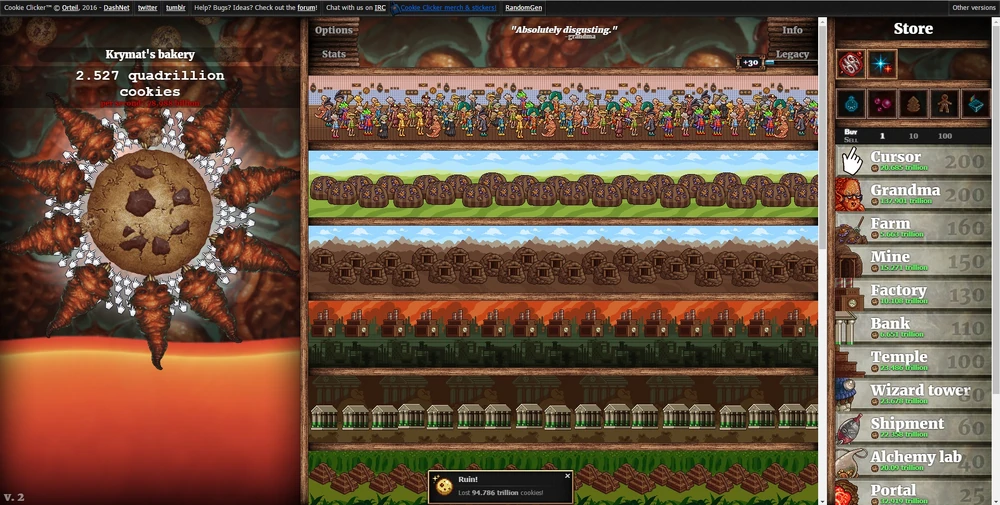
Screenshot from Cookie Clicker – Grandmapocalypse (Orteil, 2013).
Cookie Clicker’s infamous Grandmapocalypse, when sweet old grandmothers become tentacled eldritch horrors because you’ve overworked them into monstrous productivity, is the moment that I believe best captures the absurd truth of idle games.
It’s funny until you realize it’s not subtle at all.
Idle games literalize the fantasy of infinite, exponential growth—the same fantasy that drives the very real systems we live in.
The game: You can always produce more.
Me: At what cost?
Even though the cost is imaginary, the instinct feels real.
Why Are Idle Games So Popular?
The answer we kept returning to in discussion surprised me.
Idle games let you feel productive without demanding anything from you.
They turn boredom into progress.
They turn waiting into self-worth.
They turn automation into a form of comfort.
In a culture obsessed with efficiency and self-management, that comfort clearly hits a nerve.
Idle games ask almost nothing from you, yet they shape the way you think about labor more than many “serious” games do. They’re tiny mirrors of the systems we take for granted: always on, always optimizing, always performing productivity even when nothing is happening.
So Should We Be Playing Them?
I honestly don’t think idle games are evil. They’re clever, often hilarious, sometimes deeply satirical. But they do raise a question I can’t shake.
If my leisure time starts to feel structurally identical to my work time, is it still leisure?
When I close Cookie Clicker after my “break,” my brain feels the same as it does after reorganizing a spreadsheet. That’s not the game’s fault. it’s what Professor Spagoda called “playbor,” the fusion of play and labor that becomes almost impossible to distinguish.
Idle games don’t just blur that line.
They make me wonder if the line was ever real in the first place.
Maybe that’s why I CAN’T STOP clicking.
Works Cited
AdVenture Capitalist. Hyper Hippo Games, 2015.
Cookie Clicker. Julien “Orteil” Thiennot, 2013.
“Gamification in Education.” Lecture slides, Week 8.
Spagoda, Ashtrick. “Labor and Idle Games.” Lecture, University of Chicago, 17 Nov. 2025.
Spagoda, Ashtrick. “Neoliberalism and American Truck Simulator.” Lecture, University of Chicago, 19 Nov. 2025.
Do Not Feed the Monkeys. Fictiorama Studios, 2018.
Progress Quest. Eric Fredricksen, 2002.