
On the topic of Machinimas, while attending the Machinima screening, there was a single thought that was bouncing inside my head the entire time, “Wow, this reminds me of one of my favourite series of media of all time, Red Vs Blue, what a nostalgia trip!”
For those who aren’t familiar with what Red vs Blue (RvB) for short, is: it’s a machinima created by Rooster Teeth studios (the studio that’s famously known for creating RWBY). Its first episode was released on April 1st, 2003, and ran until May 7th, 2024, with the release of the movie, Red Vs Blue: Restoration. The entire setting of the web series is based on the Halo game series, with the episodes themselves being filmed within the Halo games, from Halo Combat Evolved all the way to the newer Halo titles. Of course, the most impressive part of RvB is how long it ran for, almost a decade of episodes, spin-offs, and whatnot. As such, it is known for popularizing the film methodology of machinima; you can still see its influence even in contemporary forms of media that are based upon video games.

Now, I could go on extreme lengths to talk about my love for the web series, from its evolution from fledgling for fun bro-like filming to studio-produced spectacle, the ahead-of-its-time humor, the running gags that lasted for years on end, the storytelling, the characters and their unique quirks and dynamics, and much much much more. To give an insight into the extent of the absurdity that can be found within Rvb, meet Lopez, the bilingual, Spanish-speaking robot that, due to a malfunctioning language module, can only reply in Spanish to which no one else can understand to and he resents everyone for it, and lives as a disembodied head for 70% of the time.
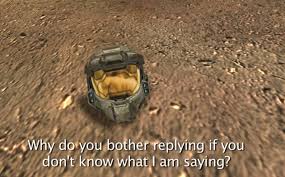
However, I’ll spare you all from the torture and discuss one of the more important points: how Rooster Teeth adapted to the Halo game series engines and works around it, the core of how Rvb works as a machinima.
First off, the first few seasons, known within the community as the Blood Gulch Chronicles, were filmed on the game engine of Halo: Combat Evolved and Halo 2. As you can probably guess, a lot of things back then weren’t conducive to high-end filming, much less machinimas, so the episodes back then were very low quality in terms of production, ie, graphics, audio, etc. But the content shown, despite the poor quality, took a lot of effort to do, as to even make it seem like the characters looked like they were speaking to each other, they had to do a glitch with the pistol, where if a player pointed their pistol to the ground, their heads would be raised, which would make the dialogue look better, furthermore they would raise their characters up and down in game to mimic their mouths moving whenever they speak. That’s merely one of many issues with the game engine of the early Halo games that Rooster Teeth had to go around to make something semblance of a high-quality production. The crazier part is that Bungie, the creators of Halo, didn’t implement any measures to make things easier for Machinima creators until Halo 3, with the release of its theater mode. Using theater mode, creators can actually have a disembodied camera that records gameplay to which they can go back and view from different angles. Before then, Rooster Teeth had to literally use another in-game character’s POV to act as the camera. So as the web series evolved, its filming techniques evolved parallel to the Halo game engines, to the point where by the time the Chorus Trilogy (seasons 11, 12, 13) was filmed in Halo 4, the production of the web series looked like something a bona fide animation studio would create rather than 3 guys sitting on a couch spending their afternoon playing some good old halo.
One of my favourite things as a long-time RvB fan is how you can directly see the evolution of Halo machinimas from its own evolution as a web series, but beyond the Halo IP, I believe that you can see RvB’s influence on machinima as a filming technique, making it one of the most culturally important things to ever exist for video games and people who enjoy videos games.



Correct me if I’m wrong, but I think this series was mentioned in the lecture prior to the screening beginning. Either way, I had never heard of this series before the Machinima screening, so I really appreciate the background you’re providing. Something that really impressed me as we learned about what machinima entails was how filmmakers have to work around the boundaries of the game to create the films, even to the extent of breaking apart and remaking the game cartridge. It seems like an incredible challenge, and it was cool to read about how Rooster Teeth did this for RvB! The choice to use a player’s first-person perspective as a camera, making the film third-person, is fascinating to me. I’ve never seen any parts of RvB, and I wonder how different the series would have been had Rooster Teeth chosen to make the machinima first person entirely. To your point about Halo 3’s “theater mode” option making the process easier, was this an intentional choice that the game designers made with the RvB series in mind?
This lens for thinking about machinima as a whole was a really great and new approach! What struck me most was your point about how the evolution of RvB basically maps onto the evolution of Halo’s own engine tools. I really appreciate the insight you provided on the evolution of the production of these machinimas from something as simple like how to tilt a Spartan’s head by pointing a pistol at the ground, and then fast-forward a decade and they’re using theater mode like a full production studio. Being on what now kind of feels like a whole other side of gaming myself, I never really realized how the games industry was forced to notice machinima as a legitimate creative form and how they intertwine over the years and going back so many years!