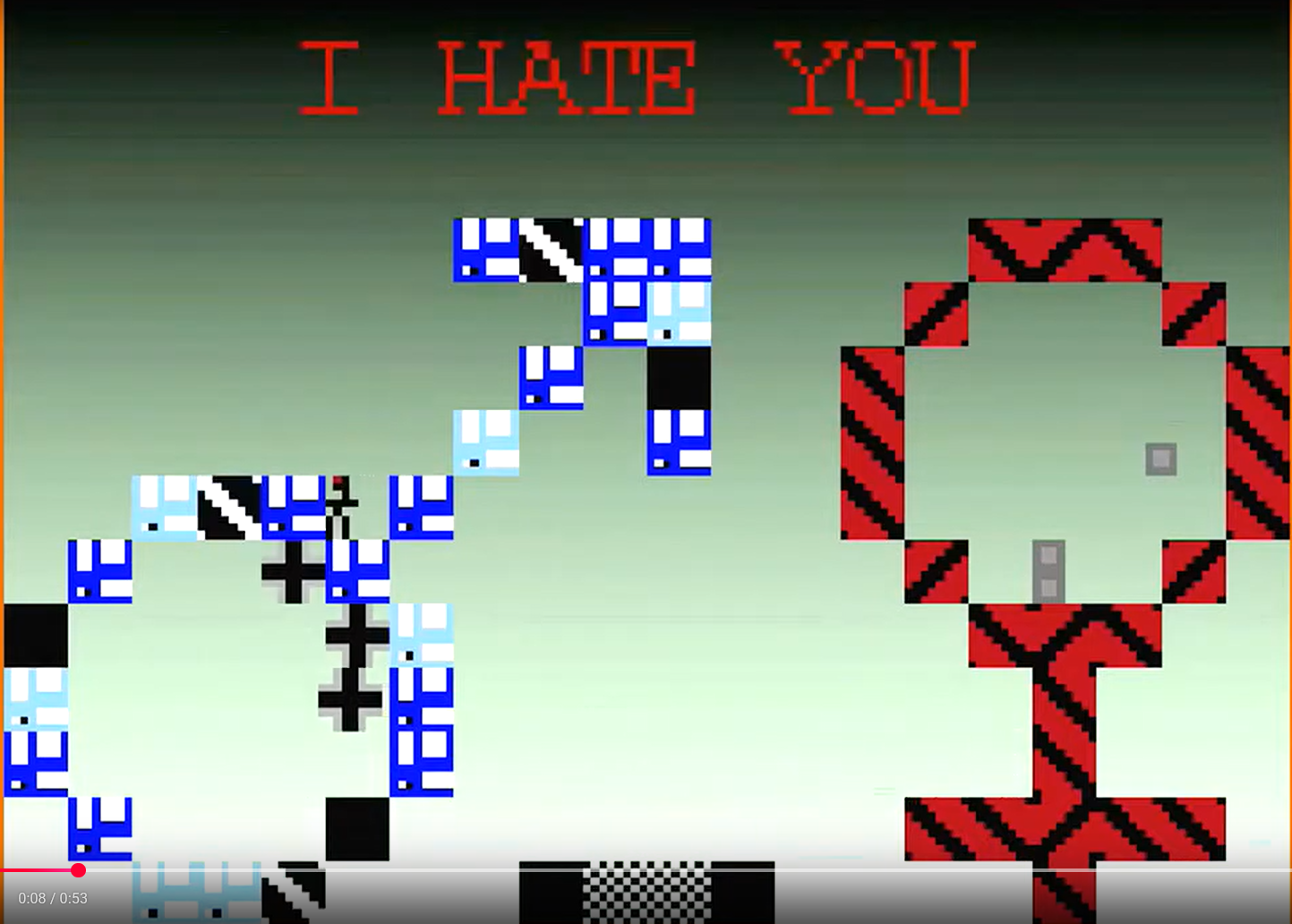
(Pictures are mostly taken from a walkthrough by Ian Bryce Jones)
Problem Attic is an interesting case. By all usual definitions, it is a bad game. The controls are unclear, imprecise, and in some levels just don’t work. The visual design makes it eternally unclear what you are even looking at. The level design is just as unclear as the visual design and the controls. It is weird, ugly, and hard to parse, to paraphrase Ryerson’s article “The Other Side of Braid”. It released, made a miniscule impact, and faded into relative obscurity.
Why, then, do some people love it so much? “Thank you so much for this game, really, I can’t explain what do I feel playing it, but it was really beautiful,” says one commenter on the game’s itch.io page. “My stomach has been in knots for hours. I loved it, thank you,” says another. My personal experience had the game resonate heavily with me, even if I lacked the skill to beat it quickly. So where do its fans come from?
The answer lies in the fact that Problem Attic is just as powerless as the player is.
The game is frustrating, and it feels like the game is working against you. Another perspective, though, is just that the game wants to but cannot. To quote the text in one of the final levels, “I wish I could feel sorry for you, but I can’t feel anything.”
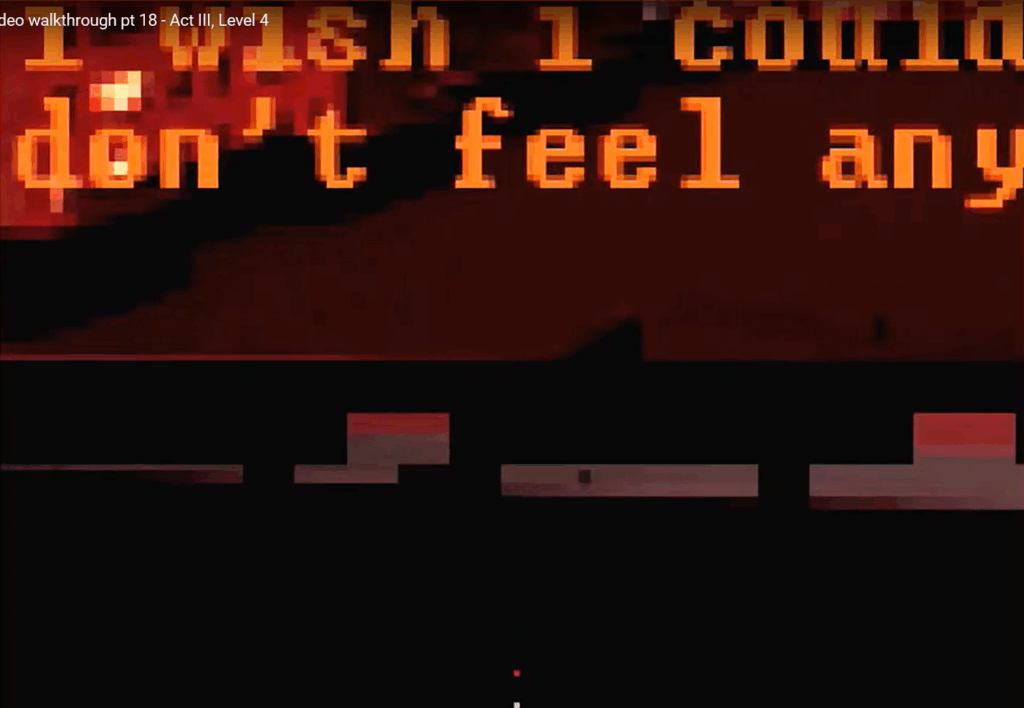
It is this quote, I believe, that unravels Problem Attic’s powerlessness. The game itself is depressed, powerless to feel anything, help you, or even work properly in many instances. The game itself feels like it is falling apart, unable to function as it should. Levels seem to glitch out constantly, it cannot communicate anything to you effectively, and the design itself is purposefully all over the place.
If we take it in the context of Ryerson’s life and assume that the game is a representation of Ryerson herself, then it seems to add to this. Ryerson was in a powerless position, dealing with bouts of homelessness and struggling with leaving an abusive home.
But then comes the ultimate question. Who is the one going through all this difficulty created by the game? The abstract nature of the protagonist means it could be anyone–there is no character attached to the simplistic sprite that you use to platform throughout this abstract space.
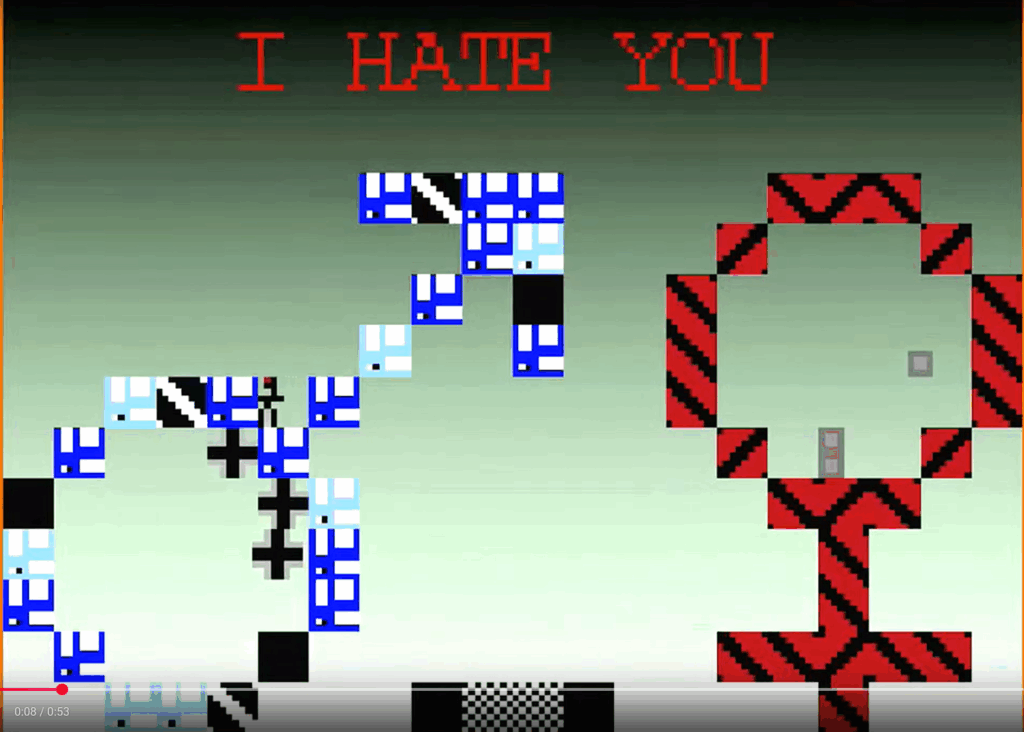
One potential answer is that the player is also representative of Ryerson. The player and the game could be one in the same, or at the very least two aspects of the same whole. There is certainly room to read the game as representative of the trans experience. The game pairs the words “I hate you” with images of the gender binary, the male and female signs, and the gray pixel in the protagonist’s sprite could be a metaphor for gender dysphoria.
These two representations make it feel as though both the player and the game are aspects of Ryerson. That would make many of the expressions of hatred into expressions of self-hatred, but they, like everything else, are part of getting through the experience, just as she did.


I can really appreciate the situational analysis you’ve done of the character, putting into context the influences that shape how obscure and difficult this game is to manage. Like you, I also read a lot of this game to be speaking on the discomfort of identity. Once I saw the level you mentioned with the binary symbols for male and female, it was hard for me to read this as anything else. The “refusal” of the game to stick with consistently functioning mechanics mirrored to me the literature which deals with non-conforming identities and their movement through society.
It also made me think about “abusive”/antagonistic design and Bogost’s procedural rhetoric, but with a twist—Problem Attic isn’t scolding; it’s stuck with you. The player and game share the same flat affect. That’s a rare, unsettling alignment.