Liz Ryerson’s Problem Attic is a game of many things. Platforming, subverting expectations, puzzle solving, failure, and endless frustration, just to name a few. It is also a game that forces the player to constantly adapt and learn new things, through potentially hours of trial and error, to ultimately tell the story hidden in the glitches and epilepsy-inducing text screens.
Playing this game to completion is nothing short of challenging and incredibly frustrating. I had to play the game from the beginning 3 different times because my computer kept crashing, and yet, despite my rage at how many times I was being forced to redo the same awful parkour sequences, I think that ultimately showcased the games meaning moreso than if I had beaten without the hardships.
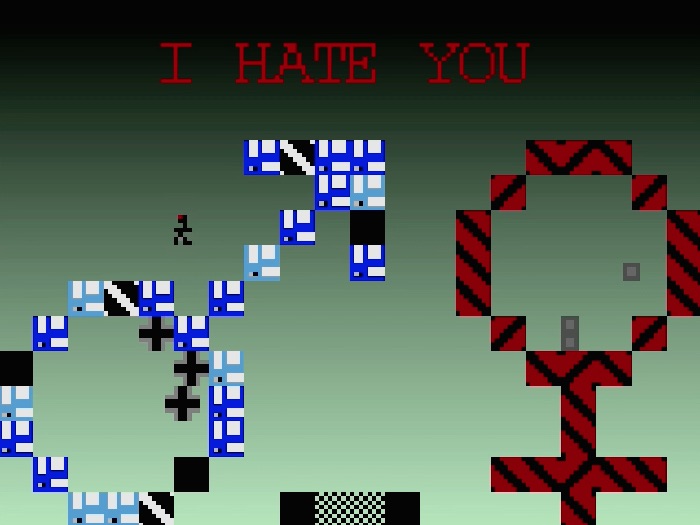
This is a game that hates you (it even tells you so) and what you are doing to it by playing it. This, however, is entirely the point. Not just because the game was programmed that way and can’t exactly disobey its code, but because the point of the game is to tell a story of entrapment and frustration by relaying those emotions through the player.
Throughout the game, there is text that is either glitchy, short, or incredibly hard to read. The clearer the text is, the easier the text is to comprehend because this text is the one that Liz Ryerson, or the game, can most easily express. While telling someone “I hate you” or “Go Fuck Yourself” may be harsh, they are short and concise, unlike the lengthy text of a later level.

This text is much harder to read because there is a lot of it, it is large, and some of it is obscured entirely by blending into the background. Reading this text is significantly harder, but one of the most readable parts of it is, generally, stating that the game (a stand in for Liz Ryerson) can no longer feel sorry for the player, or whoever they are talking to, because it is too hard for them. It is too much work to be worth it anymore, an idea that is showcased by making the player perform the same laborious tasks over and over and over again to get across the frustration Ryerson feels. At a certain point Ryerson makes the player ask the same question she did: Is it worth it to continue?
Problem Attic is a game that generates a parallel experience between the player and Ryerson’s own experiences. Her life was hard, it was challenging, and she wants to make you feel that, not by portraying her own experiences outright, but through your experiences as a player. The game even tells you this in its description: “This is a game about prisons, both real and imaginary.” The real prison is the trauma Ryerson went through or is trying to exhibit through the text, but the imaginary prison, which may be the gender roles or other ‘prisons’ people find themselves in while living in society, is the experience of the player. The player is figuratively trapped in the game by their own frustrations and, in my play through, this unfettered need to complete the game, mirroring Ryerson’s experiences in the real world.
Ultimately, Problem Attic‘s constant generation of negative emotions in the player as they interact with the game, and the constant repetition of the same few levels, showcases the amount of work that goes into being angry or trying to forgive someone. Ryerson, until she decided that she could no longer feel sorry for the person she talks about in the game, was trapped in a prison of her own making, and by booting up the game, the player places themself in a similar prison, but one that they unknowingly build the walls of themselves once frustration towards the game sets in.


Playing Problem Attic was an absolutely frustrating experience, and your point regarding that oftentimes frustration is the point of labor in video games is a compelling one. This is also gives the player a chance to ask similar questions game developers might ask when experiencing their own frustrating experiences, further connecting the two sides of the gamespace through labor.