Despite what some UChicago professors have said about idle games in recent weeks, they are a valid and respectable genre within the field of video games.
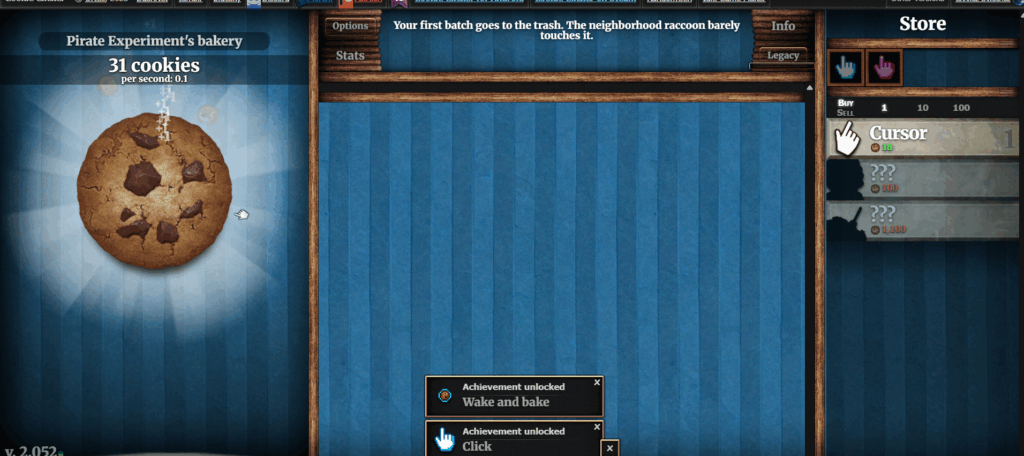
Idle games, also called Incremental Games, are centered around an in-game economy, emphasizing passive growth and wealth accumulation. While there is sometimes an active component, like clicking, this becomes overshadowed by passive gains over time. Money that is made from these sources can then be reinvested into either active or passive means, upgrading things like money per cycle, or cycles per second. Most modes of production will start to have diminishing returns after some time, which is when players are urged to “Rebirth,” or start the game over again with a special currency or upgrade that will persist permanently between “lives” in the game. (Some games have an even bigger form of Rebirth that resets the permanent upgrades for even larger upgrades, but I will not get into that.) In a broad sense, this progression of gameplay can be compared to rogue-likes in how bouts of shorter progression and lost progress culminate in permanent growth.

I first learned of Pilot Quest a few months ago when streamer Jerma985 (who frequently collaborates with streamer DougDoug who is the brother of Davey Wreden, developer of the Stanley Parable, so he is relevant to this class), played it during his playthrough of UFO 50. When playing Pilot Quest, and first seeing that you can pay moon drops to have the Gumma tree passively make moon drops, he says, “this is an idle game, isn’t it? Oh, shit. Ah, ok, I’m going to be playing this for the rest of the night” (2:49:35, Jerma Stream Archive).
Because of this, Pilot Quest was the game I most anticipated playing when seeing that UFO 50 was on the syllabus. As a connoisseur of idle games, I’m always excited to see new takes on the genre. What follows is my analysis on why Pilot Quest fails as an idle game, and a game in general.
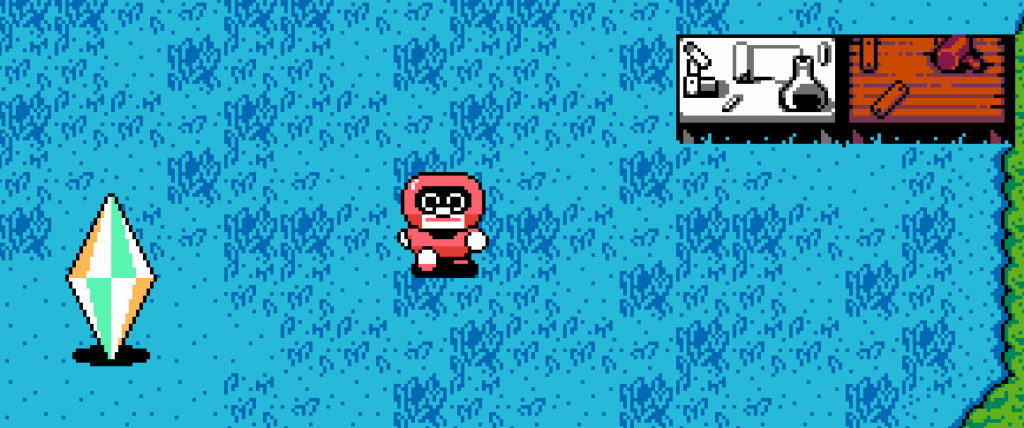
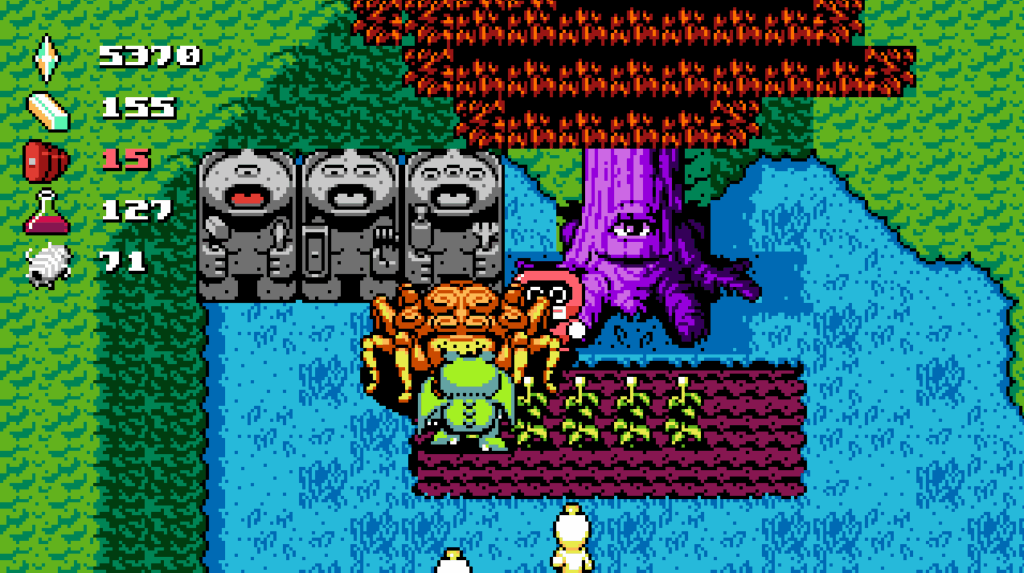
Pilot Quest’s idle elements are the first thing a player has to interact with to progress in the game. The only item to interact with, apart from speaking to unhelpful NPCs, is the spinning crystal in the center, through which shards can be collected after hitting it. Of the dilapidated structures and 5 NPCs in the small area, the Gumma tree is the only one to accept Moon Shards, and as mentioned before, will start to generate more shards passively. The next required material, Moon Ingots, can be made with 1000 moon shards at a nearby workbench.
Now may be a good time to talk about the unique way Pilot Quest treats the “idle” part of idle games. Most in the genre will have continuous but reduced passive production levels while the game is closed; Pilot Quest will not generate any materials if UFO 50 is closed, but it will if you play any other games in the collection. This not only pushes players to try out other games to make more progress (rather than just idling on one screen,) but also places Pilot Quest as a sort of “in-between” experience within UFO 50. A player may set up production in Pilot Quest, play a few rounds of other games, and when coming back to Pilot Quest, upgrade whatever methods of production are available, before returning to other games in the collection. Though it makes sense, it’s a shame that Pilot Quest is near the end of the default ordering, chronology, since a player may play through most of the game before knowing the value of having Pilot Quest run in the background.
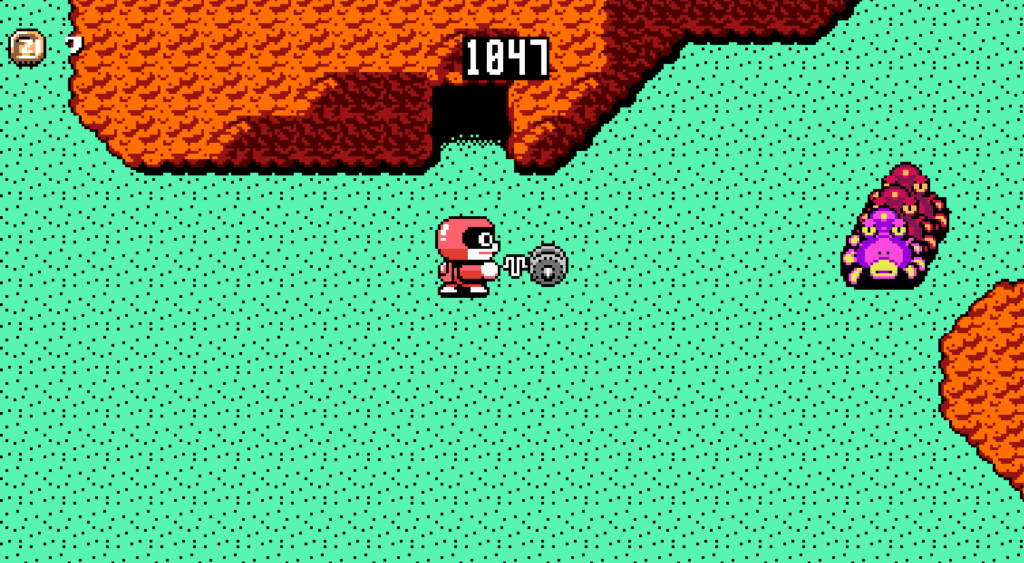
There is also a significant “Active” portion to the game, beyond hitting the Moon Crystal manually. Building a shack for one ingot makes one of the NPCs start to generate Meat, which can be purchased for 500 moon drops. Each meat corresponds to 120 seconds in the Wild Zone, but time will be reduced upon taking any damage. Returning to base from the Wild Zone allows you to keep whatever you have collected, including more drops and ingots, but running out of time makes you lose everything. The Wild Zone is what I would consider a Zelda-like; there are 3 dungeons with their own bosses, hidden chests around the world, and a questline that grants you another weapon, though there is the added element of urgency that comes with the time limit. When in the wild zone, players can explore around to find what is available, all while being cautious about being hit, so as not to run out of time. The meat that is required to enter the Wild Zone is itself an idle resource. Meat cannot be generated actively, though there is a chance of it appearing in the wild zone; failure on an expedition frequently means that another attempt can not be made for several minutes, longer if the player wants more time/health. The goal of the game is to collect three ship parts that have scattered across the Wild Zone, as well as refueling your ship.
There are a few elements of Pilot Quest that frustrate me. One is the relatively low production cap, and the other is lack of telegraphing what is needed in the Wild Zone.
Two of the buildings you can repair are silos, and the rest are houses and workbenches that bring aliens and a place for them to produce more ingots. There are 6 workbenches, costing 5 ingots each, and two houses, where each additional phase requires an increasing amount of ingots. The Gumma tree only has 6 plots to grow Moon Drops, and the Meat Man can only hold 6 meats at once, with no ability to affect rate of creation. A UFO 50 player who regularly returns to Pilot Quest will hit these production caps relatively quickly, and may have found a ship part or two with regular Wild Zone exploration. At this point, at least for me, the game started to become a pain. There is a scientist at the bottom of your base who sells various items that can increase some parts of production, except all but a stronger weapon require Science and Silk; the game does not tell you how to get science or silk. There is a machine in the base near the scientist-looking bug that says it requires a gear, so that is somewhat straightforward. I thought the gear and silk may have been found in some of the dungeons in the world, but no, the gear will spawn in some random location around the map, and silk only starts being produced if you find and beat a specific spider enemy at the top of the map. This seems fine, you need to explore the world to continue progression in the game, but this fact is complicated by the fact that exploration is limited by the idle production of meat, which cannot be affected in any way. In terms of finding the gear and spider, a player’s experience will be affected by the luck of where the gear spawns or where they think to check, and whether they prioritize finding ship parts over area exploration.
So ok, perhaps I should’ve explored the area more before trying to beat all the dungeons, (the ship parts give no bonus to production and have no value outside of being needed to beat the game.) After spending time exploring the far edges of the Wild Zone, which required waiting for more meat to spawn, I did indeed find the gear and spider, which meant I could finally progress. Science and silk are also idle resources. Purchasing the shop’s wares is an ordeal of its own that can only be started when either the spider or the gear is collected. Ship fuel, which is need to beat the game, requires 1000 moon ingots and 1000 science, but in order to hold 1000 moon ingots at once, you need to upgrade your silos, which takes 200 moon ingots and 150 string. To produce science, you need to take workers off of ingot production to start on science production. The spider will produce silk on its own, though at an incredibly slow rate; this can be increased, though only by having workers who aren’t assigned to either science or ingot production (the spider works faster when listening to the whistle that the workers do when they aren’t working, obviously.) So after getting enough silk and spending all of your ingots on silos, you now need to upgrade the silos using ingots, and then get the 1000 more ingots needed for the ship fuel, all with the cap of 6 workbenches noted before. However, to get the 1000 science you will also need, you need to siphon some workers, meaning ingots will be produced at an even slower rate than before.
Someone reading this may say, “But it’s an idle game. I thought you liked that? Just be idle for a while.” If all I wanted was to wait for something to happen, I would watch grass grow; an essential part of idle games is the strategy of where and when to allocate resources, with real time itself being one of those resources. Pilot Quest has some of this, but because different sources of production are stratified, happening one after another instead of simultaneously, it feels like the game is artificially extending how long you need to wait for progress to happen. Yes, I may have been unlucky by finding and beating the dungeons first instead of exploring the areas that had the spider and gear, so that simultaneous production could occur, but I think that shouldn’t be a possibility.
There is a saving grace, though. Like most other idle games, Pilot Quest does indeed have a Rebirth system. (Spoilers for Pilot Quest.) After escaping the planet, you will almost immediately crash your ship into the planet again, with all progress from before lost. There are now 3 statues in your base, representing production, metabolism, and defense; you now have one point to attribute to one of the statues. (Because of my previous complaints, I put mine in production, though I have yet to notice much of a difference.) On a second playthrough, the game starts to feel a lot better, at least for me. After gaining access to the Wild Zone, I made my first priority finding the gear and beating the spider. The gear, as well as all dungeons, are randomized after rebirth, so I still needed to explore to find it, but I knew what I was looking for. I could go to the spider immediately, but it would be easier to upgrade the weapon first. Here, because I knew what was needed for further production and the way I would find those resources, I was able to make a choice to get them earlier, which allowed for a much more streamlined experience.
I think Pilot Quest is attempting to be an Idle game, but with a “traditional” game map and mechanics to be more standard, but in doing so, sacrifices the elements that make idle games and non-idle games fun. I will continue playing, though.
Works cited:
Jerma Stream Archive. (2024, November 11). Jerma Streams – UFO 50 (Part 2). YouTube. https://youtu.be/BV8pMnG9lbE