
Papers Please, a game developed by indie developer Lucas Pope, dives into the life and seemingly mundane work of a border official in the great and glorious communist utopia of Arstotzka. Everyday, the player is in charge of checking passports of incoming travelers, citizens, and immigrants and stamping pass or deny passes onto their passports, similar to that of airport immigration officers. While the premise itself may seem mundane on the surface, the game and both its mechanics and narratives gives a good example of how all three types of difficulties in video games, being mechanical interpretive, and affective, can be portrayed in one single video game and mesh well together.
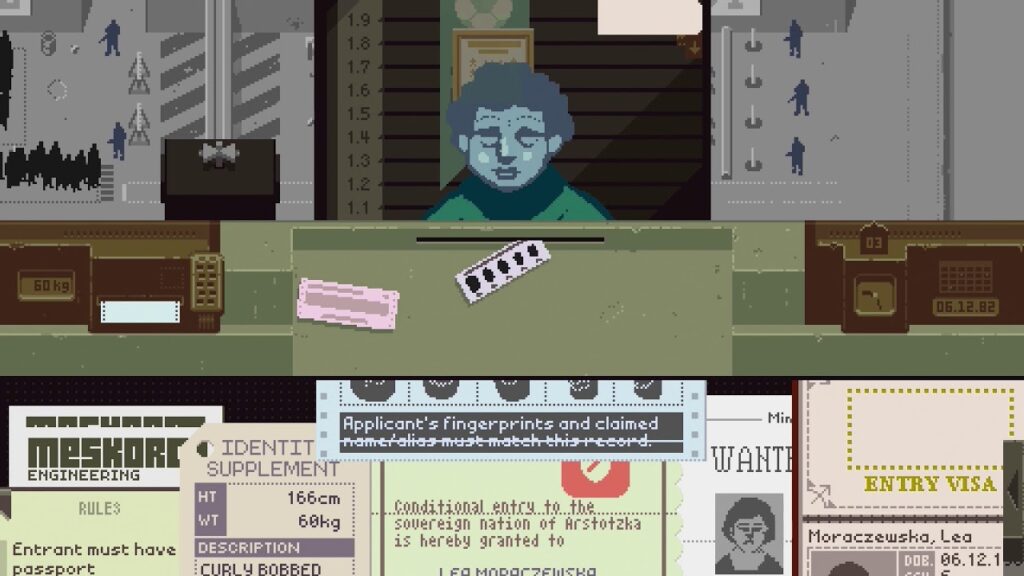
Mechanical difficulty is shown through the in-game mechanics, as when the player first starts their border control duties, they only have to look at the traveler’s passport and make sure it’s valid and didn’t expire. However as the game progresses, the mechanics start to become more challenging with new mechanics and things to look out for like forged entry permits, potential weapons and drug smuggling from overweight travelers, false work details, and even identifying wanted criminals (which may be hard to identify due to the game’s pixel art style).
As the game progresses, these discrepancies and forgeries become harder to identify, as there may be differences in just one letter in a passport code or an entry permit stamp being a sharp edge square instead of a rounded edge one, etc. Speed and accuracy also play a larger role, as throughout the game the player must earn enough money by correctly processing or denying travelers in order to feed, heat, and house their family and buy medicine for the son that always gets sick for no reason. With this, a much more precise attention to detail and mental endurance must be used in order to master the game mechanics, thus showing a curve in mechanical difficulty as the game progresses.

Interpretive difficulty primarily comes from both the narrative side through the inclusion of a specific faction called EZIC and gameplay side with having to interpret and juggle numerous new regulations and rules for travelers.
EZIC is an underground rebel faction that opposes the government of Arstotzka, the very government you work for. Throughout your playthrough, messengers of the order come to you asking for you to complete specific tasks for them, be it letting their agents with faulty documents pass undetected, passing along classified information, and even assassinating their enemies. However, the player could choose to ignore EZIC entirely and stay on the side of the Arstotzkan government. The player is thus left to interpret which side he should choose, the mysterious rebels of EZIC or the totalitarian government of Arstotzka. The player also needs to decide how to circumnavigate and avoid detection by the secret police, who in turn are looking for anyone associated with the EZIC Order.
The game mechanics further solidify interpretive difficulty, for as the game progresses, many new policies and document regulations come into place. Examples include having to check extra permits with new information, scanning people from certain nations, confiscating passports from citizens of a specific district in Arstotzka, etc. All these added regulations increase the difficulty of not only the mechanics, but also how the player interprets and remembers all these regulations when processing documents. The added difficulty thus doesn’t necessarily come from narrative themes or in-game messages, but from remembering the different rules and regulations of the game and that of life.

Affective difficulty is shown through the game’s many emotional scenes and encounters. Throughout your time as border official, many travelers who don’t have the right documents would plead for you to allow them passage for various reasons, be it a Kolechian mother who wanted to visit her sick son, an Antegrian wife who said she would be killed if she had to return to Antegria, or the longtime girlfriend of a soldier you befriend during the game (Sergei is the goat).
One big example would be the story of the grieving father. The grieving father shows up at your checkpoint one day and hands you a picture of his daughter, saying that she was killed by a man called Simon Wens and that he was going to come through the checkpoint soon. While the player should arrest Simon Wens as his picture is posted on the wanted criminals bulletin, the father instead asks you to confiscate his passport so that the father may pick it up and track down Simon to enact revenge. Confiscating the passport however would mean that the player would receive a citation, in which if the player was going for a perfect no-citation playthrough or was on the brink of bankruptcy and can’t take the citation penalty fee, is left with a hard choice of taking a hit on themselves in order for a grieving father to find peace and revenge against an evildoer. Thus, affective difficulty shows its head in Papers Please, making the player have to interpret and decide whether or not to help people in need and thus play into their emotions or going with the cold and harsh decision of refusing to help these people in favor of in-game money, achievements, etc.
Papers Please can be a relatively simple game on the surface, as you’re stuck in one position the entire game doing the same mundane task of checking passports. However, the inclusion of different game mechanics, narrative storylines, and emotional interactions gives the game an added sense of depth and difficulty in the mechanical, interpretive, and affective fields. These difficulties are also blended together, be it with interpretive difficulty from analyzing new regulations and document rules and transmitting that to mechanics or affective difficulty in emotional interactions requiring interpretation and analysis of the situation and potential outcomes. This in turn helps us as the player understand how seemingly everyday events and tasks can have their own surprises and ups and downs.


I agree that Papers Please does a good job of incorporating the three types of difficulty in its game design and has them mesh well together in its gameplay. I actually think a really good example of how it uses all three types of difficulty comes in its family management aspects, which you talk about briefly. Their is mechanical difficulty in properly allotting your money to the right resources so that your family is kept alive, interpretive difficulty in thinking about what resources are more important or valuable than others, and affective difficulty that comes from grappling with having to get rid of certain family members or seeing them get sick and hungry while you try to earn enough money to survive. All of these aspects manage to combine together very well, and despite this aspect of family management not even being the core gameplay of the game, I think it’s one of the most impactful parts of the game because of how well it balances its use of the three types of difficulty.
I think it’s really interesting how you talk about contrasting the mundanity of repetitive busy work with the interpretive and affective difficulties that arise. Papers Please isn’t a game where players can get bored easily, despite the static setting and repetitive gameplay. It is a difficult game, not just because of the level of attention to detail you need to have, but also because it appeals to our emotions and ethics, forcing us to reflect on not just the simulated in-game society, but about the real world, too. Having to make difficult sacrifices or choices is incredibly influential in one’s perception of a game/situation.