Ever since I saw that we would be discussing the topic of failure as part of our class, I was excited. Because in a lot of ways I think games are a medium all about failure. While you cannot fail a book, movie, or song, games have failure as a core component of their design. Most games except, and some even want, the player to fail in their attempts to beat it. Because of this, I think that the way games handle failure and how the player responds to their own failure is one of the most interesting aspects of studying games. And one game that I think has an incredibly interesting relationship with failure is my favorite game, The Legend of Zelda: Majora’s Mask.
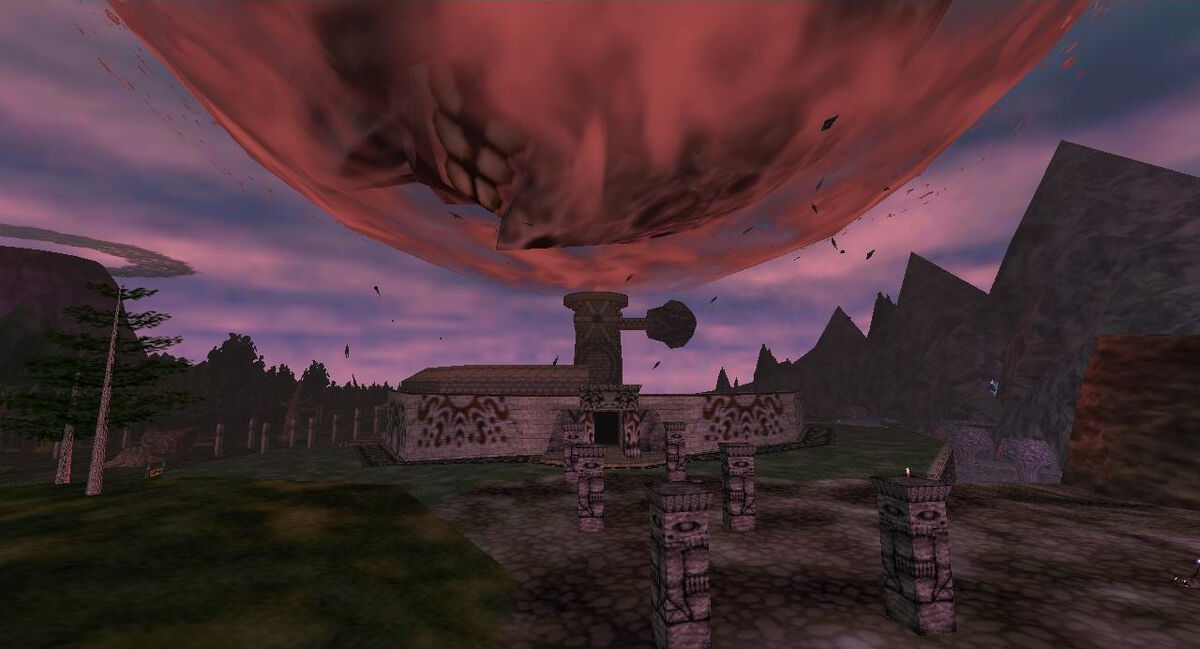
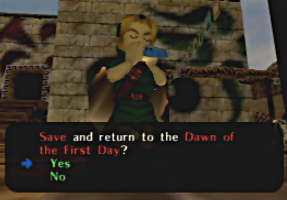
For those unaware of Majora’s Mask, the basic premise of the game is that Link has three days before the moon crashes onto the land of Termina, the game’s setting, and destroys everything. Link must use the song of time to repeat these three day cycle over and over until he ahs to sufficient resources to prevent the moon from crashing and defeat the skull kid.
From this description of the game, you may want to argue the exact opposite of the title of this post. Instead of learning how to accept failure, Majora’s Mask is instead a game about refusing to fail. The game as the player endlessly repeat the same three days over and over, desperately experimenting to try and find a way to save all of Termina from destruction. To accept failure is to allow the moon to crash and destroy everything.
And I certainly think this is a valid interpretation of Majora’s Mask. In fact, much of the core gameplay revolves around the player repeatedly failing and having to restart. The player even loses all their progress (except for their number of rupees, which they maintain through committing bank fraud) at the beginning of each three day cycle. It many ways, it is a game that asks you to repeatedly fail at it so you can learn and improve enough that you eventually have the knowledge, abilities, and skill to beat it and save all of Termina.
In many ways, I think this relationship to failure, where the player constantly resists it and attempts to prevent it from happening, is how failure operates in most games. While games provide us with fail states, and some tell us that our failure is OK or an embarrassment, they consistently ask us not to give up and accept our failure, but rather to keep repeating and trying until we eventually no longer fail.
On a macro level, this relationship to failure applies to Majora’s Mask. After having Termina fall over and over again, the player is eventually able to figure out how to get everything that needs to be done in three days and save Termina from its destruction. However, on a smaller level, Majora’s Mask confronts the player with a failure that they cannot eventually overcome. Instead, it is a failure that the player has to choose for themselves and decide they are ok with.
To explain this failure, let me explain that Majora’s Mask is a game is a game packed full of content. There are dozens of npcs each with their own side quests and goals that the player can help out over their time in Termina. Most of these npcs and their quests involve you helping them in some way. For example, you might help Gormon reignite his love of show business, save the eggs of a Zora from a band of pirates, or prevent Romani Ranch from being invaded by aliens. And for doing each of these side quests, you gain the thanks of an npc as you help them, with them often giving you an item or mask.
While the player is able to keep whatever mask or item the quest gives them, by the time they play the song of time and repeat the three days again, all their progress will be undone. In this way, for each playthrough one makes of the three day cycle, they have to accept that they have failed to assist dozens of other people in whatever they have made their mission. While in one playthrough you managed to free the kidnapped princess of the deku scrubs, you left Romani Ranch defenseless and Cremia and Romani lobotomized by the alien invaders.
Admittedly, accepting this type of failure does not bother the player. While you have to accept that in one timeline you may have failed to help everyone, they were all going to die anyway because you failed to stop the moon from crashing into Termina. For all intents and purposes, the only one that really matters is the final three day cycle where you manage to stop the moon from falling.
However, exactly because there is so much to do in Majora’s Mask, you can’t do everything the game has to offer. Simply put, it is impossible for you to help everyone. And in planning out the final three days, the player has to carefully decide what route they are going to take to help everyone that they want to help. Are they going to let the old lady from the bomb shop get robbed? Rescue and reform all the great fairies? Or reunite the lovers Anju and Kafei?
Ultimately, this decision is entirely up to the player. And while they may not necessarily care about certain side quests, they still have to accept their failure. The fact that they are incapable of completely “winning” and besting all of the challenges the game offers the player. And while there is still a satisfaction that comes from stopping the moon and watching the credits roll, there is also a bitter sweetness that comes from thinking of all the things you were unable to do.
In this way, I think that Majora’s Mask is a game that offers the player a unique relationship to failure. Rather than failure being integral to its narrative or offering the player a chance to overcome all the failures, it instead offers the player the harsh reality that they simply don’t have enough time to help everyone or do everything. They have to make decisions about what they really value and complete the game in a way unique to other players.
While Majora’s Mask is certainly not the only game to tackle failure in this way. In fact, despite the difference in genre, it reminds me a lot of the Telltale games or visual novels. However, I still find that the relationship to failure that came provides the player with is incredibly engaging. Much like the rest of the game, it provides a sort of bittersweet melancholy that comes from saving the day and overcoming your greatest failures, while still forcing the player to live with the knowledge of all those they failed to save. It’s incredibly thematic with the aesthetics and narrative Majora’s Mask provides, and I think it’s part of the reason why the game is still beloved over twenty years after its initial release.
Regardless of how much I love Majora’s Mask, games are capable of forcing the player to grapple with failure in a myriad of ways. And while allowing players to overcome failure through great effort is certainly satisfying and interesting, and I think forcing players to fail, and learn to how to live with that failure, can be even more rewarding.


I think this post brings up the interesting ways in which awareness relates to failure in games. Oftentimes, we view awareness as the means in which to avoid failure. For example, we can fail in a platformer because we didn’t know a gap was coming up, we can fail in a hack and slash game because we were unfamiliar with a boss’ moveset, or we can fail in a turn-based game because we were unaware of how much damage a move can give. In each of these cases, our inability to know what is coming next is what causes our failure. Therefore, when we retry the level or boss, we come in aware of what’s to come and therefore can avoid failure. However, as you point out with Majora’s Mask, failure actually comes from the fact that the player is aware of the other sidequests they could have done but did not. Similarly, games like Nier Replicant also show how a player can fail despite them technically not failing in the game. In this case, the player is aware of their problematic actions, but in order to progress the game, continue to engage in and become complicit in enacting violence. Failure in these kinds of games extends beyond the game and instead asks us to consider our own perspective on failure. It asks us to engage with our own personal morals and perspectives on what matters and what is right.
I find this to be an interesting contrast to other Legend of Zelda games such as Breath of the Wild, where completing every single quest in the game IS possible. While Majora’s Mask makes this impossible, BotW allows players to achieve a 100% completion rate for all the 76 quests and shrine quests in the game. However, one fascinating stipulation is that many players choose not to complete all quests, because the amount of time needed to achieve this surpasses the hundreds. I am wondering whether this choice elicits its own kind of ‘failure’.
Thanks for this post, Adam! I’ve never played Majora’s Mask, or any Zelda games (except for one when I was 10 on my Nintendo 3DS that I rage quit because I couldn’t figure it out), so it was very interesting to read about one of them. From the limited information I had about Zelda games, I didn’t realize that they had such complex narratives as Majora’s Mask. From your description, the theme of failure seems completely essential to the game. The dichotomy between permanent failure and success in the game sounds fascinating—because the player cannot possibly help all of the NPCs, even if they save the world from the collapse of the moon, they cannot ever be fully successful and “complete” the game. It raises an interesting question about agency and choice, and how the player might prioritize which NPCs to help. Is it based on the objects or masks that the NPC might give the player? Is it based on who the player deems the most in need of help? Perhaps the NPCs that have the most interesting storyline? By being forced to choose, it could put the player in a position of reflection on why they are choosing to help the NPCs they’re helping.
As a side note, has anyone ever managed to help every single NPC, or is it truly impossible? Sounds like a speedrunner’s paradise.
I have (sadly) not played ‘Majora’s Mask’ yet, so this was a really enlightening discussion. I’m a big superhero fan, and I often see this trope represented in those stories: multiple people are in danger, but the hero is incapable of saving them all. I also find myself struggling with these types of games; while I don’t 100% complete every game I play, I do like knowing that there is the option to do so. Missing out on things, even when that is the explicit intent of the game design, is something I often find frustrating. It is interesting, then, that this represents a sort of half step: on the one hand, from what I understand (not having played the game), you can do every single mission in the course of playing the game. You can, experientially, 100% the game. But on the other hand, you can’t do it all in one playthrough of the three days. It is an interesting design choice because I don’t think it would bug my completionist mentalities, but I can also absolutely see how it could affect a player emotionally.