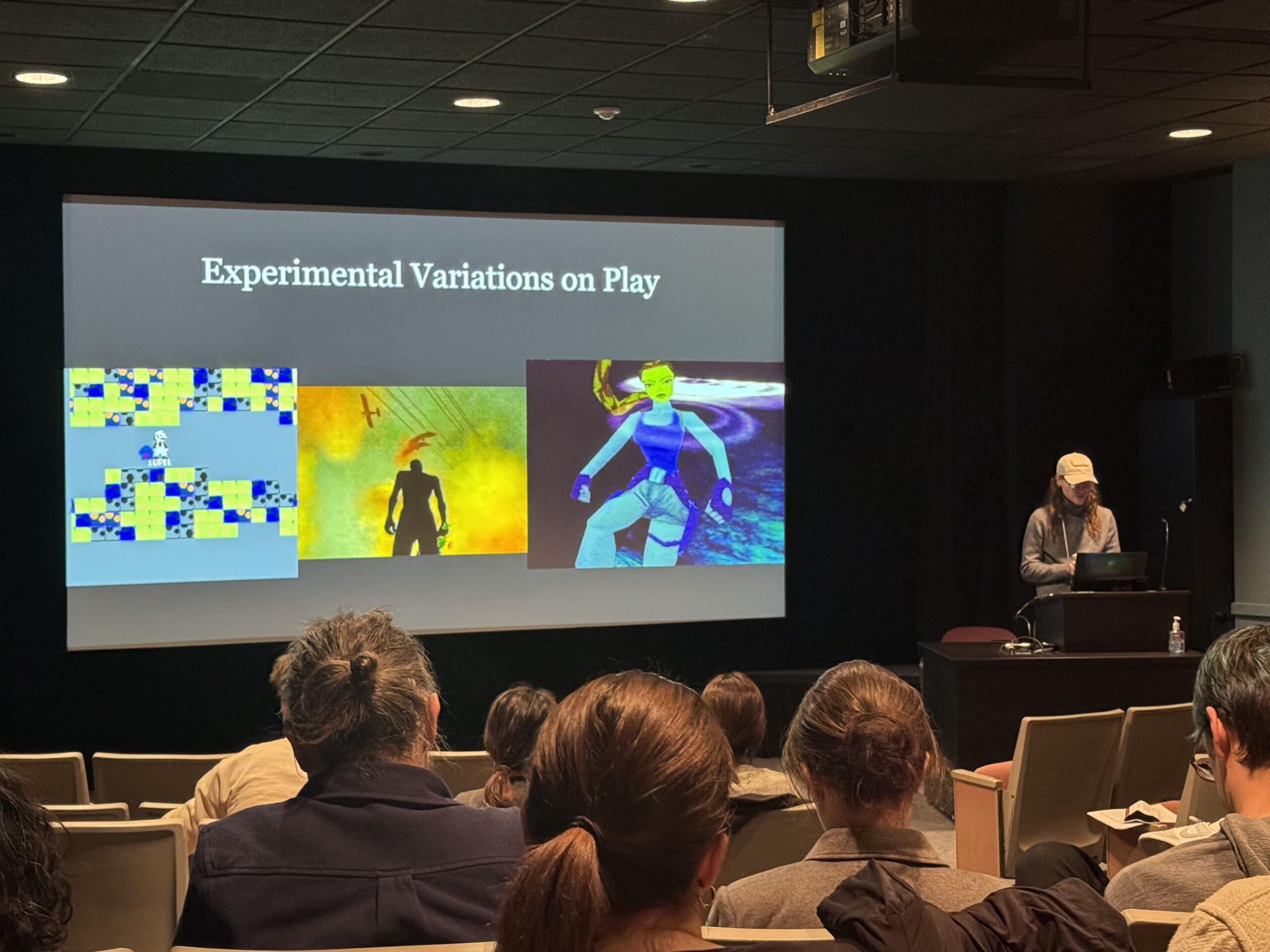
Prior to the Machinima screening, I had never known that there was a rich subgenre of film that repurposes gameplay footage for novel experiential and storytelling means. Learning about it interested me conceptually, since put in conversation with our discussions of videogames in class, Machinima strips the interactivity unique to the processing experience of videogames and transforms it into something we would receive the same way we do a movie or TV series. Yet, to obtain the scenes and environments for Machinima, one must engage with the videogame medium themselves, either through hacking and rewiring its components, or through playing through aspects of the game itself and isolating particular perspectives, character interactions, and embedded narrative moments.
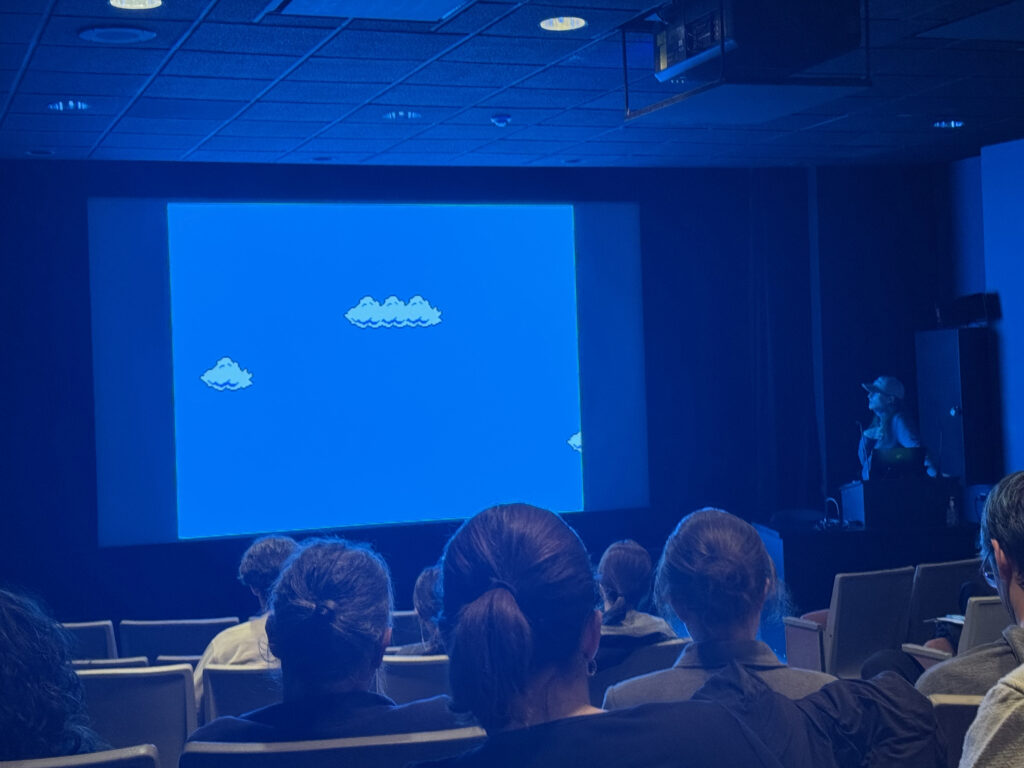
Regarding the screening itself, I appreciated the presentation given prior to the viewings explaining the evolution of the genre and the key individuals behind the selected films. It was, for lack of a better word, very cool to learn about Cory Arcangel, Phil Solomon, and Peggy Ahwesh – three major figures within the field of Machinima that had unique approaches to creating meaningful work from videogame technology. Arcangel’s methods stood out to me the most; in his films Clouds (2002) and Super Mario Movie (2005), he reprogrammed the cartridge of Super Mario Bros 1985 to isolate and sequence particular backgrounds, character movements, and visual effects.
Among the films shown after the introductory presentation, four stood out to me: Super Mario Movie by Cory Arcangel, Rehearsals for Retirement by Phil Solomon, The Edge of the World by Maximova, and It’s in the Game ‘17 by Sondra Perry.
Super Mario Movie, despite my inability to comprehend its larger narrative, stood out to me in terms of its graphics and sound design. The soundtrack in the background of the film was different from the original, having an exciting yet tense energy that added suspense to the movie itself in spite of its sometimes slow, repetitive shots. Several times, the screen would flash different colors and grid patterns, changing colors and shapes in dynamic ways. This imagery evoked that of glitch and error screens, which I think speaks to Arcangel’s physical tampering with the cartridge itself.
Rehearsals for Retirement didn’t appear to me to have a narrative, but was nonetheless interesting through its atmospheric visuals. The music was ominous, playing very well with the dramatic framing of characters with shadowy faces and wide camera shots of rolling fog and rushing water. The film shifted frequently between first and third person, which accentuated elements of GTA’s natural, forested environments – places that aren’t really foregrounded when the game is played through by the average person. Thus, even though there wasn’t a chronological throughline or distinguishable order for the sequence of scenes, I appreciated the way that the film highlighted the understated beauty of the game’s scenery.
Edge of the World was similar to Rehearsals for Retirement in the way it highlighted something that is typically overlooked in the videogames, namely the boundaries of the in-game environments and the ways said boundaries influence our understanding of the worlds themselves. The film showed several different angles of environment cut-off points, from areas where patches of grass were vacant to half-formed mountains and empty canyons. The addition of narration of “the subject” in the film also added a layer of suspense and intrigue to the ground they cleared in search of edge spaces. I think it was a good choice to make longer, cinematic shots of areas of the Cyberpunk 2077 map with empty spaces and floating ground, as it really made the audience aware of the manufactured nature of settings people assume to be continuous when immersed within gameplay.
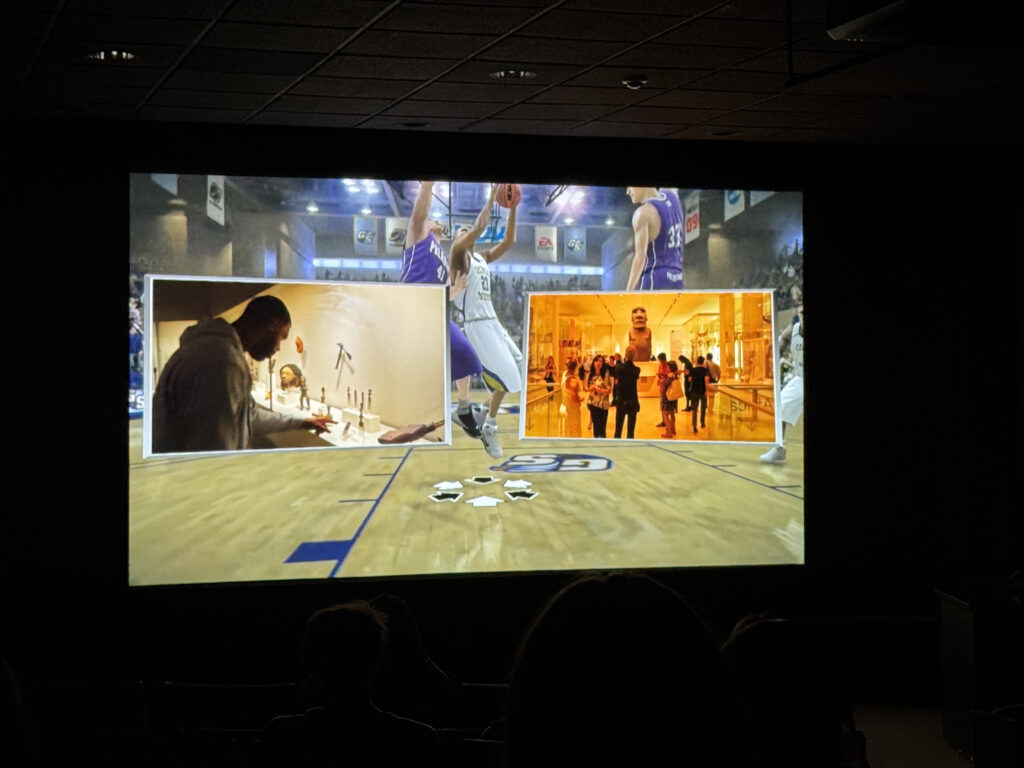
Finally, I think I enjoyed It’s in the Game ‘17 the most for its mixed media elements. At first, I didn’t understand why footage of the MET and British Museum of Art were being overlapped with EA Sports basketball videogame footage, but with the inclusion of Sondra brother Sandy’s commentary about his college basketball team peers while scrolling through playable characters, it immediately clicked the parallel between stolen cultural artifacts and athletes’ stolen likenesses.
This, combined with the 3D renderings of cultural artifacts and vlog-style exploration of both museums, added a much more personal dimension to the sports footage, which I think was very necessary considering the injustice of the subject matter. Whereas traditional videogames where we play as fictional characters allow us to create a distance between ourselves and the individuals we embody due to the fact that they aren’t real, hearing the Sandy’s anecdotes makes his peers, whose appearances were appropriated for the game, humanizes them in a way that doing so for NCAA basketball “characters” in It’s in the Game would feel morally wrong. As such, I think Sondra’s use of different audiovisual elements in addition to clips of game footage itself amplified her overarching message, which gave it a more lasting impact to me.
On the whole, although certain aspects and elements of the screened films seemed too abstract for my understanding, I still found many aspects of the screenings interesting for the ways they pushed boundaries with the medium. It’s fascinating to think about the ways video games can be employed to construct meaning, as not only can they contain narrative elements embedded by developers or impart meaning onto players through unique interactive play experiences, but they can also be repurposed into an entirely different media: film.


Really enjoyed your writing, especially the way you pointed out how Machinima removes interactivity but still relies on the player’s engagement to even exist. Your take on Rehearsals for Retirement and Edge of the World was super interesting too. I hadn’t thought about how those films highlight parts of games we usually ignore. And yeah, It’s in the Game ’17 hit me the same way, once Sandy starts talking, the whole “likeness” issue suddenly feels way more real. Great post!