I’m not going to lie, I didn’t really get most of the works of machinima that we looked at. They were very creative, and I was impressed by the multimedia aspect of the short films. However, I didn’t really understand much beyond what I was told to interpret into the films beforehand. And even with these thoughts in mind, there were many clips that did not obviously connect into the theme that I was looking for. Maybe machinima is too experimental for my taste, or maybe I missed something, but I did not comprehend how certain clips like terrain clipping and filming a u-shaped bleacher for multiple minutes played into themes of female outrage or black oppression.
However, there was various enjoyable elements. For instance, trying to follow (or more accurately add) a story line in “Super Mario Movie” by Cory Arcangel was fairly engaging and I was curious to see how else the world would decay as the film progressed. Additionally, there were humorous elements, especially in Kent Lambert’s “Reckoning 3,” where the superimposition of various characters or people making disbelieving or blank faces adds humor. Additionally, the repetition of images combined with an unusual soundscape consistently captured my attention. However, this sometimes also turned into a cacophony of sounds.
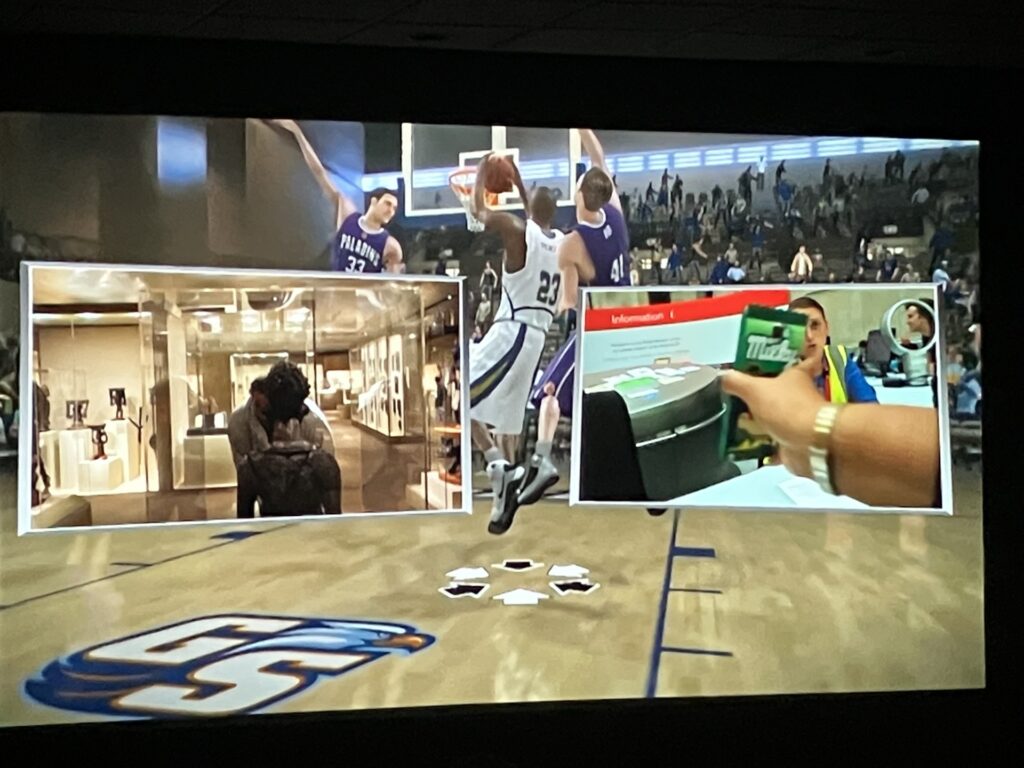
Despite my obvious mixed feelings about machinima, I do think it was worthwhile to experience. I will praise anyone trying to extend what is considered art and making something novel. That act has value in and of itself. Additionally, there were a few moments where the messages of machinima came through in a powerful way. The parallel between the exploitation of black athletes by using their likeness in video games without permission and the thievery of African artifacts by museums was well drawn. Both times, something was stolen and displayed to the world, in a way preserving it, but crucially without the consent of the involved people. “It’s in the Game ’17” by Sonda Perry cleverly uses the well known robbery of artifacts to draw attention to the thievery of black athlete likenesses, a less well-known phenomenon. “She Puppet” by Peggy Ahwesh was also able to effectively argue its frustration at the sexualization of women.
Furthermore, machinima can experiment with the strange and breach more into the realm of affect. Even if there is no explicit meaning, machinima can still affect the viewer and cause emotional responses, often quite different responses than you’d normally experience playing the game. It’s a way to see games in a different light and to change how you think about them. Yes, most machinima is odd, but it is also that oddity that opens up the space for a novel experience. And in light of this experience, it’s almost impossible not to ask yourself “why this game for that purpose?” Sometimes, like in “She Puppet” the answer is obvious. But other times, it really lets you ponder and maybe you’ll discover something more, something deeper, about a game that you like to play.


I both appreciate and admire how open-minded you are about machinima despite not getting most of the works that we saw. I also did not get most of the works and there were things I didn’t catch that you clearly did, so this has been enlightening to read. For example, I did catch the thievery of African artifacts by museums in “It’s in the Game ’17” but I didn’t realize the scenes displaying Black characters in the basketball video games were meant to highlight exploitation because I didn’t know that their likeness was taken without permission. Therefore, I did not see that parallel that you saw, but now that I see it, that work of machinima makes a lot more sense to me! Perhaps rewatching these works would be useful for me, because by the looks of it, I definitely missed some fundamental ideas.