I have always enjoyed board games, whether that means chaotic party games with friends or more traditional strategy-heavy ones. And for a long time, I have been curious about TTRPGs like DnD, even if I have not actually sat down to play one in years. Thinking back, though, I realized that my younger self got surprisingly close to that kind of play without even knowing it. The way in was through something very small and forgottne: Lego Heroica.
Heroica was part of Lego’s 2011 “LEGO Games” line, and it tried to be a full adventure game system made out of bricks. There were five sets in total, each taking place in a different location, each with hero characters, monsters, map tiles, and some relic you were supposed to retrieve. At first glance, it looked like a normal board game. You built the map, placed the enemies, and followed the rulebook. That was how I thought it worked as a kid, a straightforward “build the board and then play it” sort of thing.
What stood out to me as I looked at Heroica again is how quickly that idea falls apart once you remember that the entire game is made of LEGO. Yes, each set comes with an official layout you can follow. Yes, it explains exactly where every goblin, golem, werewolf, vampire, whatever, should stand. But nothing actually forces you to play it that way. Because it is made out of LEGO, all of it, brick by brick.
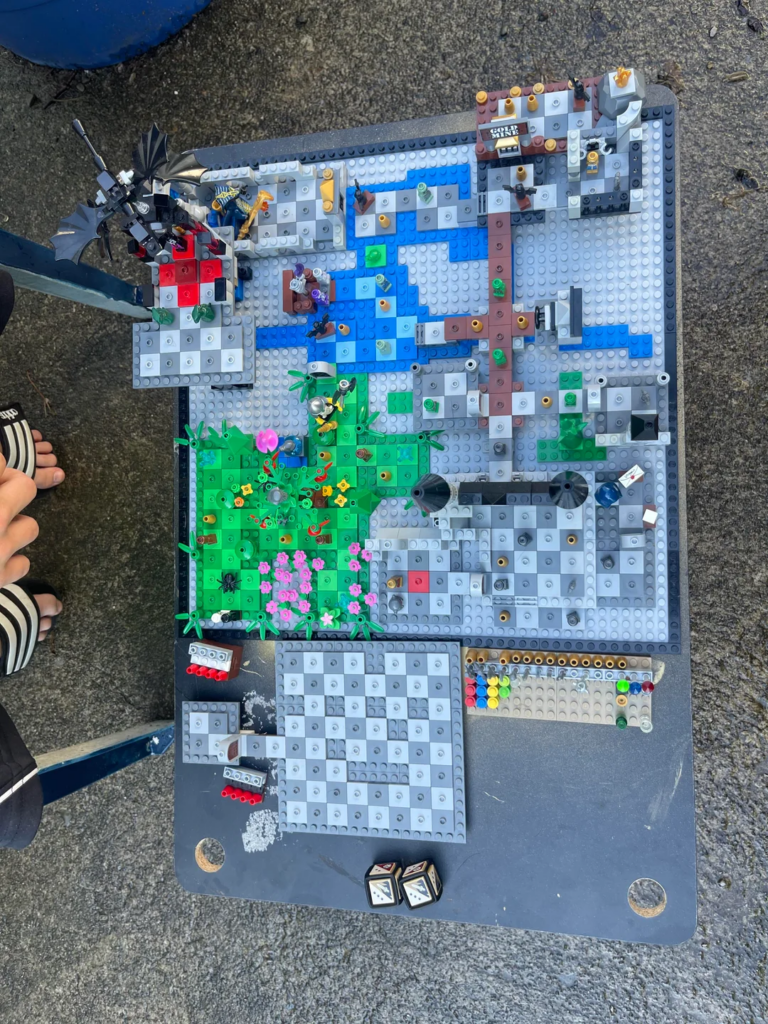
As such, the map is only a starting point, a suggestion for the person who bought the set.Every bridge, room, and tile can be rebuilt. You can extend the board, chop it in half, stack it vertically like stairs, or connect several sets into one long overworld. And that freedom does not stop at the map. The monsters can be rebuilt into something new. You can decide their stats, their abilities, and their difficulty. The weapons can be redesigned or replaced entirely. The potions can be represented by whatever pieces you want and can stand for any status effect, whether it is something from the game or something you invented. Heroica is a board game in the loosest possible sense because almost nothing in it is fixed. (below is an example of someone making their own Heroica map, https://www.reddit.com/r/Heroica/comments/15q0krr/custom_heroica/)
That freedom pushes against the very idea of what a board game is supposed to be. Usually, board games depend on a stable, unchanging structure. Heroica gives you structure, but in a way that feels optional. The rules exist to guide you, not to box you in. That becomes very clear once you look at how the mechanics actually work. Each player controls a hero micro-figure like the Barbarian, Wizard, Rogue, or Ranger. Each hero has a special ability tied to the custom LEGO die. Movement is determined by rolling that die, and combat uses it as well. If you land next to a monster, you roll again to see if you defeat it, take damage, or both. Along the way you can pick up items like gold, potions, weapons, keys, and the relics specific to each set. All of this gets stored on a “Hero Pack,” which is basically a small LEGO plate that holds your items, think of it as a limited inventory.
Despite it be mechnically a simple game, there’s a bit of nuance in it, particularly the dice mechanic which kind of dictates the entire game. As such, this game was also the first game where I first had to deal with the ever giving and taking menace that is, RNG. One play session in particular still lives rent-free in my head. I kept getting hit by monsters because I somehow rolled the skull side almost every time. (If you roll the skull side, you just take damage) Eventually I got so fed up that I pulled the skull tile off the die entirely, leaving an empty space where that face was supposed to be. This guaranteed that I could never get hit again. Of course, whenever I rolled the now blank side, I just ignored it and rerolled the dice again.
(And to be fair, since I played this game mostly by myself, I would just reroll the die if it wasn’t the best outcome for a given situation)
The rules are simple, but the modular board changes the entire experience. Instead of being a fixed path you follow, the map becomes something you can treat like a creative problem. If the hallway feels too short, make it longer. If you want more enemies guarding a relic, add them. If you want the boss to be two bosses instead of one, that is possible too. The game’s design quietly encourages invention. It gives you a basic structure and then opens the door for you to change it.
This makes Heroica feel like a small step toward the types of systems that show up in tabletop roleplaying. It is not a full TTRPG, but it captures the spirit of one. You play within rules, but you also alter them. You explore a world, but you also build it. You follow the scenario, but you also give it your own shape. TTRPGs generally pride themselves on being less restrictive than most board games, but Heroica takes that idea in a different direction, as instead of freedom coming from narrative choices and roleplay, it comes from the physical ability to rebuild the world. The creativity happens through construction rather than improvisation, which gives it a distinct identity separate from traditional tabletop roleplaying. All of this is pretty nuanced for a game that is meant for young kids, and so when reflecting upon my experiences with it, I’ve learned to appreciate it even more.


This is a really interesting game! I’ve actually seen or heard of it before, but now that I am, it feels like it should directly follow from the tradition of pen-and-paper roleplaying game that there would be a modular Lego game. Something I’m wondering about though is how much the lego brick form itself might be influencing different mechanics. It would be strange to have a tower-defense run of this game because of the form of the brick itself.