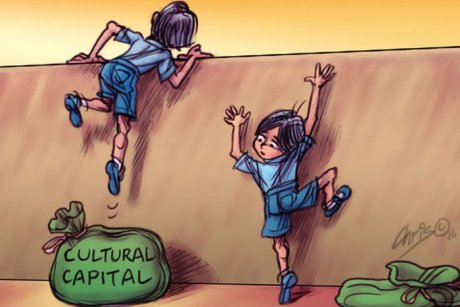
Cultural capital is defined as “institutionalized…widely shared, high status cultural signals (attitudes, preferences, formal knowledge, behaviors, goods, and credentials) used for social and cultural exclusion” (Lareau 2001). To use cultural capital to one’s advantage, one must embody the right culture for a given context, deploying a verbal fluency, aesthetic preference, or other observable cultural marker to appeal to their desired audience. Schools, as major institutions that reproduce social conditions by reinforcing dominant cultural norms, are biased in favor of students that wield more cultural capital.
Generally speaking, cultural capital is more highly concentrated among more affluent, middle class families. This is because middle class parents, by nature of their more lucrative careers and connections to other middle-class individuals, wield more knowledge of the “rules of the game” in different social contexts and are thus more comfortable interfacing with educators and administrators on behalf of their children in schools (Lareau 2001). Hence, middle class parents adopt a child-rearing strategy of concerted cultivation,which places focus on “foster[ing] children’s talents through organized leisure activities and extensive reasoning” (Lareau 2002). In other words, middle class parents structure their children’s time in a manner that develops key soft skills and knowledge needed to obtain similar economic outcomes, in addition to training their children to view adults as equals whom they can negotiate with to receive help and accommodation. Applied to the context of schools, middle class children evolve to adopt an attitude of emerging entitlement, given that they become accustomed to seeking help from educators in order to succeed and troubleshoot problems by any means necessary (Calarco 2014).
In comparison, working class and poor families oftentimes do not have the time nor money to afford structuring their children’s extracurricular lives as exhaustively as middle class parents do, opting instead for a natural growth approach to parenting characterized by unstructured leisure time and discipline through non-negotiable directives (Lareau 2001). Children of working class families therefore learn to adopt a subservient attitude to adult authority and thus are discouraged from seeking help in the context of schools – out of fear of challenging their teachers or getting into trouble (Calarco 2014). Compounded over time, middle class students are positively rewarded for their problem-solving method of active help-seeking through good grades and more tailored instruction from educators, whereas the struggles and learning difficulties of working class students are overlooked and penalized.
So what does any of this have to do with educational games?
On a practical level, educational games have the potential to bridge class-based disparities in students’ problem-solving approaches in school by dispelling negative associations children of working class or poor students have towards active help-seeking. Moreover, incorporating formal lessons on self-advocacy into school curriculums through educational games also brings teachers’ greater awareness towards strategies they can use to uplift and assist students who feel uncomfortable or hesitant to directly convey their academic struggles. Furthermore, creating an educational videogame that makes traditionally gatekept cultural knowledge available to students would help resolve the issue of class-based disparities in routine student-teacher interactions in a less costly manner. Compared to other alternatives, such as hiring additional school staff to teach those skills or investing in partnerships with organizations that have supplementary curriculums for enhancing these proficiencies, most costs associated with implementing such a change would be upfront (e.g. purchasing devices, paying to install the application) and any updates or changes to game material don’t present any cost, given that patch updates to games can occur automatically on existing devices with the game installed. Learning cultural capital is also, in many ways, similar to learning a language, as it requires individuals to be immersed and situated in specific contexts to be understood meaningfully. Thus, it’s even more cost efficient, as not all students learning modes of cultural capital have to be playing the game for it to foster learning, just as Young et al. observed in their review of language learning games.
All this considered, I have two ideas for educational games that each address a different form of cultural capital: a dress-up game and a mystery scavenger hunt game. Both would be targeted towards elementary school children.
The dress-up game would mainly instruct students on the kinds of clothing and demeanors expected for different social situations, particularly the differences between formal contexts (i.e. school, work) and informal contexts (home, friend gatherings). Students would customize an avatar’s appearance – their clothes, accessories, makeup, etc. – to complete certain tasks in different locations, which are then awarded points based on how effective the cumulative appearance conforms to the given context (e.g. wearing sleep shorts to a job interview would be awarded fewer points because it is incorrect for the situation). No style of dress would be postured as “better” or “superior” to other ones, but rather more appropriate for certain situations. The game could also include elements of language too, giving students dialogue prompts and options once their avatar is in a specific location to help them learn the kind of tone and diction expected in casual and formal interactions (e.g. “What’s up bro?” and “Hi, Mrs. Lastname” as options for interacting with a teacher in school). These would similarly award points based on appropriateness.
For a mystery scavenger hunt game, the goal of the game would be to determine the location of treasure based on clues and advice from a diverse array of experts (e.g. scientists, historians, mathematicians, cartographers). The more a player interacts with experts and asks more specific questions, the easier it is for them to get information about the hidden treasure. The game would be designed in such a way where aimless searching for the treasure would prevent the player from advancing, therefore framing help-seeking as both a solution and source of reliable support in the face of adversity. Engaging with experts would also clarify certain tasks leading up to the discovery of the treasure, similar to how asking teachers for clarification on schoolwork often prevents misunderstandings that lead to poor grades for students in the classroom.
On the whole, I think that educational games, beyond their ability to enrich learning in certain academic areas, also have the potential to remedy class-based inequalities that create achievement gaps later on in students’ educational and career trajectories.
Sources:
- Lareau, A. (2001). Linking Bourdieu’s concept of capital to the broader field: The case of family-school relationships. In Social class, poverty, and education (pp. 77-100). Routledge.
- Lareau, A. (2002). Invisible inequality: Social class and childrearing in black families and white families. American Sociological Review, 67(5), 747-776
- Calarco, J. M. (2014). Coached for the classroom: Parents’ cultural transmission and children’s reproduction of educational inequalities. American Sociological Review, 79(5), 1015-1037
- Young, M. F., Slota, S., Cutter, A. B., Jalette, G., Mullin, G., Lai, B., Simeoni, Z., Tran, M., & Yukhymenko, M. (2012). Our princess is in another castle: A review of trends in serious gaming for education. Review of Educational Research, 82(1), 61–89. https://doi.org/10.3102/0034654312436980