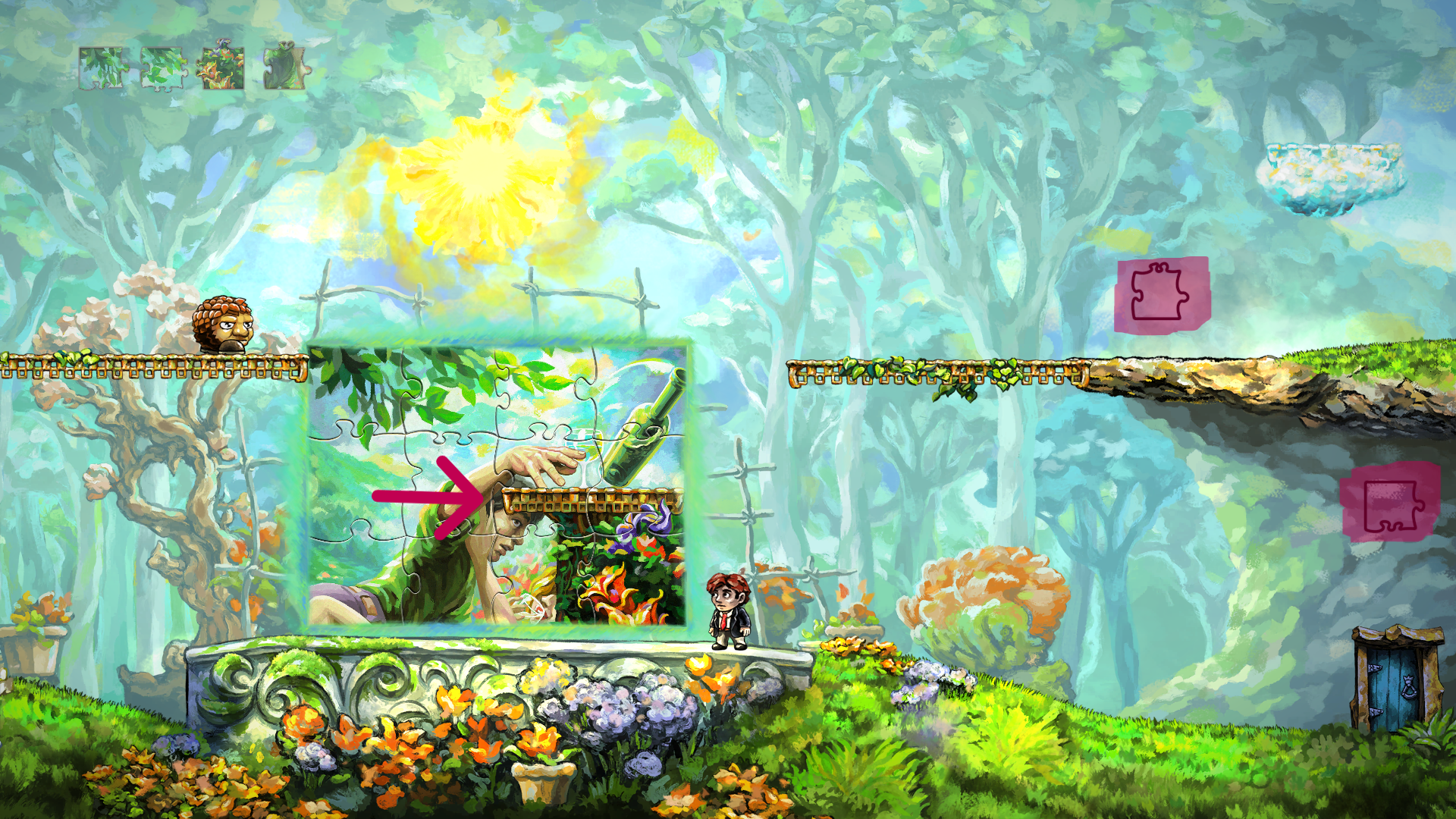
Quick apology: I didn’t actually hate playing Braid and added a bit of clickbait. But I would be lying if I said that I enjoyed it and would currently rank the game as one of the most frustrating games I’ve played. In fact, if you know Problem Attic, I thought Braid was much more annoying (though I also only played the first act of Problem Attic). Here is my issue with Braid and why I thought it was more frustrating than the objectively infuriating Problem Attic: Braid set up certain expectations for puzzle diffculty and then proceeded to break those expectations. There were sudden difficulty jumps and certain puzzle pieces that could not be completed when first exposed to the player. These were not things that Braid had teased, and I felt cheated.
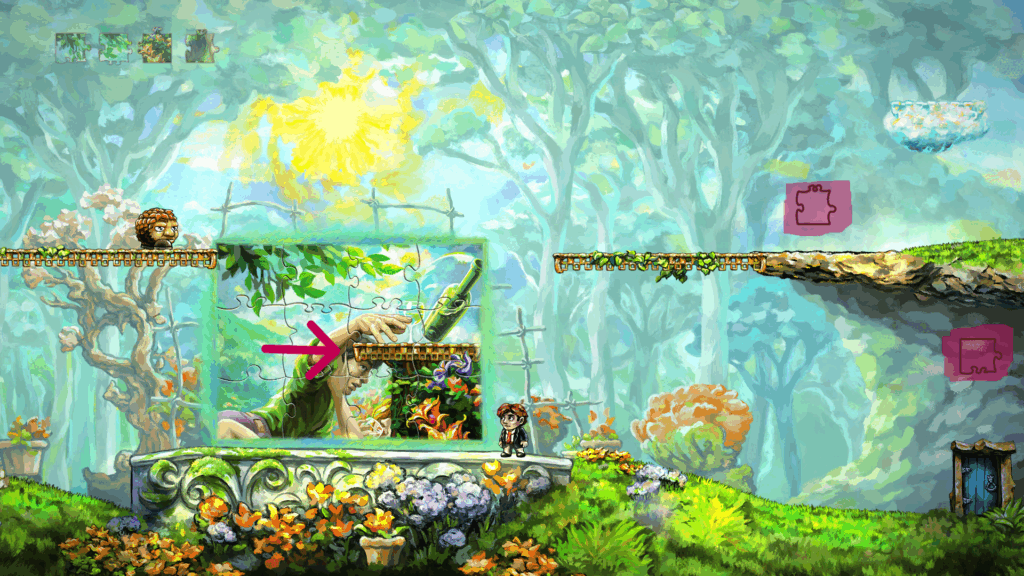
There is one puzzle in particular that caused this sentiment to well up in me. At the end of the second level of the game, The Cloud Bridge, you encounter the above puzzle. There are two puzzle pieces (the empty outlines are highlighted in pink) that are inaccesible to the player. By the point that you encounter it, the puzzle to the left of Tim maybe has two or three puzzle pieces from the first two levels, not the whole puzzle. Notably, he does not have either of the two puzzle pieces with a platform on them (as indicated by the pink arrow) because they are collected in subsequent levels of World 2. The trick to solving this puzzle by aligning the platform of a puzzle piece with the platform that the enemy is walking on, on the left. Then you slowly move that platform down (carefully as not to dislodge the enemy) by entering the puzzle screen (which is totally separate from the main level, so you cannot see the enemy’s position), until the enemy is positioned such that Tim can jump onto it and bounce onto the platform on the right. And the bottom puzzle piece is reached by dislodging the enemy when it is facing right, but not left, and then jumping on the enemy to reach the piece.
There are a few problems that I have with this level. First, you do not have the necessary puzzle piece to complete the puzzle when you encounter it. Second, this is by far the strangest and thus (in my opinion) hardest level in World 2, which produces a sudden difficulty spike at the very start of the game. Except that it doesn’t feel that way, it just feels bad because there is nothing to indicate the solution of this puzzle. And while you can see (in hindsight) that the platform on the puzzle piece and in the game world look near identical, the most egregious problem is that this mechanic is never repeated in the game, preventing the player from learning about it in another context.
Many other worlds had a variety of puzzle that greatly varied in terms of difficulty, which frustrated more often than not. Additionally, the way that you continue your momentum when you bounce on the edge of things (ie no coyote time) and some of the incredibly fine grain control needed to be executed despite slidy controls made the game feel bad to play from moment to moment. I am told that playing on controller is better, but I played on keyboard and it sucked. Another strange part of the control scheme was highlighted when fighting the rabbits. Half the time they would kill Tim the player character and half the time Tim would kill them, with no (to me) obvious indicator as to who had jumped higher to bounce on top. Overall, I did not enjoy Braid.
On a second reflection
Now looking back on how I felt, I realize that Braid was not quite as bad as I originally thought it was. Yes the control scheme was terrible and alone can almost ruin the game, I stand to that, but the puzzles oscillating wildly in terms of difficultly was thematic. Braid is a game that very obviously and intentionally plays with the nature of time. Given that the game breaks time’s linearity so much, it makes sense that the puzzle are also not meant to be played in a linear fashion. That is also why you can walk through all the levels without needing to solve the puzzles. Additionally, I did not have a lot of time when I played Braid and am bad at puzzle games. So I obviously did not have the time needed to ponder some of the puzzles or to try out various solutions. I was impatient and quickly ended up looking at a walkthrough. So perhaps my experience of Braid isn’t an accurate reflection of the game itself.
And yet, despite all that, I can confidently say that Braid was too hard for me. It’s not the type of puzzle that I am practiced in and I lack the technical ability needed to execute of some of them. Thus, while I turned to the walkthrough too quickly, it’s only natural that at some point I sought help. And yet, Jonathan Blow (the designer of Braid) said that people shouldn’t do that and that it would ruin the game. He thought that the final content of Braid should be gated based on player skill. While I don’t object to that per se, I think it is a little ridiculous to say no to a player who is passionate but lacking in competence, who when they get help are made to feel bad about their decision to further engage with the game. This really ticked me off and validated some of my complaints above, because they become much more egregious when you are not supposed to seek help. So, Braid. It’s a complicated game, that I certainly did not enjoy playing which misses out on some key design principles. Maybe that’s how it is supposed to be, but I for one cannot endorse it.


To be honest, I’m also not the biggest fan of Braid. Like you, I played the game on keyboard and found the controls to be awful. I felt like the game required far too much precision in much of its movement, particularly in interacting with the enemies, compared to the level of control you have over Tim, who in my opinion felt really heavy and slippery. I also fully understand your frustration with much of the game’s puzzles. I really dislike the puzzle at the end of second level for not following the game’s established rules or not developing into something for the rest of the game (to my knowledge you don’t interact with any of the other paintings in the levels they appear in aside from assembling them). However, I do want to defend the game’s puzzles a little bit. While I found most of the different puzzle mechanics hit or miss (I hated world 4), I do think the game managed to use the puzzle mechanics very well. Each puzzle piece requires a novel use of the world’s established mechanic, and many of the game’s harder puzzles required really creative implementations. As someone who likes puzzle games, I found thinking about many of Braid’s puzzles to be an enjoyable experience, even if trying to move Tim around was a slog. But, I can easily see how not having enough time to really think through the puzzles can make many of the puzzles not enjoyable to solve, and I would be lying if I said the game didn’t make me feel incredibly frustrated at times. I just think that the puzzles in Braid are actually pretty well designed, aside from the infamous second level one.
I initially clicked because I grew up playing Braid, its one of many games my dad introduced me to and I disagreed. But as I read your entry, I realized I actually did hate playing the game! The controls are way too limited for how ambitious the Braid pretends to be, and the level difficulty personally leads to paralysis to the point of giving up the game –in addition to the unpleasant initial graphics of the first version though the art itself deserved much more respect. But, I only hated PLAYING the game, not experiencing it or learning from it. It asks for so much time and dedication, that sort of immersion in Tim and his mind was frustrating but ended up making perfect sense for the end. It is a game that you can’t just briefly play and watch the rest. By the end, going through all the horrible gameplay and frustrating levels being on Tim’s side, we adopt his mindset. Without realizing, we are arrogant and self-forgiving, expecting the princess come back to us. The disappointment of her leaving for good stems only from us seeing all the effort Tim, we, went through to go back. Being disappointed in another’s valid, autonomous decision and realizing what is wrong with that is unpleasant, but I grew to like playing as him and being able to separate myself from his mindset. I experienced something other than being myself, and felt satisfaction in understanding that and going back. If I was another type of person, I probably would have learned something about myself through being Tim.