
In many academic works, such as disabilities studies and gender studies, the paradox of hypervisibility and invisibility is often discussed when addressing issues of “otherization”.
Hypervisibility is a phenomenon that occurs at the societal level, which then influences the individual level. On the societal level, a person may feel highly visible (and consequently, scrutinized) based on certain interactions with others in public spaces. On the individual level, such exposure to heightened visibility causes a person to internalize other people’s acute awareness of them as their own. Hypervisibility often produces an exhaustive emotional and mental state that leads to anxiety, pressure, and distress. Efforts to avoid this traumatic state can cause people to make themselves invisible — as hypervisibility is born out of just the existence of specific, “non-normative” expressions.
Dys4ia (2012, Anna Anthropy) creates the space for the effect of hypervisibility to be felt and understood by a player through its linear design and straightforward gameplay.
On a macro level, both elements allow a player to focus on the emotional narrative of Dys4ia. Undemanding mechanics and a lack of variability means that there is no need for a player to practice or improve their playing abilities (at least, not in the same way that say, a rhythm game would demand). Thus, the low barrier for entry pertaining to skill level allows players to devote their attention or energy to the game’s narrative.
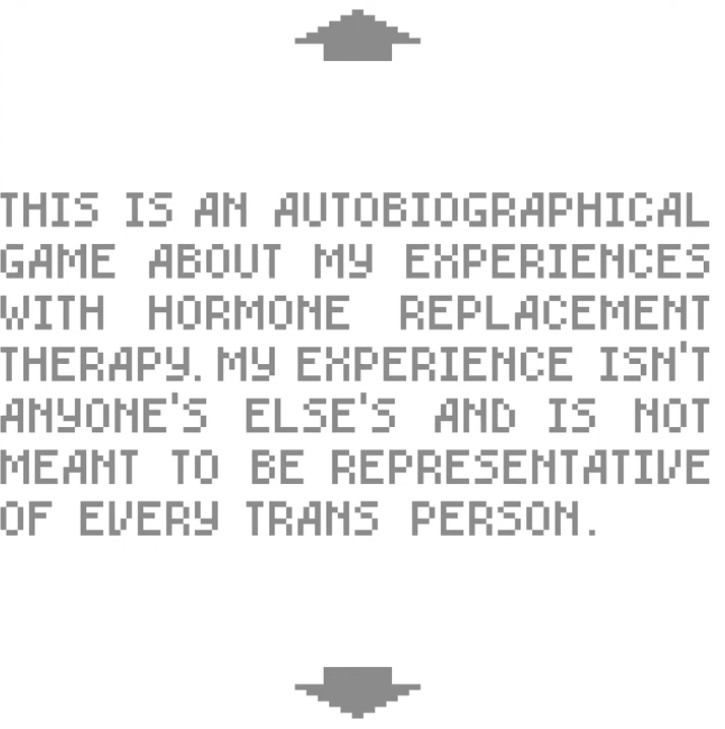
As stated in the beginning of the game, Dys4ia is an autobiographical game about Anna Anthropy’s own experiences. At its heart, Dys4ia is a story about a specific emotional journey of exasperation, irritation, and affirmation.
Understanding the push and pull between hypervisibility and invisibility, therefore, aids in defining the emotional weight of the game.
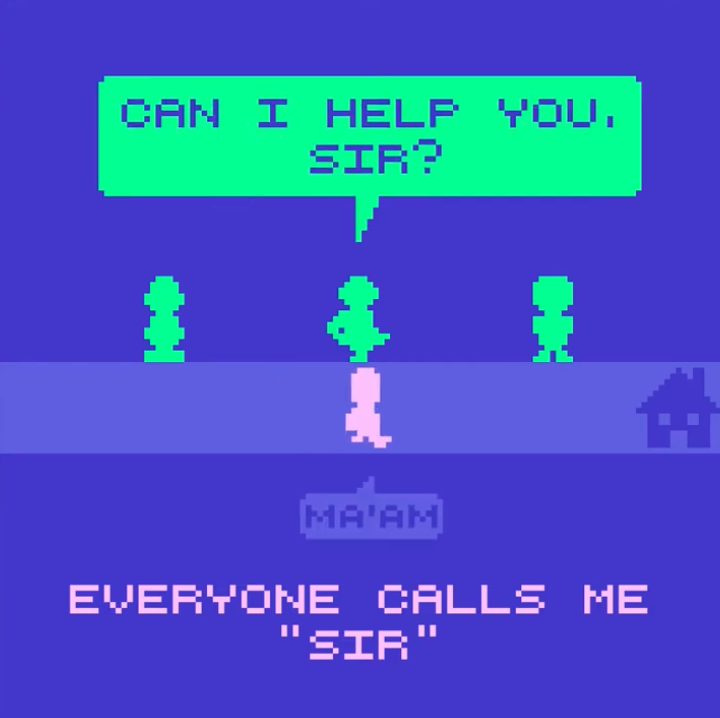
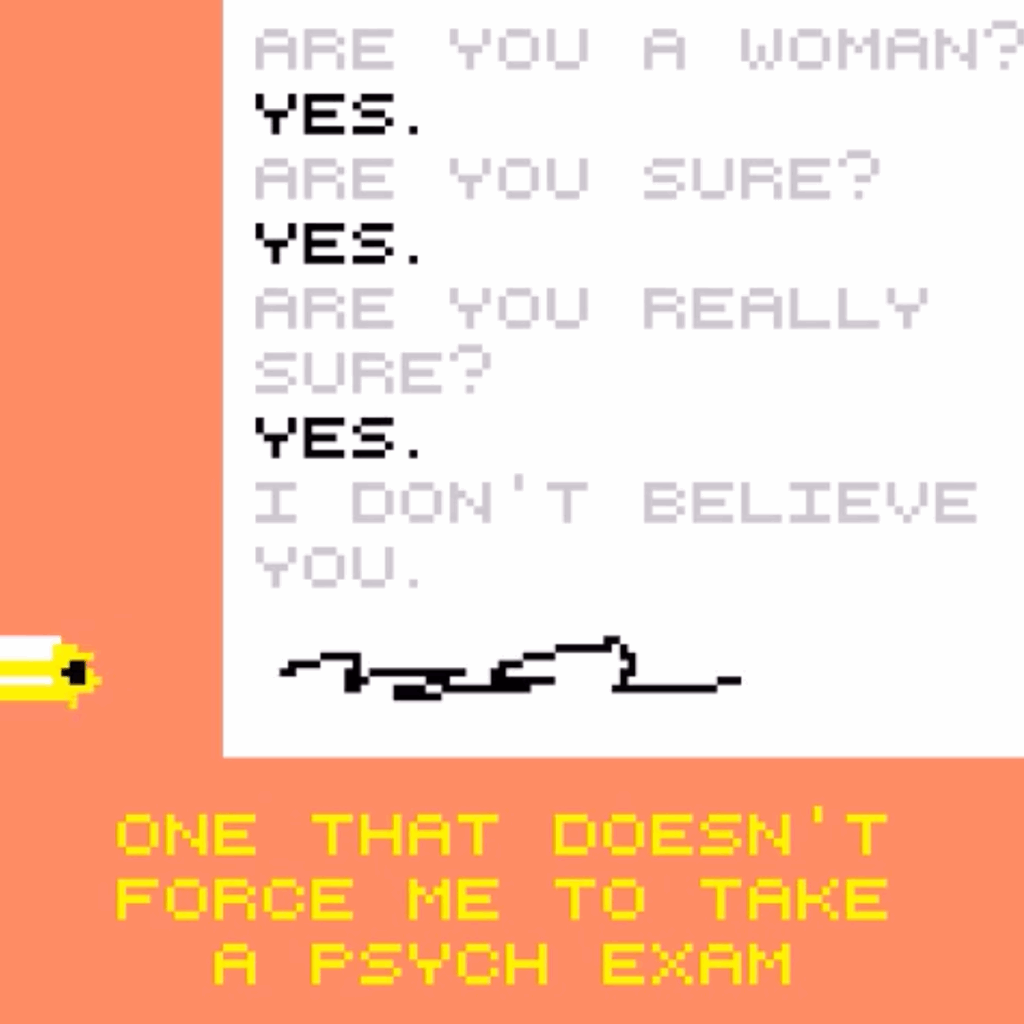
On a micro level, there are many moments of hypervisibility present in Dys4ia’s narrative. Some instances include walking by people who use the wrong pronouns, or even having to plead your case to multiple doctors who “don’t believe you”.
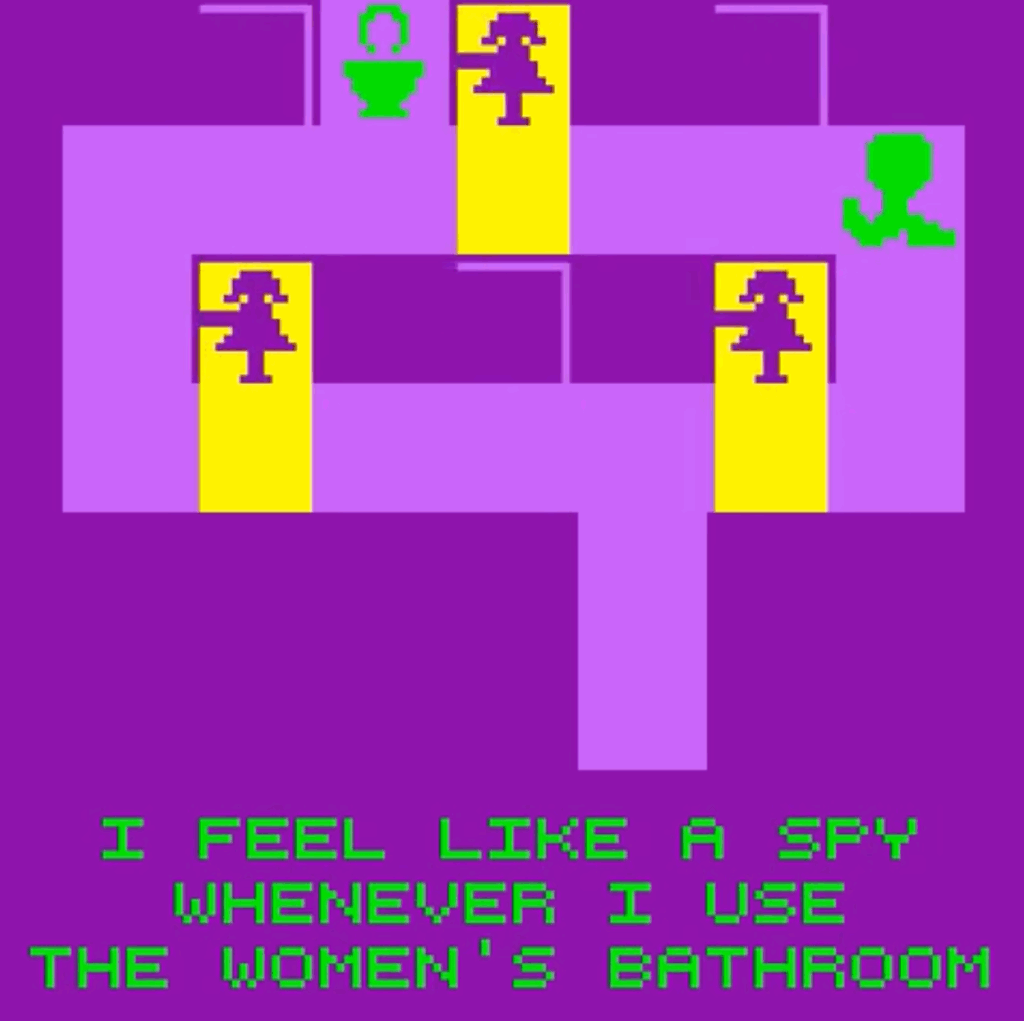
Perhaps, though, the most prominent moment of hypervisibility occurs in the section about the women’s bathroom. To avoid being scrutinized and judged for using the bathroom, the aim of this section is to avoid entering the line of sight of others. Essentially here, the goal is to evade hypervisibility by rendering the avatar invisible. Notably, the avatar will naturally stop before entering any line of sight — highlighting the compulsion one feels to be avoidant. This contrasts to other moments of movement in the game, where when a key is hit, the avatar slides across the screen until it hits a wall, or when a key has to be held down for the avatar to move at all. However, while the game naturally pauses the avatar before she enters a line of sight, the player can choose to keep moving regardless. If a player chooses to enter the line of sight, the avatar flashes, and the scene immediately ends. This implies that, when seen, the scrutiny from hypervisibility kicks in (a reading I will subscribe to, since an avatar flickering harkens back to how older games showed taking damage), and a “game over” scenario is reached (that of being unable to use the bathroom).
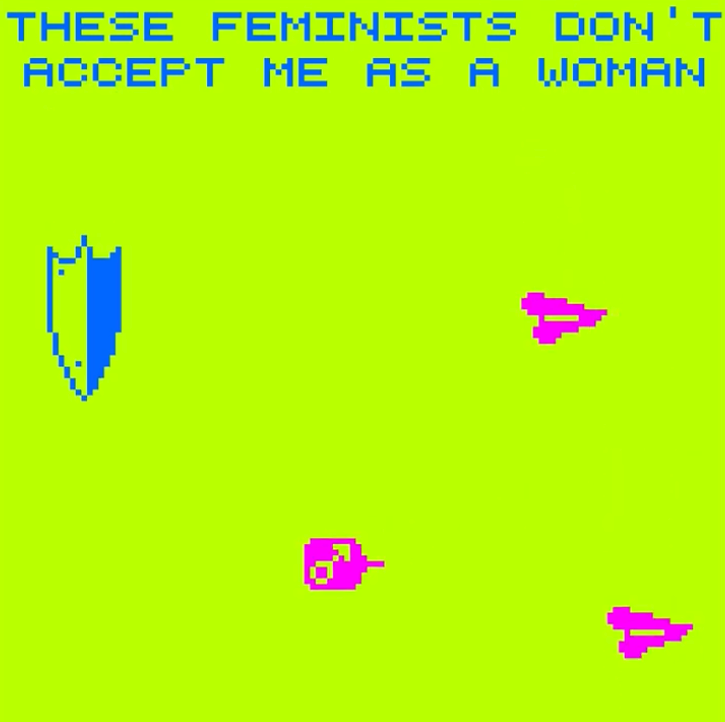
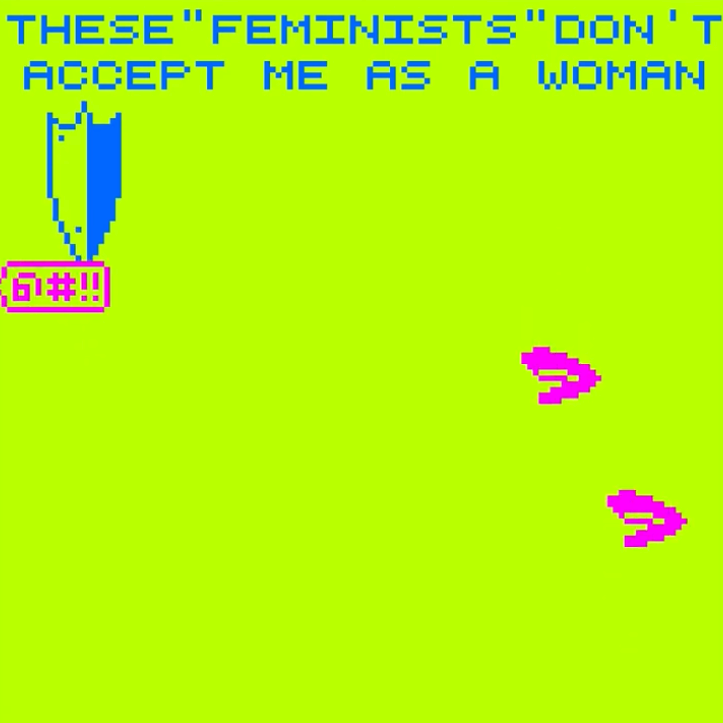
The hypervisibility and forced invisibility show the frustration experienced by Anna Anthropy, which creates the stage for her story. This can be prominently seen in many sections throughout Level 1. Take for example the section where certain feminists don’t accept the avatar as a woman. Towards the end of the minigame, quotations are added around the word feminists to express the tiring toll of hypervisibility.
Also, consider the end of Level 1 where the final moment closes on Anna Anthropy’s reflective decision to go on hormones. From its placement at the end (after expressing various frustrations) and its framing (beginning with a maybe, that can be read as reluctant), it could be argued that this decision was not entirely voluntary, coming from a place aimed at how to avoid the oppressive gaze of others.
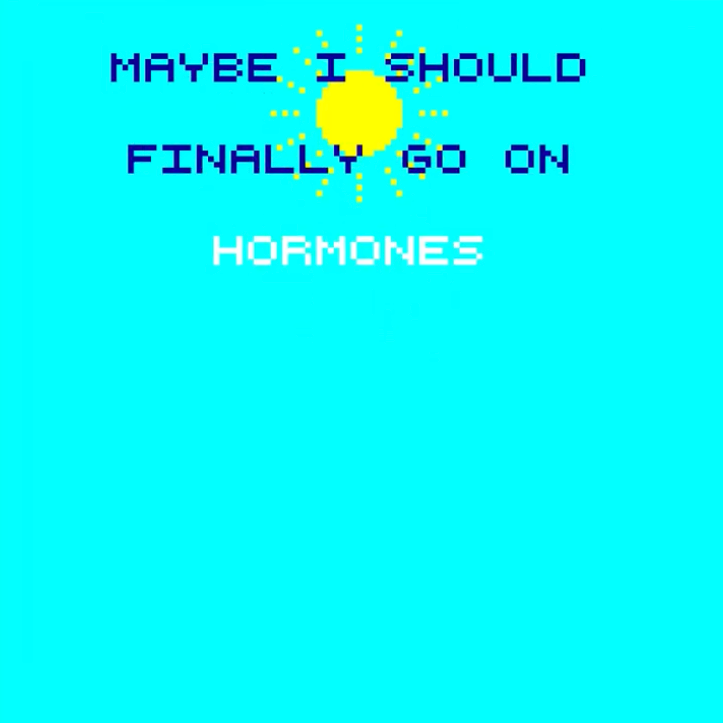
Hence, the intentional decision to limit interactivity through linearity can also mimic the lack of choice felt by Anna Anthropy. It shows how a lack of control over one’s situation gradually inflicts discomfort, and it shows how a person may feel the need to be invisible to avoid the pain of hypervisibility.
While hypervisibility is not the only element that can influence a person’s decision, and while hypervisibility may not affect people to the same degree (if at all), it is nonetheless a possible element to consider.


Hi Aimee, I appreciate you sharing this post highlighting the tensions between hypervisibility and invisibility present in the game Dys4ia. The decision to undergo HRT can indeed be influenced by the discomfort associated with being too visible in the world, of not quite fitting in. Of being called the wrong pronouns and being scrutinized for not passing. Oftentimes, to pass is partially to relieve some of this discomfort and can be influenced by the pursuit of safety. Your post reminded me of my Gender and Sexuality Civ class last year, specifically when we watched the documentary Framing Agnes. This documentary touched upon visibility for trans people and how it can often be a negative thing. We often think about visibility as a positive thing, as uplifting and recognizing a more diverse array of people. However, visibility can also come with a lot of baggage, as you described in this post with hypervisibility. And I think Dys4ia tackles that issue effectively, inviting players to exist in the world as she does–trudging through the discomfort of gazing, doubtful eyes and eventually choosing to bring herself closer to invisibility. It’s interesting because Anna Anthropy provides the players with agency in this game but also takes it away through certain inevitable events, which you highlight while discussing the lack of choice in considering HRT. I concur with you in that the linearity of the game helps take away this agency, or as you say, limits the interactivity. Which serves as an effective element in tackling the tension between hypervisibility and invisibility.
To zero in on a specific section, I really liked your analysis of the women’s bathroom scene showcasing hypervisibility. Personally, I did not even encounter the fail condition on my playthrough, so I did not realize that it immediately leads to a “game over” scenario. It does a really good job of painting a picture of how Anna Anthropy felt in these instances, putting it into game terms that many of us are familiar with, like a game objective of “Don’t be seen” and a loss condition of being caught and scrutinized. The frustration and discomfort that comes about from losing is a great way of eliciting an empathetic response in the player, and it moves the game further beyond simply “winning” and “losing.”
I really appreciated your thoughts on hypervisibility and forced invisibility. I think you put into words quite clearly the experiences that Anna Anthropy was trying to convey throughout the various mini games. To build on your point about hypervisibility in Level 1, where the “feminists’” words attack the avatar, I thought that the visual representation and gameplay mechanics similarly reflected her experience of being hypervigilant about others’ opinions. The avatar itself is not a person, but instead a shield. This visually portrays the idea that Anthropy is forced to put on a strong front, being forced into an invisible, objectified role. This similarly makes the gameplay confusing, as the avatar is a shield; my first instinct was to use the shield to block the harmful words. Only after the avatar began flickering did I realize that I should be avoiding the words instead. I feel as if this is how Anthropy wanted the game to be played – with a sort of planned confusion. The player falls victim to Anthropy’s false front and takes on the role of the oppressor in this sense, pushing Anthropy into uncomfortable situations and forcing her to be strong under the guise of the shield. This way of inviting the player into the situation makes the role of hypervisibility more visceral and real.
Thanks for sharing this—I really appreciate the detail you go into, especially with the section on women’s bathrooms! I wanted to add that another element to consider about ‘hypervisibility’ here is the design of the protagonist’s sprite. Here, she becomes akin to an alien or some kind of octopus-esque creature. Additionally, the color scheme used is very discordant; purple and green are on the opposite sides of the color spectrum. This seems like a literal painting of the deeper notion that runs through the entire game—that the protagonist is separated from the rest of female society, that the rest of society views her as ‘different’ and ‘alien’. Another thing that struck me about the game is that it constantly changes activity without waiting for the player to be ready. This almost paints the author’s experience in that they feel a lack of autonomy over what happens next.
I’d like to thank you for pointing out the different ways the word Feminist is used in Dys4ia. I think your interpretation, that the quotation marks in the word’s second appearance is symbolic of the emotional toll of hyper visibility, is very compelling, but I’d like to offer an alternate one as well. During my play through of this game, I took the quotations to be almost mocking the people who refuse to accept Anna—that they are feminists in self-proclaimed name alone. I think the quotation marks could represent Anna’s self-acceptance as a woman, and as she goes further in her transitioning journey, she realizes that the people she once sought the approval of aren’t worth the time of day.
Having not failed in the game, I completely overlooked the impact of when the situations simulated went wrong for Anna Anthropy. I didn’t realize the bathroom scenario would lead to “Game Over” for example. You have a very strong argument here, I hadn’t thought about the extremes of visibility and how they played into the game. Along these thoughts, I am wondering what it was like to make, publish, advertise, and share this game for Anna. It probably took a very deep and difficult level of hyper-visibility acceptance. I wonder if that also played a role in the design of the game, the bright distracting colors as well.