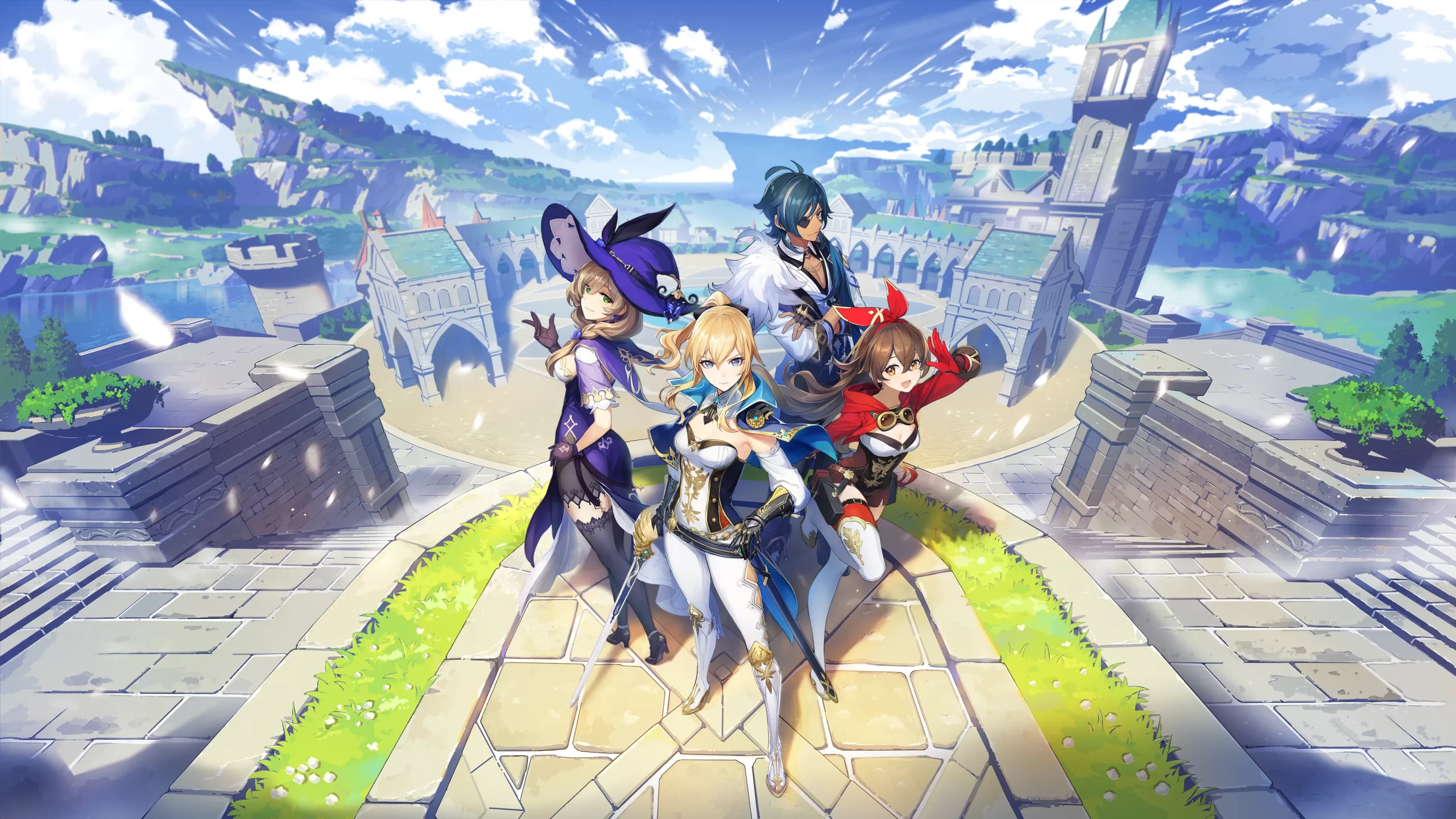
When talking about randomness and uncertainty in games, gacha games are the prime model. The uncertainty clearly manifests in the pull system, where your chances to get the desired character are a gamble.
Because of how obvious the connection between gacha games and uncertainty is, I am electing to not talk about that, and instead talk about something else within a very popular gacha game that relates to this week’s readings.
Genshin Impact is a 3D adventure role-playing game with many different regions that the player can explore to their heart’s desire. When you first start the game, you can choose whether to don the male or female avatar for the Traveler, who will be the main character throughout the story. As you continue to play over time, you’ll gain primogems, the in-game currency, which can be used to pull for other characters.
I am a Genshin player (cue boos). In this post, I want to explore how Genshin Impact undertakes its role-playing aspect, and uncover how its game content encourages numerous unconscious games to unfold between the players.
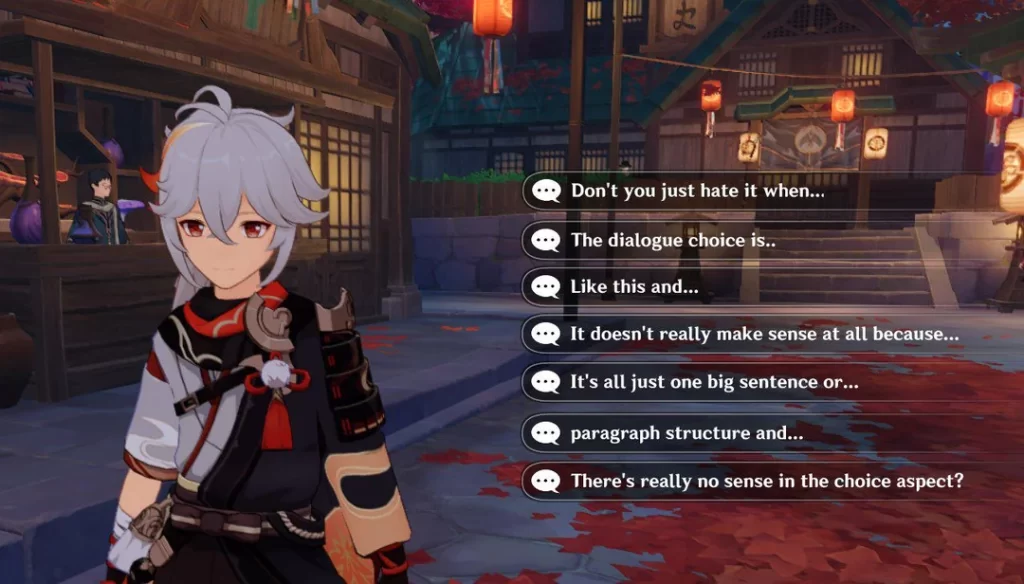
While Genshin Impact may be categorized as a role-playing game, I believe that the player’s role in the game falls under the category of “acting” rather than “role-playing”, considering the definitions outlined in Peter McDonald’s essay Act Natural. Genshin Impact’s story follows a pre-determined script, and your character, the Traveler, merely follows along. The Traveler is not an active character; instead, they seem to happen upon the events of each region by chance, and get swept up into the story rather than making calculated plot decisions to influence the narrative. Furthermore, within the very limited opportunities for dialogue options, your choices are either one or two short sentences that basically say the same thing, and choosing one or the other has no effect on how the story plays out or your relationships with the characters. Rather than having the game be a space for exploration of different possibilities within the story and situations you find yourself in, the story is a rigid script that you have no freedom to deviate from.
I attribute most of these lackluster role-playing mechanics to Genshin Impact’s focus on character marketability. Playable characters never have a bad relationship with the Traveler; if they do, it is resolved through the story before they are released. Additionally, even if a character has a developmental arc within a story, they don’t show visible change in the future because they need to retain their main marketable characteristics. Thus, Genshin Impact’s prioritization of profit causes its role-playing aspects to become overshadowed.
Role-playing comes more into play in the “overworld”. The overworld is the explorable 3D world of the game, as opposed to endgame levels where your characters are used to fight bosses and win rewards. In the overworld, bosses and enemies are significantly easier to defeat, granting you flexibility in which characters or teams you decide to deploy, which in turn affects your combat through different possible elemental reactions and weapon types.
When it comes to unconscious games, Genshin Impact’s co-op system fosters subtextual interactions. In the game, you have a profile that you can show to other players, in which you can display your different character builds, your character roster, the endgame content you’ve cleared, etc. This ability to show off the characters you’ve worked hard to improve creates a sense of competition among players. Whenever I look through other players’ profiles, I always look into their characters and compare their CRIT Rate and CRIT Damage ratios to my characters. This kind of comparison even prompted a third-party leaderboard system based purely on player’s character builds. Your profile and characters become an opportunity to boast your skill and status as a player.
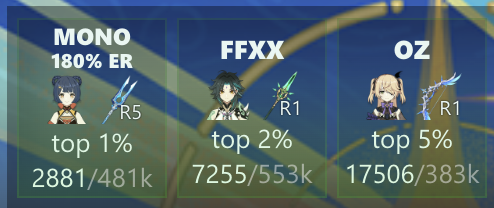
I had to put this here…I have poured my f2p heart and soul into my Xiao build
As the game develops over the years, end game content becomes more difficult in tandem with new characters that powercreep older characters. Genshin Impact purposefully caters the enemies in this endgame content to be easier to clear with the current marketed characters, which incentivizes players to pull for and possibly spend money on these new characters. While the new characters aren’t explicitly stated as a requirement, some content can be significantly more difficult to clear without these characters. Thus, Genshin Impact’s developers are interacting with the players in an unconscious game of “spend money on the new characters, and your life will be so much better.”
However, even with this insidious encouragement to spend money, some players, like me, sometimes enjoy rebelling against this system. If I don’t have any interest in the new characters, I stubbornly continue with my old characters, who have long since disappeared from meta (most efficient tactics available), out of spite for the game’s attempts at persuading me to spend more money. Even if my life would be more convenient with the new characters, this stubborn opposition I enact against Genshin Impact’s systems is more fun than giving in.


I’m glad to see this post, as I considered writing a blog post on gachas this week (but ultimately didn’t). I don’t play ‘Genshin,’ but do play ‘Zenless Zone Zero’ and ‘Wuthering Waves’, with the latter being relatively similar to ‘Genshin.’
The point you bring up about the storytelling is interesting. It’s something I’ve encountered in WuWa, where, once a character’s patch is over, they are rarely if ever heard from again. Even characters that should logically be appearing again (just to give an example, Lupa should be in the hunt against the Dark Tide) simply don’t show up; instead the game always focuses on the character of the patch to the detriment of its storytelling. Even though I don’t come to gachas for storytelling, rather the gameplay and characters, it’s still frustrating for the games to be more concerned with selling you the new character than telling a compelling, or even competently written, story.
Also, the dialogue choice meme is on point. I regularly complain in the feedback surveys about that.
As a person who has never played Genshin (cue cheers), I find this commentary insightful, particularly your point regarding using old characters as a means of sticking it to the game developers and not following their implicit signals to get you to spend money on the game. Finding meaning and enjoyment out of spite is an interesting approach to gameplay, and I’m curious how this “rebellion” of intent can be applied to other videogame formats. Also, your point about the game roleplay being more akin to acting is also very interesting. I agree that dialogue options that have no real sway over the progression of in-game storylines are not truly roleplay, even if they masquerade with the format of typical roleplaying options. It is disappointing to see how profit incentives have impacted the game in such a way where the “choose-your-adventure” component becomes an embellished cutscene. The idea of free exploration was one of the draws of Genshin that almost convinced me to play it when the game first came out, but having read your post I think that the narrative experience they offer is not as interactive as I’d prefer, so I will continue to abstain from playing it (cue raucous applause).
As someone who has played Genshin (cue boos), has since drifted from it (cue cheers), and has recently been considering getting back into it for Flins (cue confused shrugs), I really appreciated your thoughts on this. Like others who have commented already, I have felt the same way about Genshin’s gameplay and have considered writing my own post about it. I have always found arguments against implementing a skip button a little silly – people are consistently bringing up points about how no one pays attention to the “lore” when someone is mischaracterized in the fandom, and how adding a skip button would worsen this. In my mind, Mihoyo not adding a skip button reveals that they themselves understand how weak some of the narrative choices are (especially as you mentioned, the Traveler’s lines). Without forcing someone to sit through the dialogue, they have no guarantee that anyone will pay attention to the game outside of the character pulling aspect. Honkai: Star Rail (HSR), another Mihoyo game, for example, a skip dialogue button was added in one of the recent updates (and I personally have been abusing it to speed through events). HSR falls victim to many of Genshin’s faults as well – but there does seem to be more of a conscious effort to make the choices entertaining, like sneaking in pop culture references and meta commentary by the characters. Ultimately, neither game is great at grabbing players by anything other than character design and gambling-esque mechanics; we’re dragged along by our wallets, and the story is just also there. (Also, as a fellow f2p Xiao main, your build is beautiful)