
During a conversation following the incredibly fun playthrough of Night Trap, a point I had never considered before was brought up: the Five Nights at Freddy’s (FNaF) series could be viewed as an evolution of the basic gameplay of Night Trap. This mildly blew my mind. I grew up being a fan of FNaF, and though I’ve fallen off of the recent games, the originals hold a lot of nostalgic value. I also knew plenty about Night Trap, even before the playthrough. It feels so obvious in hindsight, but I had simply never made the connection.
So that is what I want to consider here: how Night Trap and FNaF work comparatively. For a quick explanation of both games, Night Trap is an interactive movie/video game where the player uses cameras to look around a house being invaded by enemies called Augers. By activating traps in the house at specific times, the player can defeat the Augers and protect the girls in the house. Aesthetically, it is an 80s slumber party slasher. In FNaF, the player is tasked with surviving the night by keeping watch of and protecting himself from Chuck E. Cheese inspired animatronics. The player has a limited power supply, which is used to check the camera, close doors so animatronics can’t get into the office, and turn on a light to check if the animatronics are outside.
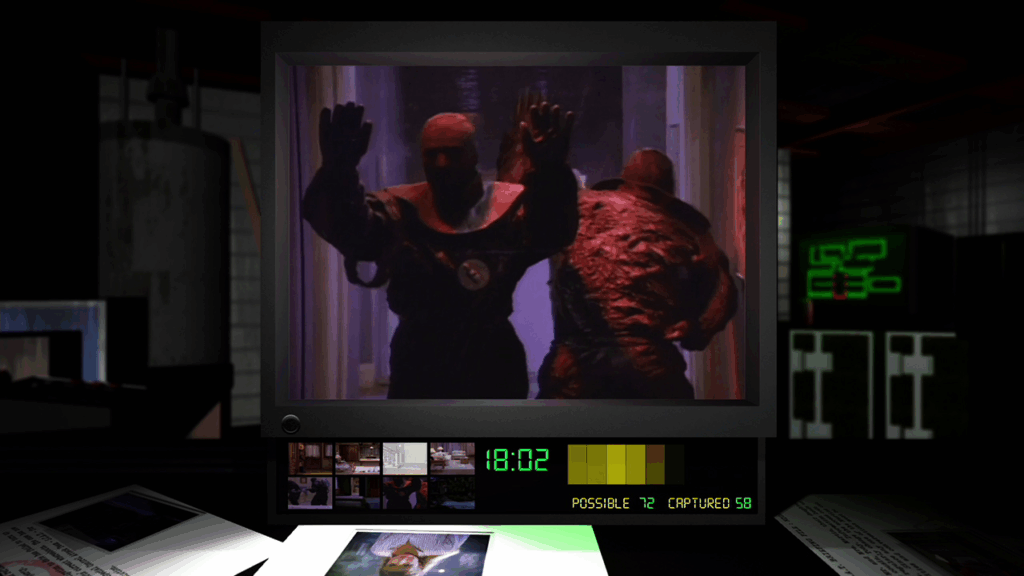
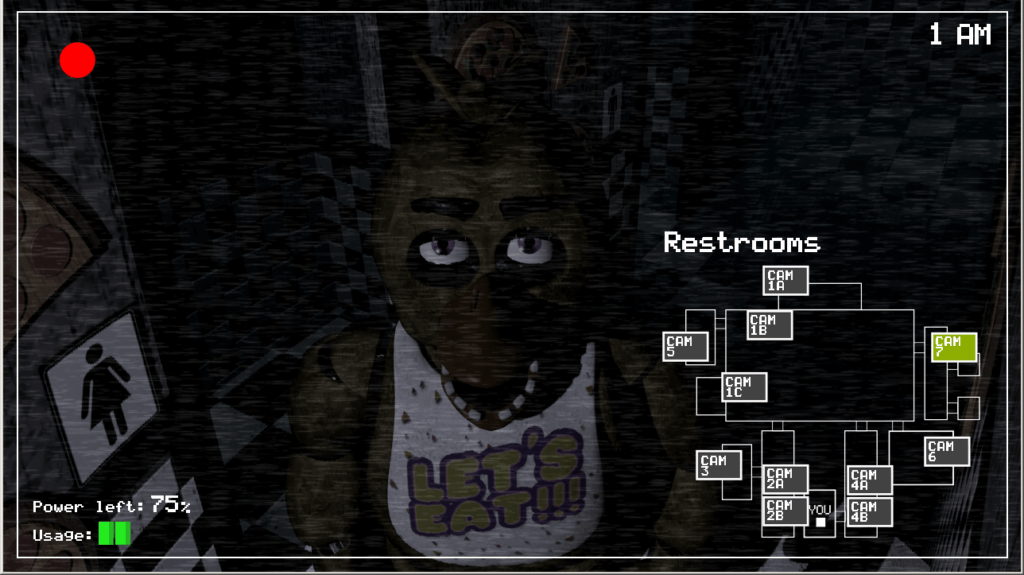
To limit the scope of this post, I am only going to look at the first FNaF game. There are plenty of interesting things to say about the later games in relation to this topic, including the removal of the camera system in the fourth entry, but the first game provides fertile enough ground for discussion. Also, my focus will primarily be on gameplay, not aesthetics. I love the aesthetic of FNaF, particularly the first entry, and Night Trap, for as cheesy (and fascinatingly controversial) as it is, is fun, but the aesthetics are less ripe for comparison than the gameplay.
The primary issue with Night Trap, as I see it, is that the game relies heavily on trial and error and stringent execution, but makes neither of these “fun.” As was shown during the playthrough, in order to “beat” the game, it must be mapped out with timing down to the second to know where each and every Auger is and when they need to be defeated. The only way to map all this out is to play the game over and over, or look up a guide by someone who has. Once that is mapped out, then it’s simply a matter of execution. The “gameplay” is just switching to the right camera and pressing the button at the right time; they’re glorified quick time events, except that each one is like a secret that the player must find. Additionally, with the exception of the color codes, each run is exactly the same. I would argue that this is fundamentally poor game design in both function and fun.
So, what does FNaF change, and is it better? Instead of a hundred Augers to catch, FNaF has the player track four animatronics: Freddy Fazbear, Bonnie the Rabbit, Chica the Chicken, and Foxy the Pirate. Each of these animatronics has their own associated mechanics: Bonnie will attack from the left, Chica from the right, Foxy needs to be consistently checked on at Pirate’s Cove, etc. The game introduces these mechanics over the five nights, which nicely spreads them out and lets the player get used to each of them. The animatronics will also act with some randomness, while still staying confined to certain broad pathways. Each run is then different, but the player can also learn what to expect and adapt to the randomness from there.
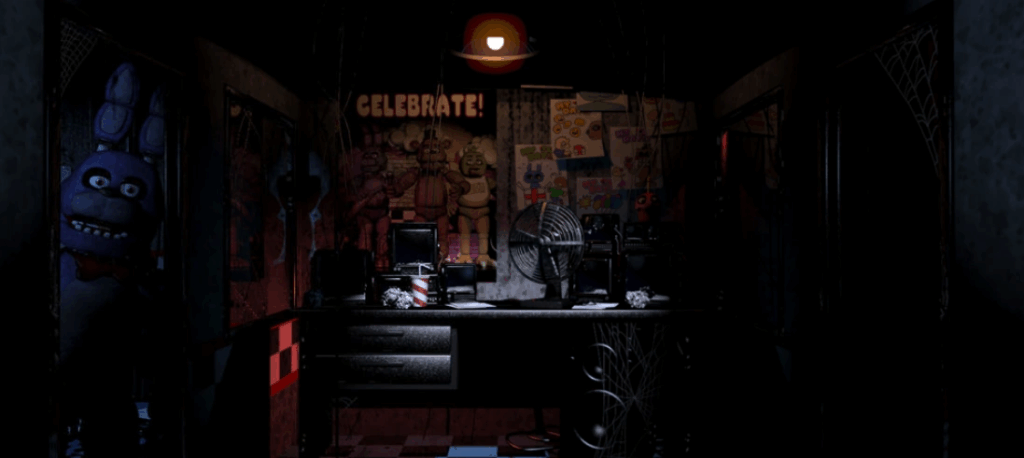
With the need to switch cameras and capture Augers, time is a precious resource in Night Trap; in FNaF, power takes over that role. Even when the camera and doors aren’t in use, power is passively draining. The doors are the only thing keeping the animatronics out, so a power outage usually signals death. The task, then, is to track the animatronics’ movements so that the doors can be strategically shut to block them off while conserving as much power as possible. Time still matters in FNaF, since the player must survive for roughly nine minutes, but there are not timed events in the same way.
Are these systems better than Night Trap‘s? I would argue yes. They ask the player to be more directly engaged with the game by tracking the animatronics randomized movements and managing their power instead of requiring strict adherence to a schedule that must be constructed. It expects the player to play the game instead of solving it and then executing the solution. The gameplay itself isn’t more engaging than Night Trap’s—it’s a point and click—but I would argue it does improve upon Night Trap’s fundamentals.
The problem is that the game is kind of broken. In 4/20 mode, where all the animatronics’ aggressiveness is at a maximum, there is a strategy that is essentially necessary to win. It requires very little engagement with the game’s mechanics, only checking the doors and one spot on the camera. The infamous run of Markiplier beating 4/20 mode is a perfect demonstration of this:
Since this strategy is optimal for the highest difficulty setting, it works for lower ones too. It’s certainly not necessary to beat the five main nights, but it would certainly work. This makes the game much more akin to Night Trap’s stringent requirements for victory than the more engaging, varied gameplay that was initially presented.
So, for a casual player, I would certainly argue FNaF is better. There is no real “casual” way to beat Night Trap, and FNaF will offer a more directly engaging experience. But when optimized, they’re much more similar. FNaF doesn’t require a mapping out of where to be at what time; instead, the player must loop through a sequence with minor adjustments based on when the animatronics show up. FNaF is arguably more mechanically difficult than Night Trap, but playing with this strategy forms a rhythm, which will certainly help ease the difficulty. Still, while FNaF has solved some of the problems of Night Trap, like the mapping, it introduces its own problems while still leading the player to play a largely predetermined game rather than one they are more actively engaging in.
What I found most interesting about the comparison, though, is that the gameplay style of Night Trap didn’t die with it. It’s certainly different in FNaF, but they are similar games. Considering the explosion of popularity FNaF experienced, with the movie alone making nearly 300 million at the box office, and the sheer amount of fan games, it suggests that Night Trap was ahead of its time in many ways. It pioneered a gameplay style that would go on to define one of the most important indie games of the 2010s while also managing to find an audience before Congress. In so many ways, Night Trap is a fascinating object of study and is truly a game worth experiencing despite its design flaws—especially when played on the Nintendo Switch, where it was never meant to release.


.png)
First, amazing pun.
Second, I really like how you compare the mechanics of these two games and how you argue that Night Trap’s main mechanics didn’t die with it. It reminded me of my comparison of the film played before the Night Trap screening and Telltale’s games.
I’m also a pretty big FNaF fan and I’ve never heard of Night Trap before, but I thought your comparison of the two was really interesting. I agree that FNaF’s randomness of the animatronics makes the game more enjoyable than Night Trap and I also think it makes the game much more replayable. Rather than being forced to play a game over and over again until the player gets a singular strategy to beat the Augers, there’s more room for different strategies in FNaF, and there isn’t so much that strategy finding and simple execution that you mentioned in regards to Night Trap. Another part of both games that I find interesting is who the player is playing as. In Night Trap, the player seems to just be an observer trying to save others, but in FNaF, the player character is actively in danger and they’re trying to save themselves. I wonder how that affects the player’s experience.
I think a charm that FNAF as a game has is its section of the community that really focuses on the gameplay of the games, people who like FNAF not just because of the jumpscares, lore, or whatever but also its mechanics, these are the type of people who play hours on end trying to beat some max mode that is literally designed to be almost impossible to beat (infact when Scot Cawton first made 4/20 mode, he thought that it was physically impossible, we’ve come from a very very long way). So while I do agree that in their most base forms, perhaps Night Trap did implement its mechanics smoothly for your average player, I believe that there’s always going to be a niche in these games where some people really love certain janky parts.
It’s so interesting to note the similarities in both games, and how FNAF drastically improved the mechanics of Night Trap. I wasn’t able to make it to the Night Trap screening event, but based on how you described the mechanics, there only ends up being one “correct” way to play the game every single time. There is no player adaptability or randomness in the games, which is what makes up the fun in a lot of games, so there would also be no replay-ability.
Although FNAF’s mechanics become simpler as you become a more hardcore player, I think the reason the gameplay is still so engaging is because the player learns these tricks and shortcuts through experience. FNAF 1 still uses randomness to maintain suspense and make sure that each playthrough is unique, and for the highest difficulty of custom night the tricks still require skill to succeed. I recently watched a video explaining why FNAF Sister Location was much more lackluster in terms of gameplay compared to the other games in the series, and lack of replayability was a huge factor in Sister Location’s flaws.
Either way, let’s thank Night Trap for paving the way for FNAF to absolutely transform the games industry.