
“Children use games that imitate war or play “house” to mimic the adult activities for which they must ultimately prepare; ergo, Civilization IV or World of Warcraft (WoW; equal to war games) and The Sims Online and TirNua (the virtual equivalent of playing “house”) can be said to have obvious sociocultural and educational affordances for the simulation of, enculturation to, and learning about adult activities.” —Young, Our Princes is in Another Castle, p 63
Set in modern LA but created by Capcom, a Japanese company, Phoenix Wright: Ace Attorney (PWAA) is a visual novel adventure game where you play as Phoenix Wright, a rookie defense attorney that must defend a host of colourful clients. While not meant to be a wholly accurate depiction of a career in law, it would be foolhardy to deny the cultural impact that PWAA has had over several years, alongside its subsequent sequels / prequels. This notion raises the question: does PWAA’s fictional depiction of law and order in America help or hurt the subconscious opinions that players go on to have about real law practices in America?
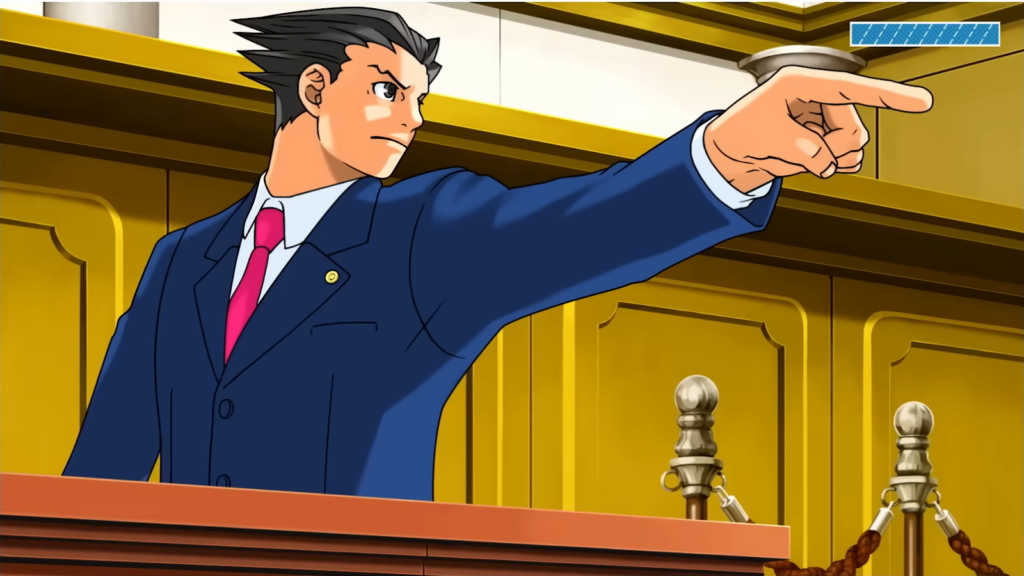
Phoenix doing his signature ‘OBJECTION!’ pose.
Paraphrasing from a Reddit post, as well as some academic analyses of the game, PWAA is—to cut a long story short—horribly inaccurate when it comes to a realistic representation of the American law system. Additionally, this YouTube video showing a real lawyer playing PWAA nicely sums up some of the more obvious inaccuracies of the game; from Mia’s slightly inappropriate outfit to the complete and utter absence of a jury for every single case you take on, PWAA shows a highly dramatised and inaccurate vision of what real American courts of law look like.

A rather absurd screenshot from PWAA’s 4th Episode: Turnabout Goodbyes
The first example, that is discussed several times in the YouTube video, is that the burden of proof does not fall on the defense, but on the prosecution. Only when the prosecution has proven beyond all reason of doubt that the defendant is guilty will the judge pass a guilty sentence. It is important to note, as a counter argument, that the game has this notion of ‘burden of proof’ falling on the defense (as well as the quick trial turnaround) due to the Japanese law system’s high conviction rate and rushed trials.
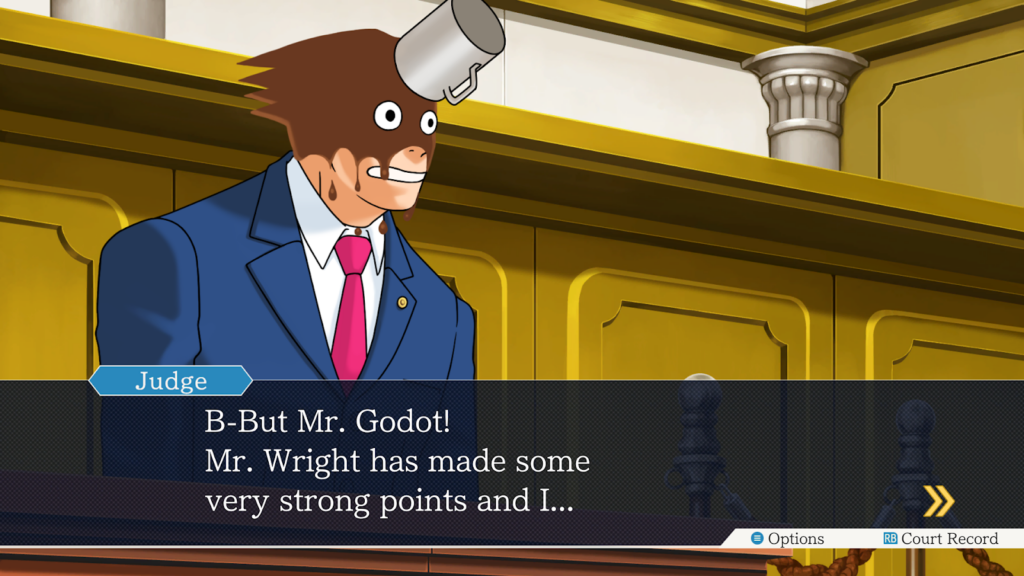
Poor Phoenix often does not get the credit he deserves, considering that he shouldn’t be the one proving innocence or guilt…
Additionally, both the prosecution and the defense will have all the evidence needed before going into a trial. In other words, there is no room for surprise evidence (Edgeworth, I’m looking at you!). Furthermore, both parties will be thoroughly prepared prior to engaging in a trial. Defense attorneys do not “guess” their way to the “right” answer; rather, the prosecution must prove beyond a shadow of a doubt that the defendant is guilty, whereas the defense must know the case well enough to poke holes in the prosecution’s reasoning.

Phoenix is often sleuthing his way to the correct answer… something that would never happen in a real court of law.
It would be remiss not to acknowledge what PWAA does get right, however. It is indeed possible to defend oneself and waive the right to an attorney, conditional on the judge’s approval. This happens in the second case of the first game, Turnabout Sisters. Additionally, defendant do occasionally disappear prior to a trial in real life as well as PWAA.
So, where does this put us? While PWAA is a fantastic game series, its likeness to the real world of law and order is rather slim. Though the game is not framed as an educational or serious game, its impact on its players is remarkable. My cousin, an undergraduate at Cambridge, is studying law—in part, because of Phoenix Wright. She grew up playing the games, fell in love with the characters, and even still listens to the game soundtrack while she studies. For her, Phoenix represents a dogged determination to succeed, even when the odds are not in his favour.
I believe that Phoenix Wright, while a terrible representation of the real law system, has what most (if not all) lawyers aspire to: a strong sense of justice. It is the heart of the character—not the mechanics of the game, or the logic of the worldbuilding—that drives players to look at law from a different lens. To put a long story short, yes, PWAA makes a mockery of the American law system… but it simultaneously inspires entrants to that very same system. PWAA is not about accuracy of law, but accuracy of the hearts of lawyers.