
Yesterday, I played through the entirety of Dispatch in one sitting. I really enjoyed the gameplay, and I’m looking forward to revisiting the game to try out different choices. However, something about the way that the gameplay and the narrative meshed together didn’t seem right to me, and I found myself generally unsatisfied with the ending. I thought back to our discussion of video games and neoliberalism, particularly the discussion surrounding simulators of different kinds of labor. Dispatch bills itself as a workplace comedy, with the workplace being a model of office life. However, Dispatch’s gameplay exposes the precarity baked within the corporate ladder and the ending leaves it unresolved, which ultimately offers a more normative view of the efficacy of corporations. There are spoilers ahead, and since this is a recent game I wanted to warn you before you continue~
The central gameplay loop of Dispatch involves managing a team of superheroes as they tackle various calls from members of a superhero service. Already, this feels dystopian—public infrastructure is so non-existent in a world of superheroes that you need to subscribe to a private corporation for help from superpower-induced disasters. The gameplay is quite stressful—you never have enough heroes so that the time limits are comfortable, which introduces a lot of tension. Also, your heroes’ professional development (leveling up) only occurs when they are successful during a call, so sometimes you send one of your heroes and they don’t even level up. Experience, in this case, is not enough for “experience points.”
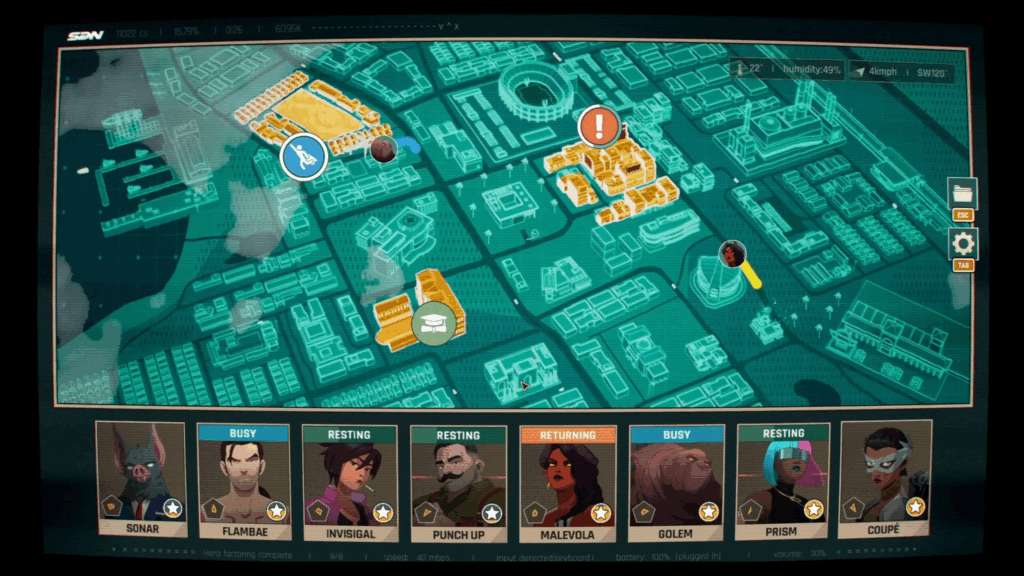
Image from gam3s.gg “Dispatch Superhero Team Management Guide”
Robert, the main character, visibly struggles with his responsibilities as a manager. We see that he tries to read about leadership strategies outside of his work, but nothing comes of it. Meanwhile, the expectations placed upon him get larger and larger, with very little support from upper management. One of the most difficult parts of the game comes early, where your boss actively makes your job harder by forcing you to cut a superhero to “send a message.” This is never framed by the narrative as being a terrible idea, even though it is. It also isn’t the thing that forces the Z-team to become more cohesive; Robert only achieves team synergy by understanding them as people. However, the corporate structure of SDN doesn’t see people, only output, which leads to either Coupe or Sonar being cut.
None of these power structures are radically different by the end of the game. Even after becoming almost completely overwhelmed by the opposing supervillain forces (I was only one failed call away from failing to protect LA…) the game’s text does not acknowledge the fact that SDN’s structure is itself non-conducive to growth of the team.
Dispatch’s central conflict is itself a question of labor, that is—is Shroud correct for saying that the Astral Pulse belongs to him? According to him, Robert’s father did not uphold his end of their deal by failing to create a mech, which is what sparks his descent into being evil. There are parallels to be made by his feeling rejected by this and the ex-supervillains feeling rejected by SDN, but the game does not follow through on this message because the corporate structure returns to the status quo. In this way, Dispatch is more of a job simulator than a narrative-centered game at times, because the narrative has no effect on the structure of the job you simulate. I feel like this was a huge missed opportunity, and I think the characters (specifically Robert, who is our point of view/audience self-insert) could have pushed against the structure of the company.
Cover image comes from u/DeleriousBeanz on r/DispatchAdHoc


This game sounds really interesting. It seems to subvert expectations of the superhero genre by grounding the internal conflicts in real-life workplace politics. It reminds me of the Justice Gang, funded by Maxwell Lord, in 2025’s Superman movie. I agree that the game would be more impactful if it fought the status quo more directly rather than just illustrating it. I read that they want to continue the game, so hopefully that’s something that will be addressed in the second season of the game.
i do think that the gameplay of dispatch is more similar to other job simulation games than it is to narrative-driven games, but i don’t agree with the claim that the narrative has no impact on the structure of the job you’re simulating. the first example that comes to mind is the morale mechanic that comes up after you cut either coupe or sonar from the team. the feelings and emotional state of z-team has a HUGE, nearly frustrating effect on the gameplay because they’re pissed at robert! no one wants to do their job, no one is working together, and if you make the wrong match up, some of them will even sabotage each other! i do agree that dispatch is a game about labor, especially because the background narrative of the game seems to follow that of the tabletop roleplaying game, masks: a new generation: superheroes appeared many generations ago, and have grown and developed over that time such that Being A Superhero has become a job, an industry, a business. but dispatch isn’t a story about SDN, it’s a story about the rag-tag group of disasters and disappoints carving out a space for themselves in that corporatized space; in that way, i feel like the gameplay is doing a lot to help tell that story.
Ooh I like the idea that the narrative and main part of the game distracts from the seemingly nonsensical workplace environment, in turn kind of allowing it to be normalized? When I played I was so engrossed in the story (and the heinous writing for Invisigal FIGHT ME) that I didn’t really think of it as a job simulator, which you made me realize it is!! Just with some really crazy HR violations, lol. I intentionally kind of zoned out during the management part and focused on the emotional aspects. I also want to comment on what @mminter brought up, the concept of Dispatch as a representation of alternative types being squished into a corporate space, as you call it, was eye-opening. Especially when the conflict is a corporatized version of familiar comic tropes – Shroud’s business-like deal leading to his non-corporate evilness.