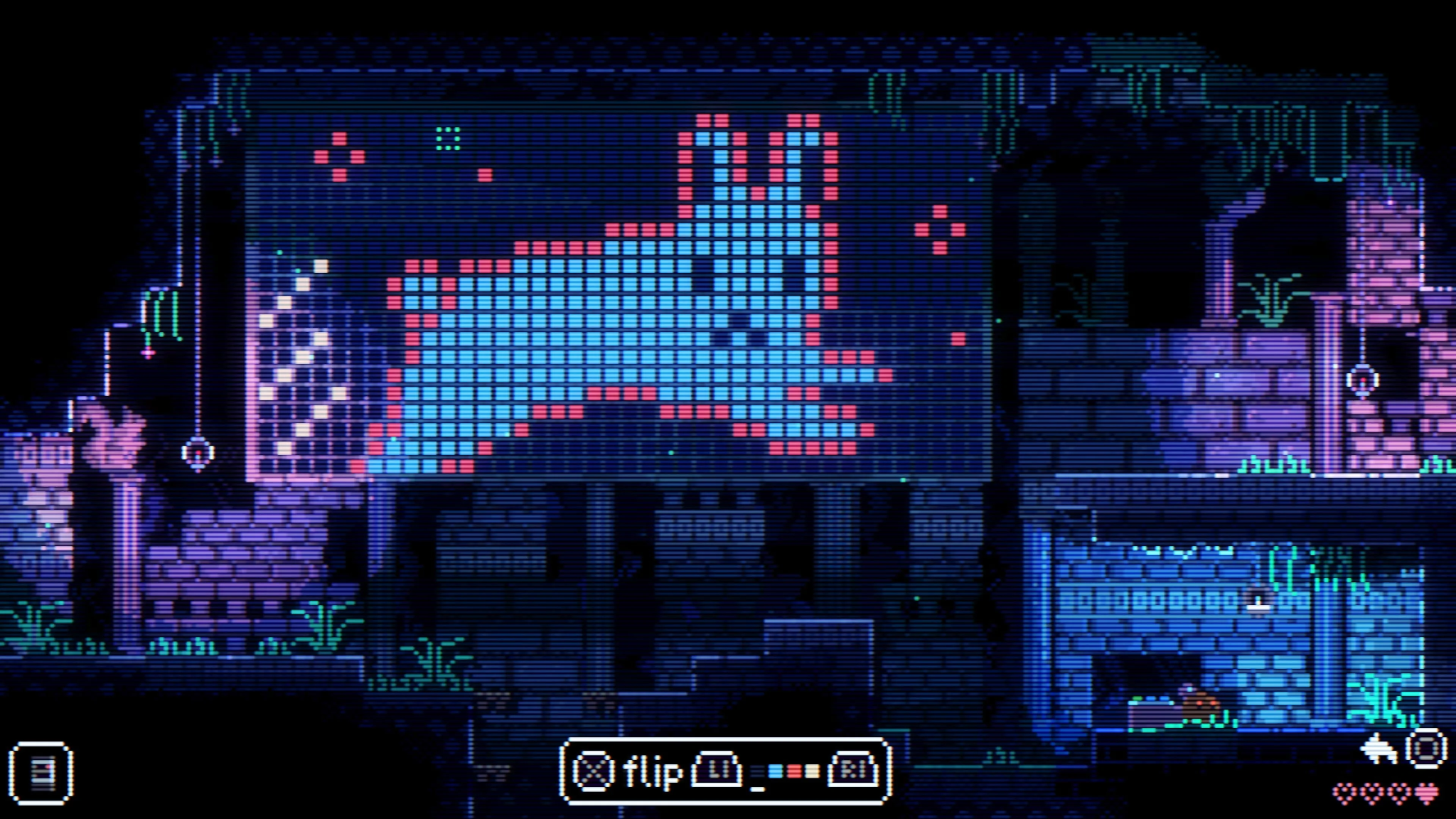
I went to the panel on Difficulty in Games, and I was really struck by what Billy Basso said about the tile bunny puzzle from Animal Well—
He remarked that this was the only rabbit that could be solved through “outside help” since 50 unique copies of the game need to be combined to solve the puzzle.
His discussion of the game was really interesting because it highlighted some of the tensions between our definitions of puzzle vs. secret vs. collaborative work. I think when thinking about designing your own game, these sorts of questions are worth dwelling upon. Without directly talking to the player about how they should interpret some of the ‘collectibles’ in the game, how can one communicate a specific affect?
I’m reminded of this because I was an incredibly basic Animal Well player. I beat the manticore, I got some eggs, but then I was sort of done with the game. My boyfriend, on the other hand, was DEEP into the Animal Well. All he could talk about was eggs, and when the eggs were all collected, it was rabbit time. He became obsessive, laser-focused on the bunnies, nothing else seemed to matter to him. And when the rabbits were all found, what else could there possibly be?!
This was a wildly different experience than what Billy Basso said during the panel. He said that he designed the puzzles and the game in a way that didn’t need to be completed, or totally “beaten.” He imagined two friends who both played the game and stumbled across different secrets, and then talked about them in person. Instead, the community has compiled solutions, guides, and much more in the quest for bunnies. You can spend no time at all noticing the atmosphere of the game, or subtle hints towards bunnies or eggs, and completely finish the game. Now with things like steam/xbox/playstation achievements, games tell you when they are totally finished. Sometimes if I haven’t totally 100% beaten a game, I feel like I’m not a real Game Player. Completionists may artificially inflate the difficulty of the game, but I am afraid that it comes at the cost of a more organic-feeling playthrough. I think both styles have their merits; I am always incredibly proud of myself when I have 100% beaten a game. I think I’m imagining an alternate world, without achievement markers, where the air of mystery surrounding a game is permanent. You never know when it’s truly been beaten, but you feel comfortable putting the game down at 99%. In that way, the difficulty never becomes “unfair” because the expectation of total completion is out of the picture.


This is a really interesting examination of the completionist mindset. Some secrets aren’t meant to be found by everybody, but we have a drive to find them anyway. I wonder if that is special to game players or part of simply being human?
This post reminds me a lot of how it felt to grow up with Five Nights at Freddy’s—as off topic as that might sound. I loved the games with my whole heart in elementary school, but I was also an 8 year old who wasn’t very good at video games. The main appeal for me was the mystery; it was coming home from school to watch Game Theory try to make sense of a game whos story was being written as new installments were posted. I was never good enough to beat the games, let alone 100% them, but I was content with watching other people beat them and piecing together the story with that degree of separation. Its probably because I liked the games from a story element, rather than a gameplay one, but I think the community aspect of 100% completing games can be a valuable asset. You don’t need to be the one completing the game to feel connected to it, at least in my case.
I really like how you frame the difference between curiosity and completionism in Animal Well. The way you describe your own experience versus your boyfriend’s really captures how different kinds of players can interact with the same game. The point of playing games is less about completing the game and seeing the end screen, and more about bringing people into a community in which they are able to share the mysteries and joy of playing.
I agree that achievements and completion goals really change how we experience difficulty. Once a game starts tracking progress for you, exploration can start to feel like a to-do list instead of an adventure. The sense of mystery turns into something to “finish” rather than something to linger in. I really like your point about feeling comfortable putting a game down at 99%, it creates a space where players can decide for themselves when the experience feels complete.