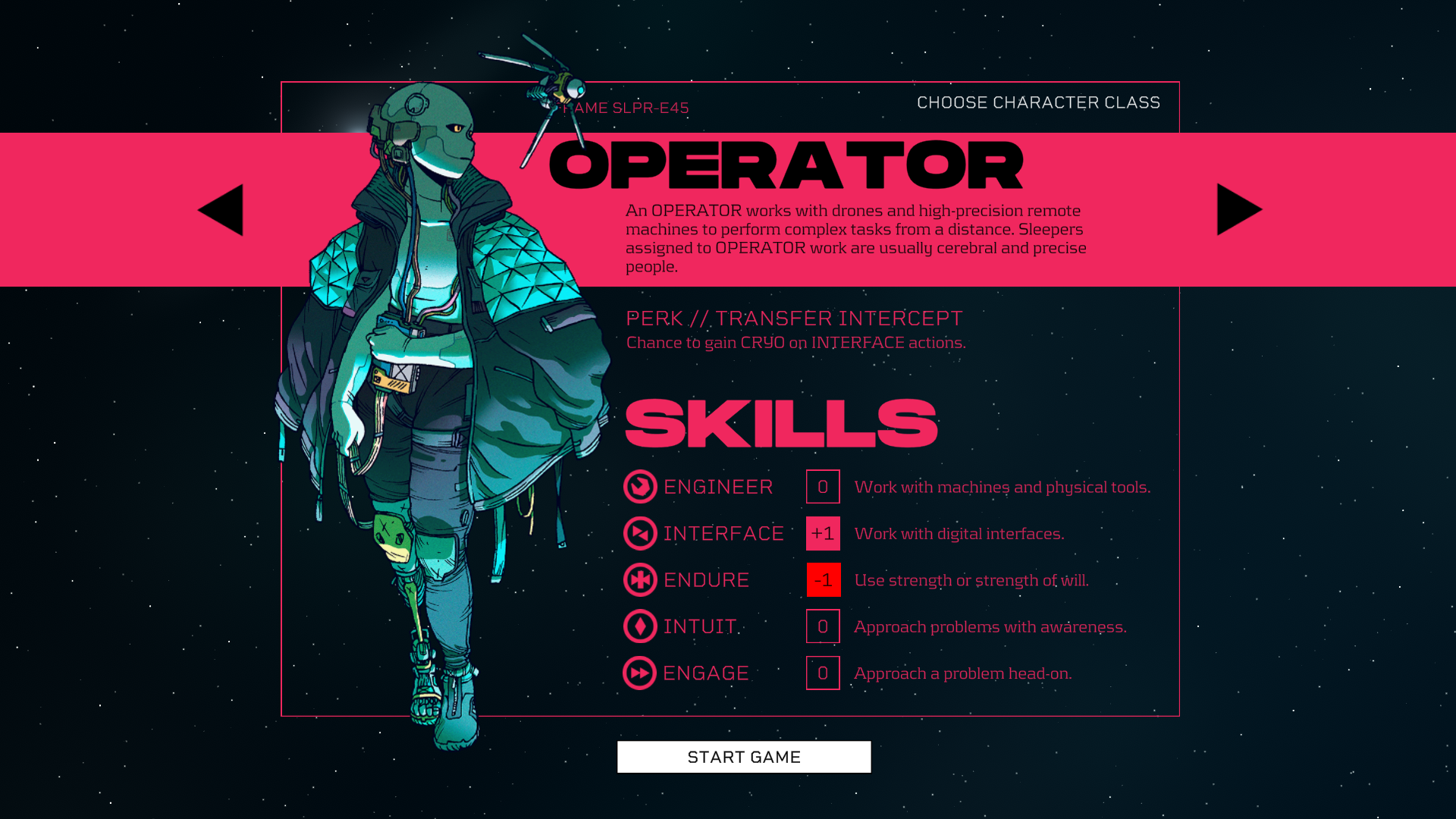
I want the game Citizen Sleeper to be as good as it can be. When I first played it back in 2023, I fell in love with the art style, the clean dice mechanics, and all the different characters that you meet. While some people critize the game by saying that they did not connect with any of the character and did not appreciate the story of the game, this was not the case for me. I thought it was very interesting to see a variety of responses to the situation of “life in an abandoned space station,” and to get to know the colorful cast of characters. The different tales of hope, finding a new home, and connecting with family (blood or chosen) did geniunely affect me and spurred me to help as much as I could.
Additionally, the game has a really clean set of mechanics, where you roll one to five dice each day based on the physical condition of your body and then are able to perform that number of actions, where the higher your dice roll is, the higher the chance of success. This neatly ties into the constantly decaying body of the Sleeper (the player character), allowing you to do more the healthier that you are, as well as letting you choose what to prioritize with your high dice rolls and where to attempt a greater level of risk. Lastly, the background music is subtle but lovely, and the sound effects are some of the best that I’ve experienced in a game. I really do like this game a lot, and I wish I could say it was a great game, BUT…
SPOILER WARNING: If you continue to read, I will be discussing various occurences in the story of Citizen Sleeper, as well as showing images, some of which may contain end game content.
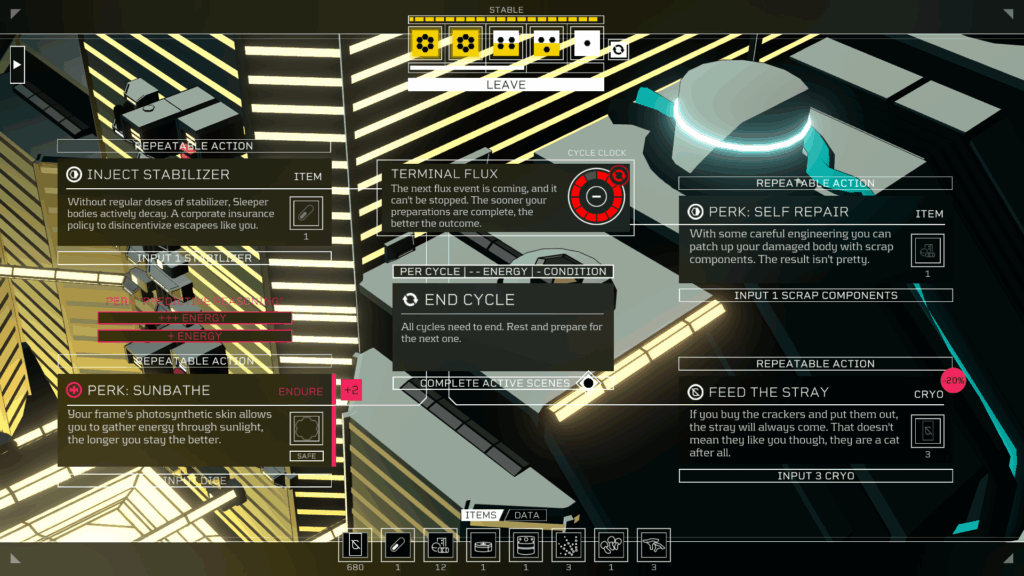
But your actions don’t matter and the game shies away from the most intense and interesting concepts it introduces. That’s a pretty big accusation, but hopefully you understand that this critique is coming from a place of love, based on my words above. So let’s get into it. In my experience, the Sleeper’s dialogue is entirely cosmetic. For the most part, this is fine and lets the player roleplay the type of sleeper they want to be. You never change the direction of a conversation or its outcome based on what you have the Sleeper say, and the player quickly adapts to this. However, there is a total lack of choices that the player has with how certain storylines resolve. Let’s look at two examples, one from the midgame and one at the very end of the game.
In the midgame, you come across a mercenary named Ankhita with a broken ship, whose partner Ashton sabotaged the ship and abandoned her for some reason. You decide to engage with her storyline and begin helping to fix the ship. At some point, you run into Ashton and find out that he had stolen technology from the ship to help a fellow sleeper like you (sleepers are indentured servants whose minds have been placed into robot bodies). I, like many other players, found this understandable and hoped that the sleeper would be saved. However, this is where the game presents you with a choice. You can either inform Ankhita as to Ashton’s whereabouts or not, knowing that she is quite mad and could retaliate. No matter what you decide, Ankhita will show up either way and the encounter ends with her shooting Ashton and the sleeper remaining dead.
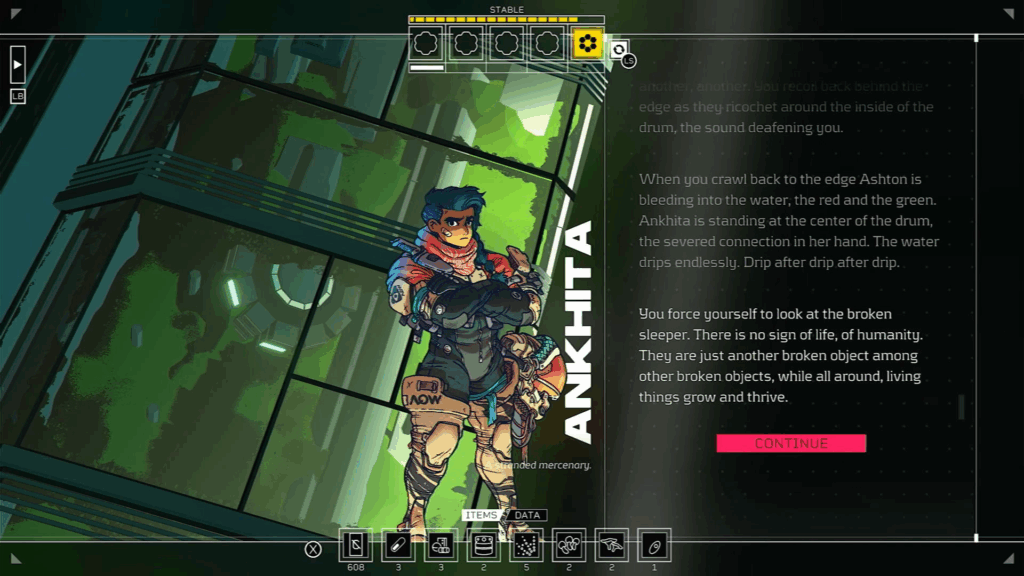
I was very upset at this interaction, as I had completed every action at my disposal to prevent death of Ashton and the sleeper. But unless you decide not to engage with Ankhita’s storyline, this encounter always ends the same way. For a game that is supposedly about choice and roleplaying, this encounter was very linear indeed. In fact, to my knowledge, you can only make game altering decisions when deciding which ending to complete and whether you leave the Eye (your space station) or not. To make things worse, not only can you not chose how storylines in the game evolve, but where you spend your dice becomes trivial once you get into the midgame and no longer struggle for money or medicine.
At the very end of Citizen Sleeper, the Eye is facing a virus that would destory all its essential systems, killing all residents, and the game proposes two potential solutions: you could flee or you could try a crazy plan to capture the virus using a mutated AI. I chose to attempt to save the Eye and was told that the faster I completed all the tasks, the better the outcome would be. And yet, after completing 90% of the preparations for this crazy plan, I was told to help out the folks trying to flee as well, because they could not be jeopardized by this crazy plan. So I had to help out with the flee solution as well, despite having decided on the other solution as a player. I completed these preparation in record time and was ready with two full days before this virus was supposed to hit. And yet, when I advanced to the next day, the game did not reward me for being so quick, instead it made me wait a full day doing nothing, until the second to last day when the crazy plan was enacted. So it would not have mattered how quickly I had gotten things done, the plan would seemingly always be enacted on the second to last day. So much for my dice rolls and choices of what to priotize mattering.
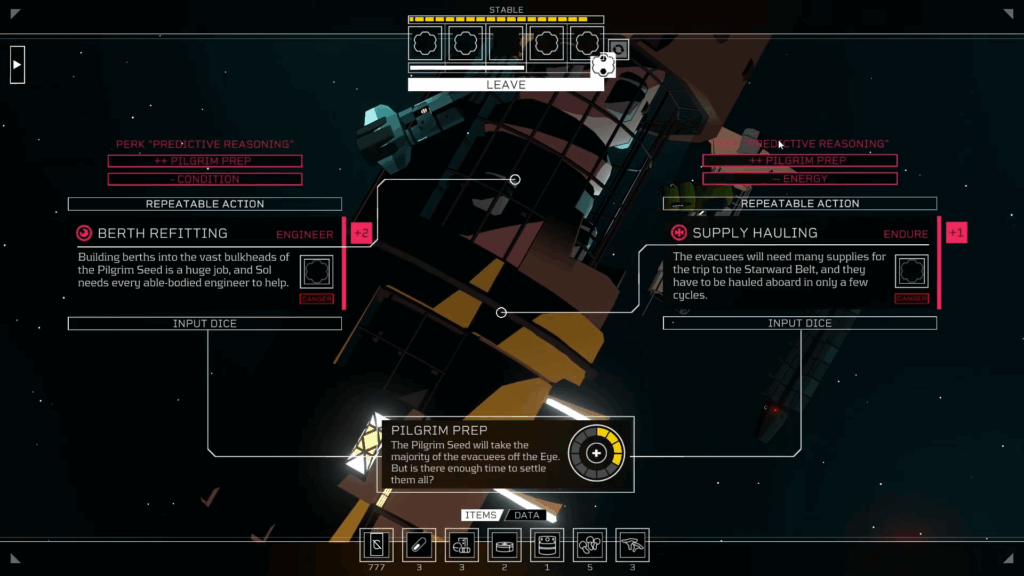
In a way, Citizen Sleeper is more like a visual novel than an RPG. A final part of the issue with this is that the player gathers so many upgrades throughout the game that the Sleeper becomes so powerful that every dice roll is massively stacked in your favor. Most abilities will have a +2 bonus (and at least a +1), and you can reroll bad dice once in your action bar at the top. So the dice rolls already trivial to the story of the game are further trivialized mechanically, removing all but the smallest amount of risk when playing. A fact that further emphasizes this is that you can complete all content (minus the ending text for all endings) in one playthrough of the game. I don’t care whether games offer replayability, but it is a core part of the RPG experience, due to the story choices inherent to that genre.
Finally, one more criticism in an already too long blog post: Citizen Sleeper does not explore its most intense and interesting concepts. This technically deserves its own blog post or even video essay, but I will touch on some of the details. One thing you may have noticed is that I mentioned that sleepers are indentured servants. Holy shit! Yes, this game does have some dark themes, especially regarding capitalism and how that system values (or doesn’t) human life. But indentured servitude is still on the more extreme end of this. Also, given that your brain was planted into a robot body, does that mean that your brain was planted into multiple robot bodies, meaning that you would have clone siblings throughout the galaxy? The game never touches on these details or tackles any of the truly hard topics beyond “look at the costs of rampant corporate greed,” which I think is a shame. It had such an excellent premise and world set up, but only goes halfway in exploring it. This is where I understand the narrative critiques of other players, though I still found the characters in the game to be compelling. But clearly I and many other players had deeper thoughts and questions that the game just did not want to engage with. In fact, sometimes Citizen Sleeper almost starts to lean into the cozy genre, which is an odd choice for a truly cyberpunk game.
So where does this leave us? In my opinion, this leaves us with a lovely game that had so much potential and yet failed to live up to all that it could be. I think Citizen Sleeper is an excellent roadmap on how to execute a game, because it is so obvious what the goal was, even if it wasn’t truly achieved. The game also provides some excellent lessons in design, as well as a sleek core mechanic that one could easily steal for their own game. Even though I just ripped apart the game pretty hard, I still think it is quite good and highly enjoyable. But I also am left wondering at all that which could have been.


Playing Citizen Sleeper for the first time this week, I initially enjoyed the ability to select a character and the sensation of gambling on actions. At the beginning, I felt the impact of needing to decide between food and medical attention and money in a way that I feel is often not reflected in other sci-fi media. For example, in Star Wars I never fear for if the rebels or refugees are getting enough food or running out of money, which makes the stories more distant to me. Whereas in the game because I was the agent making decisions I became keenly aware of scarce resources.
Like you explained though, I felt overpowered quickly to the point where actions felt trivial. If I chose to wait to do an action I wouldn’t face any repercussions. If I got lower dice, I would just use the numbers to gain intel which generally used lower numbers.
Overall I also liked the plot and the diverse characters, but I felt like this could have also been a good book or tv series. The medium of being a video game didn’t mean a lot to me after a few days on the Eye since it seemed failure was not a potential outcome of the game and I lacked authority on the outcome of events.
I very much agree with the main points of your post. Even though Citizen Sleeper included RNG mechanics like the dice rolling system and time limited events, I didn’t feel a whole lot of urgency throughout my playthrough nor any real sense of control, as the random generation of dice numbers would usually mean I was stuck doing one task or storyline instead of another because I was limited by my dice numbers. Furthermore, events like the ship rebuilding quest or the being hunted storyline ended up falling flat in some ways, either by having no sense of personal choice in the ship quest or the being hunted storyline just ending up not amounting to anything but an extra money requirement and one encounter that doesn’t affect the player much. Overall, while I would agree with the above comment that Citizen Sleeper has some good worldbuilding and atmosphere in the Eye, albeit with some lacking in plot holes and innovation, and that a medium such as a tv series or novel would serve the world better than a videogame, at least a videogame with these kinds of mechanics and storyline progression.
I agree with pretty much everything you said here, but I think a lot of the game’s design restrictions revolved around the main dice mechanic. Can you imagine if the game provided you with a time restriction (like when Feng is infiltrating or when Navigator is fighting Killer) and you just didn’t have the correct number of dice to proceed? The more I think about it the more confused I get as to why they chose to create arbitrary and fake time restraints when they clearly knew they could not do that with their system. This is especially true with the Navigator vs Killer fight, which requires you to have incredibly specific dice faces to proceed. The game pretends like it’s a time-constrained challenge, but because you need specific dices you are very likely to need a quicky nappy before finishing the fight.
One of the first things I thought of when seeing the dice mechanic was Dungeons and Dragons, as I assume was the same for others. The combination of player choice and random chance affecting your experience is always an intriguing concept. Though, when reading this analysis, I couldn’t help but also think of DnD, albeit one with a bad DM. The patterns of not wanting to stray too far from a pre-planned path, an unbalanced endgame, and concepts that aren’t fully fleshed out all ring true. Though, being a video game where all stories and lines of dialogue have to be written ahead of time, its ability to give player’s freedom is somewhat limited. While faults should be pointed out, and I’m glad that you did, I feel that this is an interesting case study in what power is given to the player.