I had played Buckshot Roulette back when it first came out on Itch.io, recommended to me by a friend who played it just the day before. I became quite impressed by both the gameplay mechanics, which had kept me on my toes and gave me the opportunity to name myself “Muscle Man” from Regular Show, and the atmosphere of the dingy bathroom you wake up in, the nightclub you peer down from the catwalk, and of course the Roulette Room. While the game did color me impressed, I had only gone through one playthrough before moving onto other endeavors, that is until the multiplayer version released.

When the multiplayer version was announced, a few friends and I had the bright idea of going back into the Roulette Room once again. In the first couple rounds, it was all fun and games, drinking beers, shooting friends with buckshot rounds, a regular Friday night for all. But soon, a shift in tone started to settle in. Knives, handcuffs, and other various gadgets started to pop up more and a sense of competition and uncertainty filled us all. Before long, we all started to instill uncertainties in each other, bluffing and manipulating the one who had the shotgun “Oh that’s gotta be a blank, no way there’s anymore live shots,” “you better not shoot me man or I’m gunning for you next,” “Are you really sure you want to shoot me? What about teaming up against him instead?”
Player uncertainties had taken on a whole new level, introducing a kind of “psychological uncertainty warfare” where we all tried to sway the shotgun man to do one thing or another in an effort to increase our own chances of success. A mix of mechanics randomness, player uncertainty, and competitive uncertainty had changed us from shooting each other for fun to calculating cold blooded murder all in order to gain that sweet, sweet bread money.
After some more rounds of CIA level interrogation tactics later, we decided to hop off and find another game to play, leaving our psychological tendencies behind. That is until a new game released on Steam back in 2024, Liar’s Bar.
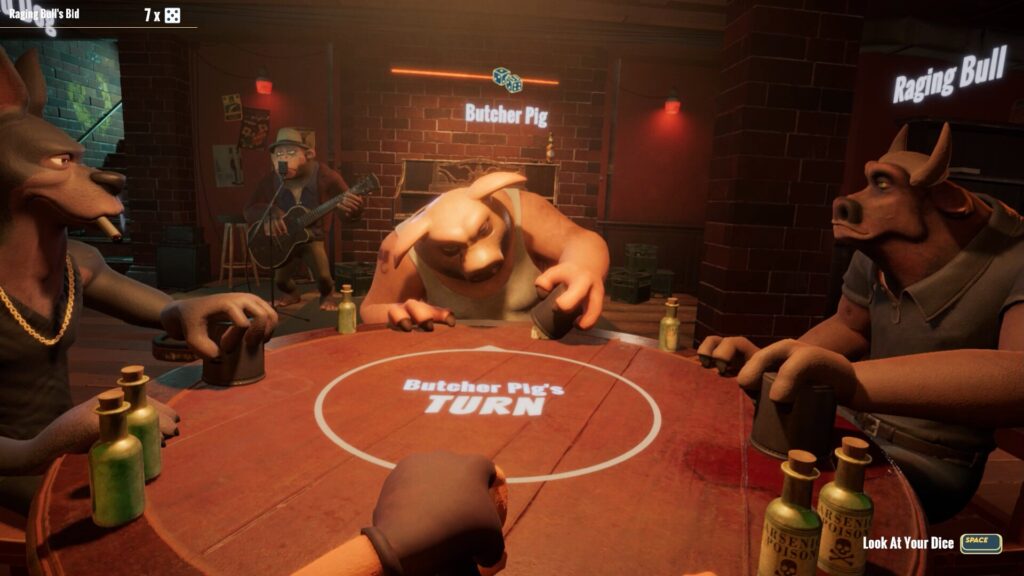
Liar’s Bar features some very different mechanics to Buckshot Roulette, where instead of shotguns and live vs blank rounds, we used the centuries old traditional game of Russian Roulette or poison drinking. The game featured two different gamemodes, one where after everyone randomly rolls some dice in their respective cups, each of us took turns to guess the number of dice of any number, with the amount of dice increasing between each guess. However, the person in play could call the previous player a “liar,” accusing them of bluffing and in turn the whole table reveals the number of dice they have and which number is shown on their dice. If the accused person guessed the correct number of their chosen numbered dice or a lesser amount, the accuser would have to drink a bottle of poison, with two being the max number of bottles one can drink before dying and losing. However, if there aren’t enough chosen number dice on the board, the accused has to drink a bottle instead. There was also a card mode featuring Russian roulette which featured the same premise, though instead of dice it was based on face cards (J,Q,K,A) instead.
After we all got accustomed to the mechanics and rules, I noticed the atmosphere immediately shift back to the one in Buckshot Roulette, enhanced even more by the fact that the game wants you to bluff or call out those bluffs by your so-called “friends.” A new kind of uncertainty showed its head though, one where we were left guessing if the player before us was truly bluffing or if they were bluffing their bluff when in reality they played/guessed the actual amount of cards/dice they specified. One may even connect this kind of uncertainty to certain competitive sports components like chess strategies or basketball fake outs or even gambling games like Poker. After many rounds of bluffs, betrayals, and temporarily broken friendships later, I had somehow managed to fool my friends the majority of the time and come out on top, much to the dismay and distrust of my fellow players.
Buckshot Roulette and Liar’s Bar both were very interesting experiences to say the least, giving our friend group a unique sense of tension and unease between us that we haven’t experienced since Pandemic-era Among Us. But if there’s one positive thing we all learned from these games, it’s that one should never trust their friends, especially in a game of dice or shotgun roulette.


It’s always surprising how cutthroat you become with your friends when you engage in zero-sum games, especially when these games have you lie and manipulate your fellow players. Despite the fact that you care deeply for the people you are playing with, you begin to enact terrible things upon them and start thinking with ruthless logic and utter self-interest, when the gamespace not only provides the opportunity but explicitly encourages this. Another game with this effect is Diplomacy, where the rule is that you have to betray any ally first before they betray you. This brings up interesting moral questions, such as how far can you go in the gamespace. I definitely have had experiences in Among Us and Diplomacy bleed over into my real life, if only temporarily. When you are in a space where generally immoral things like lying and killing are permitted and even encouraged, does that make them moral in this new context? Would playing the game in a traditionally moral way be somehow immoral, because you are not following the game’s rules and acting as a sort of spoilsport? And even if acting immoral is fine in games, there has to be a certain line, right? I have ticked off my cousins a few times because I took a card game much more seriously and played a ruthless strategy to win at their expense. Granted, this wasn’t in the context of a ruthless game, but I still maintain that there is some sort of a line that you should not cross, even in a deeply immoral gamespace. Because if there wasn’t, why would we ever be geniunely upset and hurt due to a game?