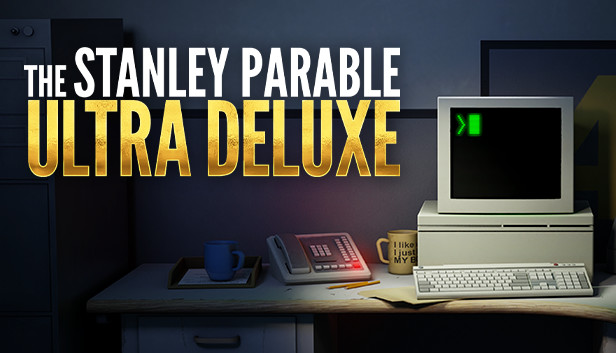
When I first played The Stanley Parable, I thought I was about to experience a funny walking simulator. You play as an office worker named Stanley. One day, everyone in the office disappears, and a narrator begins to describe what Stanley is doing in real time. The game immediately tells you what to do next. For example, “Stanley went through the door on his left”. And right in front of you, there are actually two doors. One on the left and one on the right. That moment really made me laugh, should I follow the narrator’s instructions, or should I try to prove that I have free will? Without thinking too much, I walked through the right door.
At the beginning, refusing the narrator makes me feel exciting. Every time the voice tells you what to do, and you do the opposite, it feels like you are winning. The narrator reacts with frustration, sarcasm, and even anger. The game feels alive. It feels like it is responding directly to your rebellion. It really does feel like you are breaking the story.
But the longer I played, the stranger that feeling became. No matter how many times I disobeyed, the game always had something ready for me. A new speech. A new hallway. A new ending. Even when I tried to escape the game, the game already knew what that escape would look like. The game did not just plan my obedience. It also planned my refusal.
The Stanley Parable has many endings. Some are funny, some are dark, some feel hopeful, some feel cruel. At first, I tried to unlock all of them, like collecting achievements. But after a while, the endings started to feel strange. Every ending felt less like a final answer and more like another version of being trapped. Even the endings that look like escape just lead to another reset. The game never really lets the story end. You always come back to the same office. The same desk. The same narrator. It made me wonder what an ending even means in a game like this. If every ending loops back into the beginning, then maybe the point is not where you end up. Maybe the point is that you never truly leave.