On November 11, 2025, during week 7 of 9 of the University of Chicago Autumn quarter, Mack Minter, “in a haze” as they described it, used the bingo card website bingobaker.com to create jatrick pagoda bingo (2025), its name an obvious spoonerism of Patrick Jagoda, one of the “Critical Videogame Studies” professors, and a published author within the field of game studies. Mack Minter, a fourth year undergraduate Media, Arts, and Design and English double major, has a deep focus on game studies and as a result interacts with Jagoda’s work fairly often, both for their enrollment in Jagoda’s Critical Videogame Studies course and their thesis work. At around 10pm that night, they said in the class’s Discord server, “inspired by the earlier convo on metagames and the fact that i’ve read a lot of his writing in the last two weeks, i have created a patrick jagoda bingo card”. They continued, “feel free to play in class tomorrow or while doing the reading <3”.
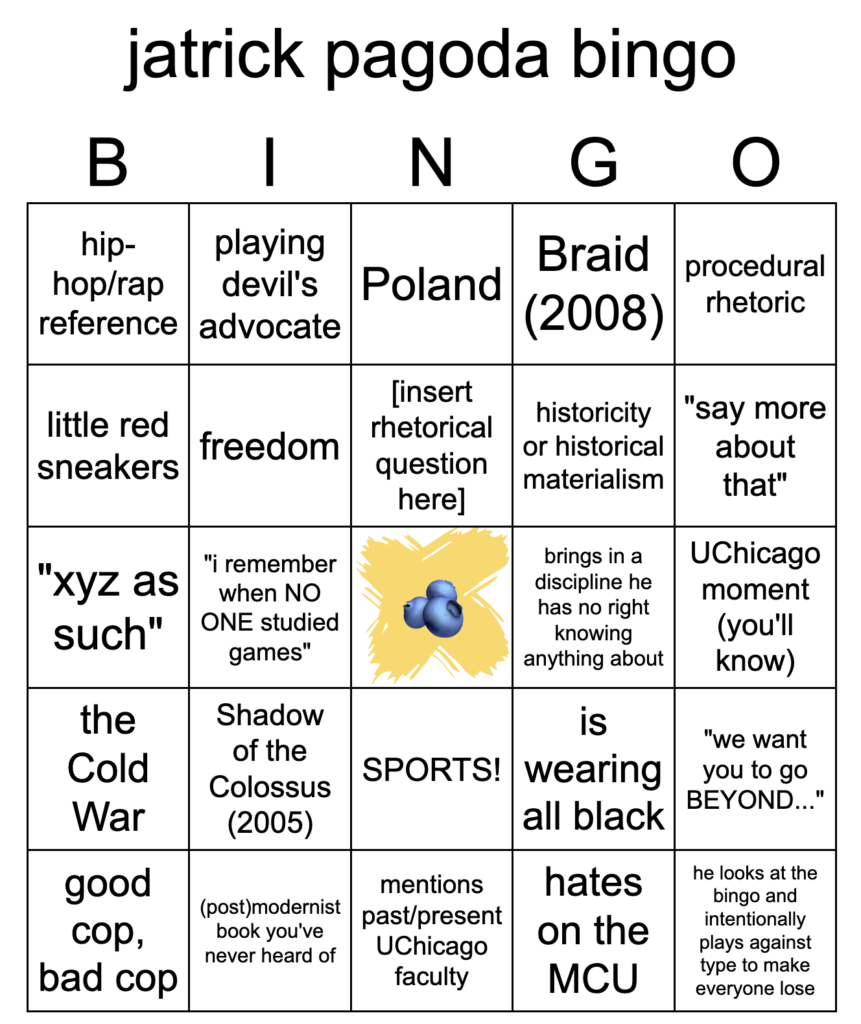
And play they did. It would not be a surprise if it turned out that Wednesday, November 12’s class on Pyre and Difficulty was the most remembered by those in the class. During class, people were latching onto his every word, hoping to hear a reference to sports or mentioned something random that, as Minter put it, “brings in a discipline he has no right knowing anything about”. The class’s lecturer, essentially, had been gamified to encourage listening to the lecture. Sure, perhaps it wasn’t for the “correct” reasons, but regardless, in 18 lectures, I as a student in that class can say that 11/12’s was one of the ones I can recall the best. I don’t really remember playing bingo, but I do remember being locked in and listening intently to the lecture at hand.
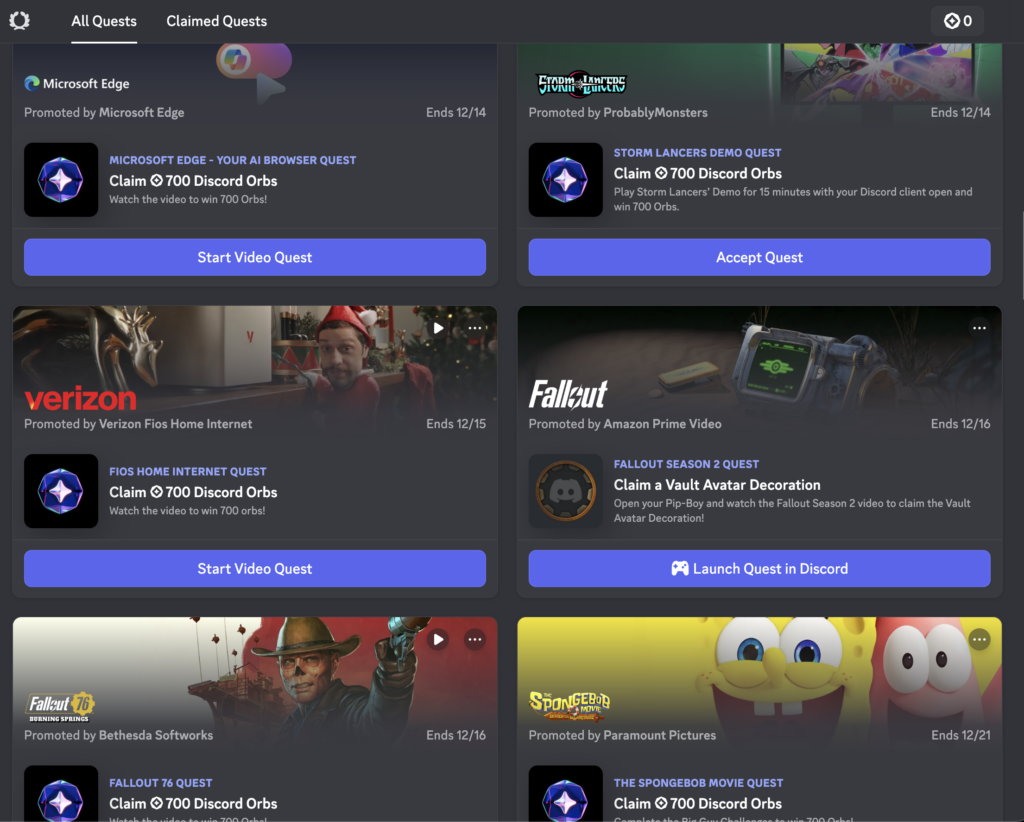
This concept of the gamification of something that could otherwise be considered monotonous is not new, and has been used before in both productive and destructive ways. In 2024, online chat service Discord began integrating ads into its platform, calling them Quests. In this advertising setup, users would rarely naturally encounter ads, as they would while browsing the web or walking down a street, but rather it would be a choice from the user to interact with them. Why would they ever willingly interact with ads though? Each Quest comes with a reward that the user can receive, from points to be spent in their online shop to buy profile customization, banner animations, and font changes, to exclusive in-game content, to trials of Discord’s premium service, Nitro. According to an article released by Digiday in October, 2025, Discord has seen unheard of levels of engagement with their Quests. Users seem to not only be chasing rewards, but it would appear they are genuinely interested in the content they are engaging with, showing the impressive statistic that 99% of users who began a Quest finished it and received the reward. However, Quests have been criticized by other users because while they are minimally invasive, they are still invasive in the forms of small pop-ups and banners that need to be manually clicked away by those who are uninterested.
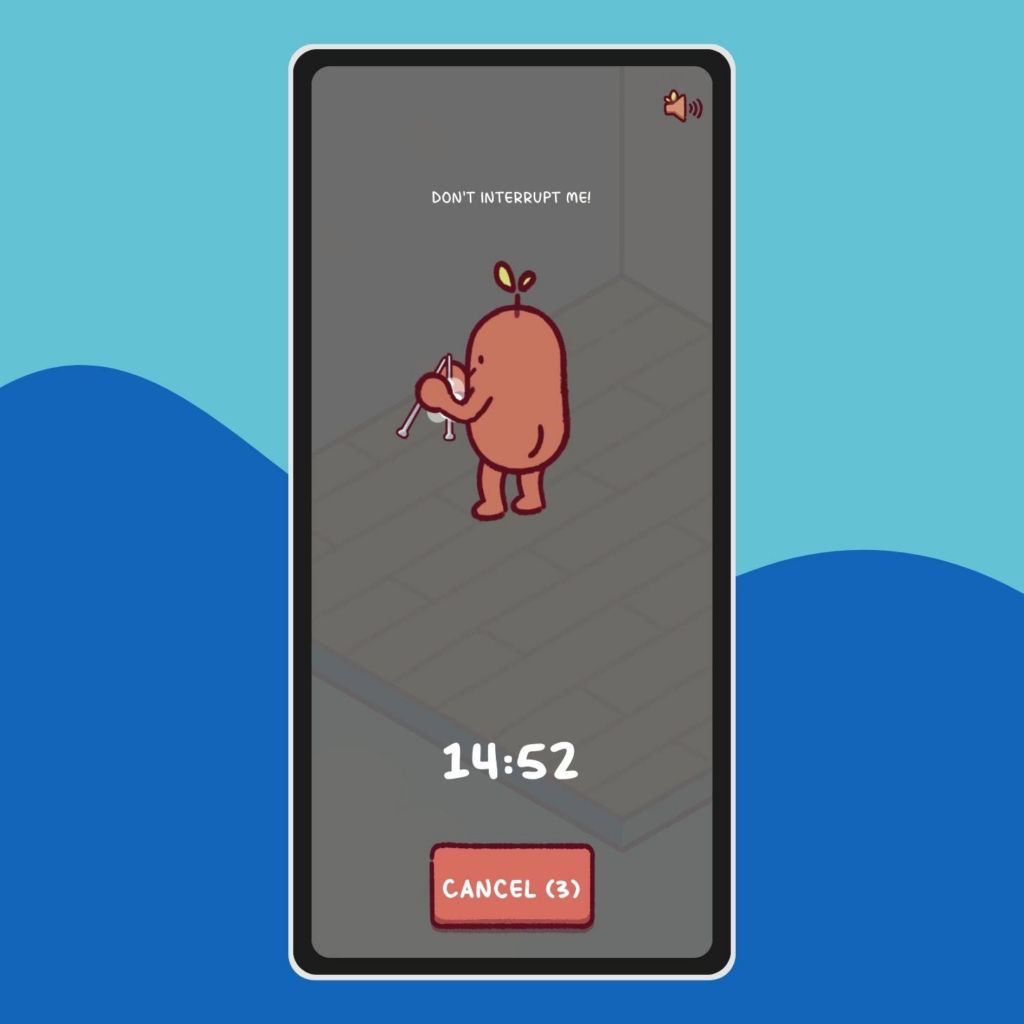
Conversely, immense good has come from Focus Friend (2025), an app created by Hank Green, an author, educator, comedian, and internet social figure, in collaboration with Honey B Games. In July 2025 when it was released, it quickly grew to be the most downloaded app on major download platforms, word quickly spreading due to Green’s promotion on his social platforms. In Focus Friend, the player has a small anthropomorphic bean that they can name, who starts in an empty room. The game has an isometric artstyle and an easy-on-the-eyes color palette, with a comfortable lo-fi soundtrack. In the game, your focus friend needs to take time to knit, but can only focus on knitting if the player is focused on what they need to be doing. The player can start a project, and when they do, a timer appears on the screen, and the focus friend starts knitting. When knitting, they look so happy! If the player tries to leave the app, however, to respond to a text, look at an email, or play a game, the bean’s progress is interrupted, they mess up, and all the progress they made is wasted. This point is emphasized by the bean sadly setting down their knitting needles, making a flustered sound. When a project finishes, the player can use the reward for focusing to buy cosmetics for the focus friend, placing little trinkets on its walls, giving it cute outfits to wear, or buying it some furniture to decorate the space. And that’s all there is to it, the game encourages focus and being away from your phone, and actively discourages breaking one’s commitment to the time they have set aside to be apart from it.
jatrick pagoda bingo proves once again that gamification is a great way of turning a mundane task into something more enjoyable, exciting, and engaging. Gamification creates a strong argument for games being applied to tasks other than leisure, the space that they exist in broadly.
Written by Echo Ziemba


I love games that trick you into learning something, as someone with ADHD who functions effectively only under the condition of either necessity or interest, these games help me SO MUCH! Although I am always interested in the CVGS class (in a perfect world i’d be a MADD major) I can’t help but to lose focus sometimes, and if I have the option to shift over to a game that is interesting and funny, that also related to the class..BOOM! I am back in business, gamefication as you said is a rising trend that I’m excited to see grow.