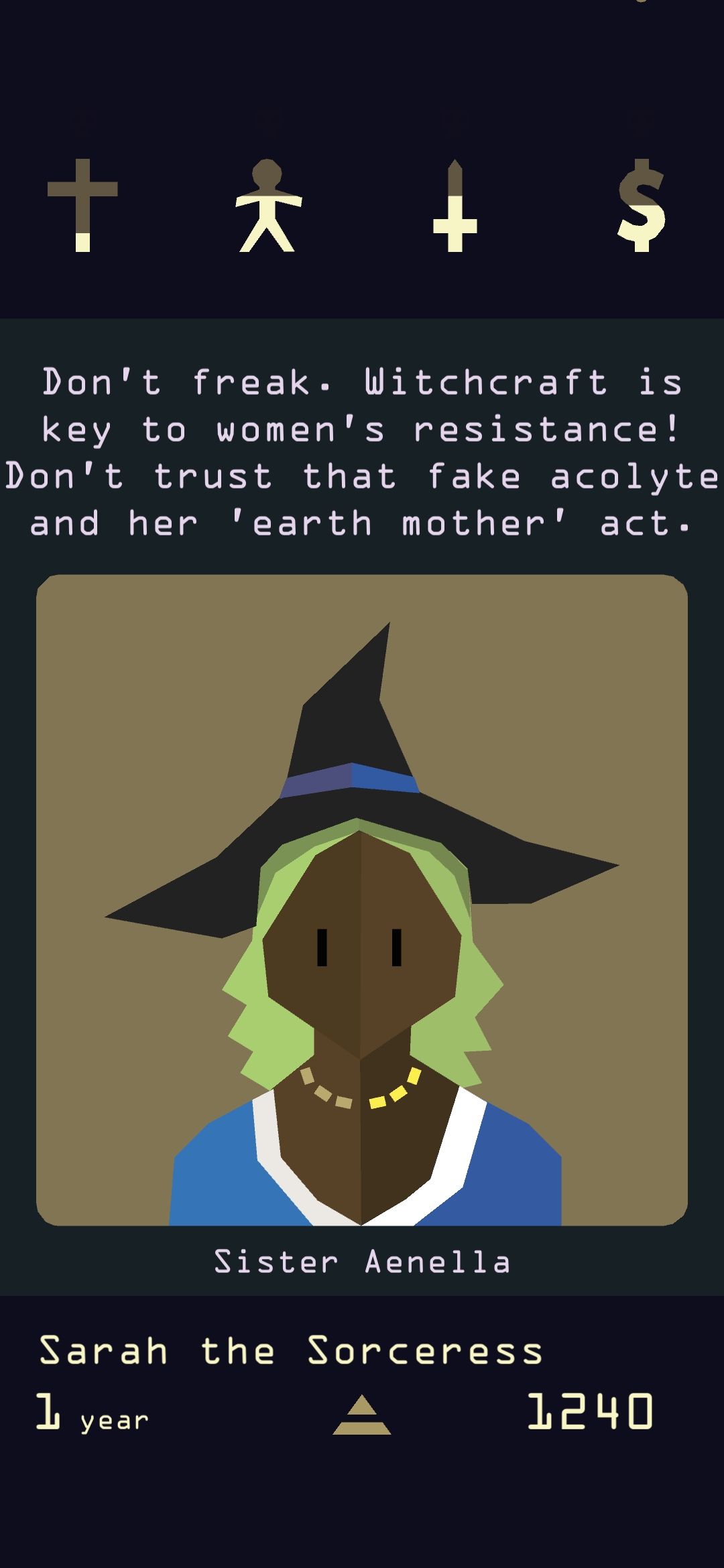
I was really excited to play Reigns: Her Majesty. I liked the concept and the Tinder-style swipe mechanics. And, as I mentioned in my last blog post, I’m a big fan of mobile games.
The game illustrates the constant balancing act of being a female ruler, trying to keep the church, the people, the military, and the treasury all satisfied. Each swipe left or right affects one or more of these factions, and no matter what you do, death is inevitable (often in pretty humorous ways). If you are too popular among the people, you get crushed to death. If they hate you, there’s an uprising, and they behead you. If you leave the nation destitute, savage hounds chase you into the woods. If you lose favor with the church, you are accused of witchcraft and torched at the stake. If the church loves you, you die from dehydration in an effort to prove sainthood.
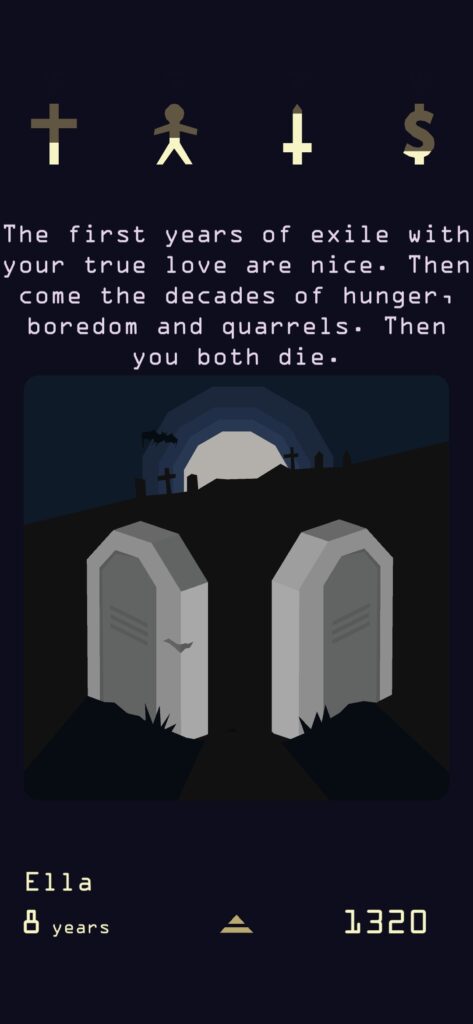
My favorite queen and death was Ella. Ella was the first queen to successfully run off with her secret lover. I knew exile was guaranteed with this route, but it was worth it to have a few years of freedom.
After playing several rounds, I was slightly disappointed. The game successfully uses humor to highlight the absurdity of womanhood under patriarchy and the impossibility of pleasing everyone while holding power. But from the players’ perspective, this comes at the cost of replay value. The humor felt old after a bit, and the outcomes of some choices didn’t always make sense. It often felt more like a game of chance than one of strategy, which accurately reflects how womanhood feels sometimes: the cards are stacked against you from the beginning. Sometimes I want to play games that give me more agency than I feel in real life.


I think there is an interesting tension between choice and futileness posited by Reigns: Her Majesty. In this game, the only thing a player can do is make choices by swiping left or right. The fact that choice is the only mechanic of the game makes the player feel as though their choices are magnified or heightened. However, because the outcome is always determined (causing the death of each ruler), there is no way to avoid a tragic ending. There is only an illusion of agency in the face of a tragic death.
I think the illusion of agency/control is a central element of the tragedy genre. It is easy to argue that Reigns: Her Majesty is a tragedy because of the tragic death of a ruler. What makes it interesting is the fact that the tragedy is not around a single ruler (as tragedies usually center around a single tragic hero) but is instead around any ruler who is a woman. In this way, the tragedy is not because of the flaw of a single person — it is the flaw of the patriarchal system.
I resonate with the last passage a lot. There is certainly a tension between games being either fantastical or representative, or relatable. While this is subjective, I think measures of realism should certainly be a valid point of criticism for all games. It is a noticeable part of the design and overall message. I am curious about the creators of Reigns: Her Majesty and their positionality with respect to women’s experience.
I completely understand your disappointment with replay value! After a while, the humor can feel repetitive, and the randomness might overshadow the sense of mastery players often want from games. I think that’s part of the tension the game sits in, and something that I really found interesting about this week’s games, particularly because these are the exact sort of games I’d never really play myself. With that being said, I can definitely still appreciate what they offer as far as the meaning of the lack of agency.
While I was addicted to playing the game at first, I felt that the more endings I discovered the less excited I became to play. I knew that there were more people to find and places to explore, but at a certain point even new endings lost their humor and thrill. I played for a high score (I think I reached 25 years), and I would be curious to learn if there is a non-tragic ending where the queen dies of old age. This reflects a lot of mobile games for me which start fun as I learn the mechanics but lose their appeal by being repetitive even if the game gets more challenging.
I would argue that the repetitiveness of the game is helpful to completing the game’s “True Ending.” The game has multiple objectives that eventually help you gather the items you would give to the All Mother, which leads to the True Ending. However, there are many obstacles on the path to completing the game. Knowing what specific choices lead to your previous deaths are helpful in avoiding each death flag, and it then allows the player to progress forward with completing their objectives.
I share the same disappointment that you mention with the replayability of the game. I played for a while and kept getting the same endings, while feeling that the consequences for my actions felt disconnected. I can’t speak to womanhood, but you raise a point that I had not thought about before. I think it also makes sense when you consider the ending, where you are isolated by the king for being strong and consequently minimizing his masculinity.
I really found the lack of agency in this game to be frustrating. I know that was the purpose, especially within the context of this class, but I just wasn’t even entertained by the game due to the lack of choice. Especially when I started getting repeat endings like being trampled by the hoards of citizens. And maybe I was just having a dumb moment but I couldn’t figure out what increased/decreased the four counters, and if they really even mattered. Sometimes I emptied one icon and the game continued, and sometimes it ended with everything full. I think the mechanics of the game precluded me from experiencing the balancing act of being a female ruler, as you mentioned. I could tell that examining the patriarchy in this way was a key goal of the game, but the mechanical frustrations really took away from my experience.