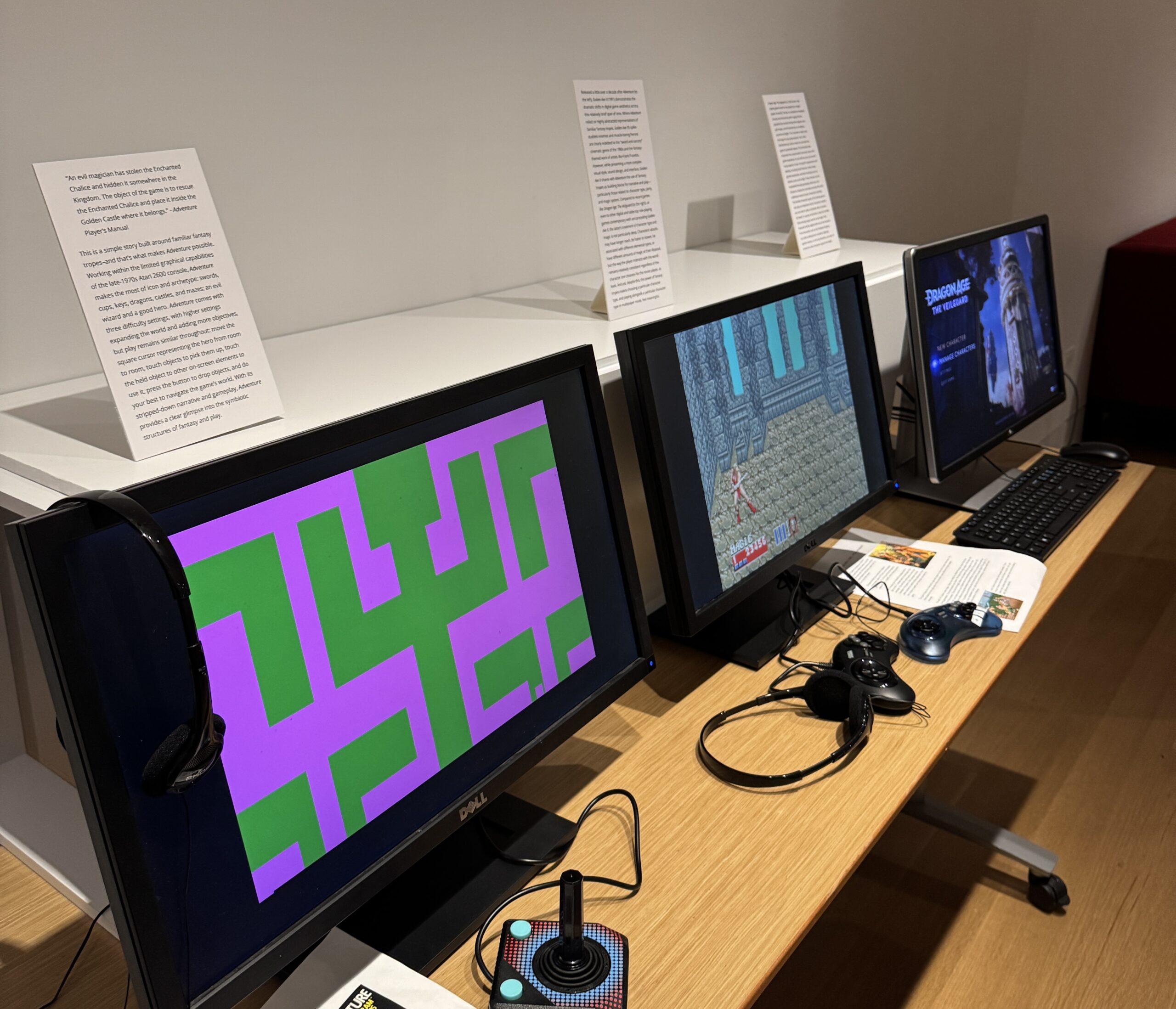
Last week, I visited the Charting Imaginary Worlds Special Collections exhibit in the Regenstein Library. I’ve walked past it many times this quarter, and it was nice to finally go inside and see the exhibit up close. The idea of fantasy being integral to video games seemed so intuitive to me, but I really appreciated all of the connections that the exhibit made. It helped me to see some of the smaller detail fantasy elements that can be present in games.
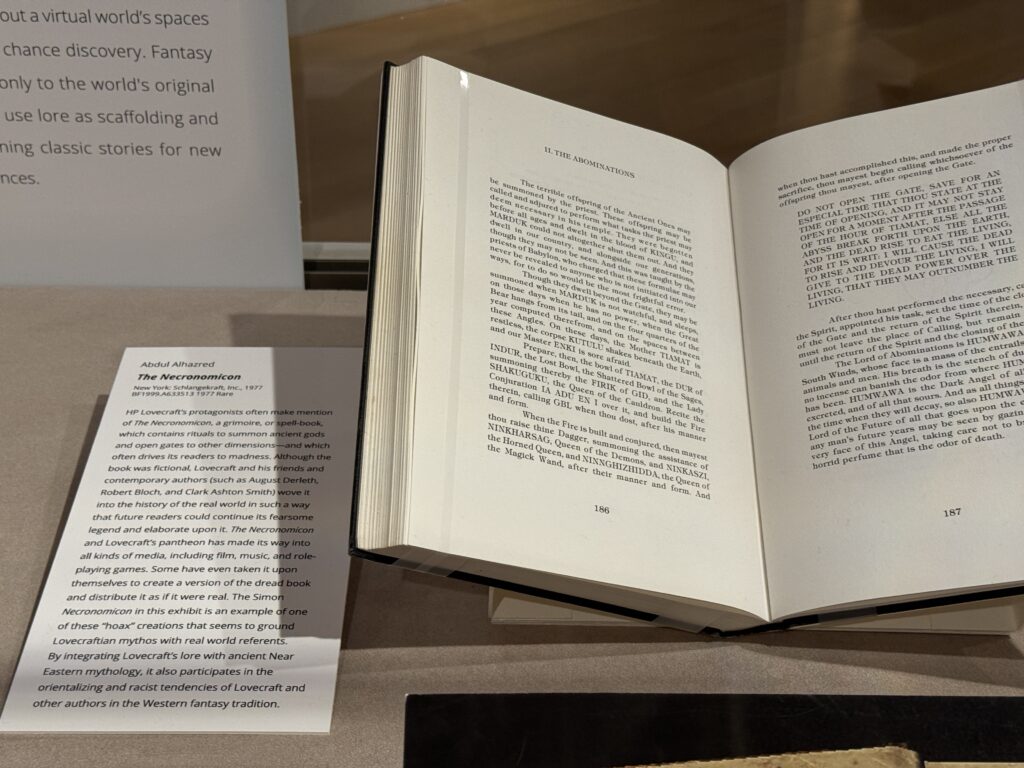
Something in the exhibit that really captured my interest was the copy of The Necronomicon from Abdul Alhazared (pictured above). I honestly didn’t realize that the Necronomicon wasn’t at some point a real book (whether or not the content was accurate). I think I just assumed it was something weird/satanic from Medieval times? I’ve seen the book come up so many times in different media, from TV Shows to video games, and it was interesting to learn that the book(s) are completely fabricated and made “real” for the sake of making it seem like the fictional accounts of the book were embedded in reality.
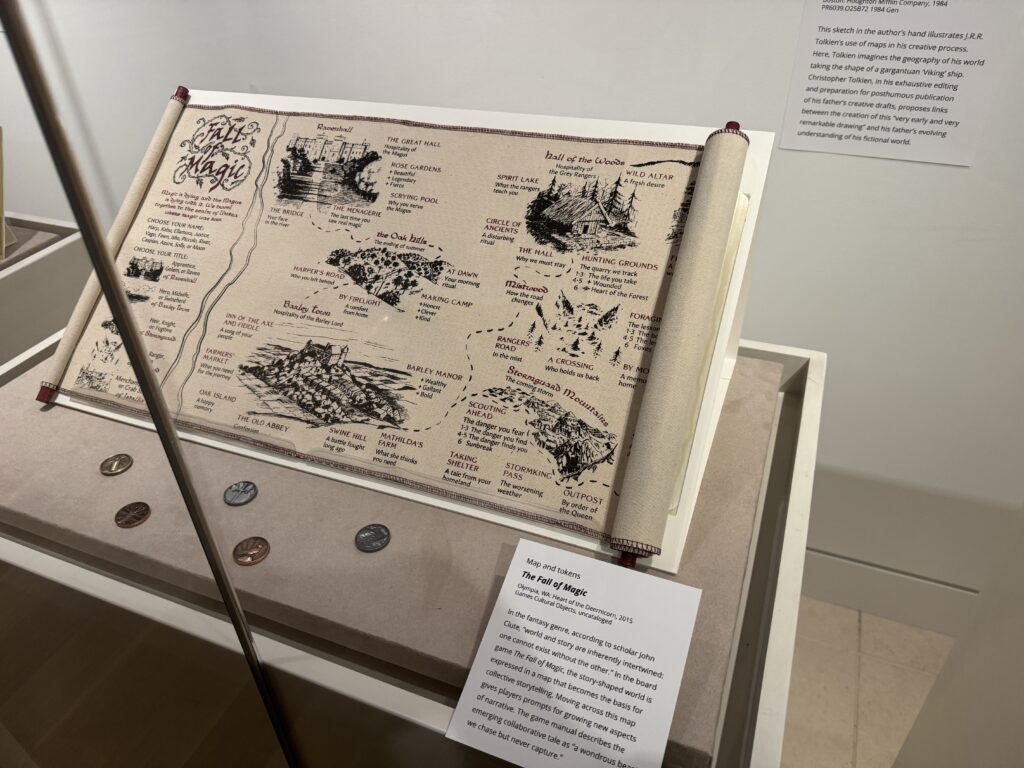
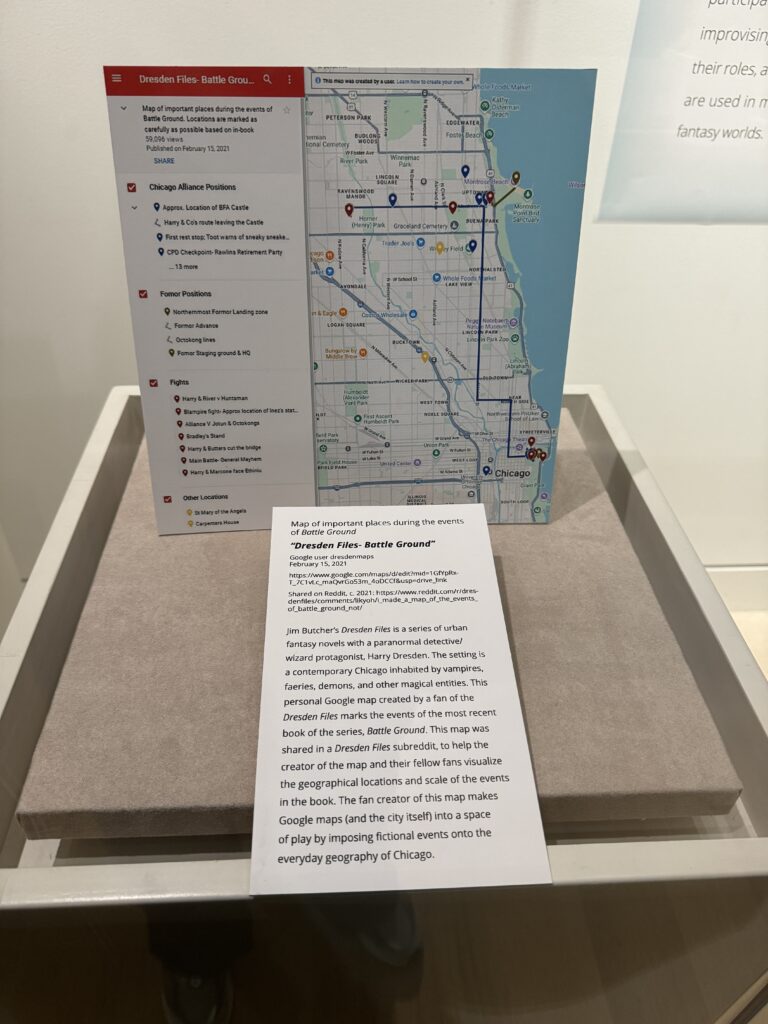
The copies of the fantasy maps were also really cool to see. I read a lot of fantasy novels, and one of my favorite parts of the books are the maps in the front. The Fall of Magic board game map/game manual existing as a scroll was a really interesting object to see. I appreciated that the map was combined with instructions and descriptions, and the multi-use object was also artistically compelling. Seeing this contrasted with a Google Maps map (pictured below) of Chicago that had all of the locations present in Battle Ground (which is set in Chicago) was a fascinating comparison. Seeing an entirely fictional map and a still fictional map that is based on a real location pushed me to think about the intersections between fantasy and reality. Sometimes I struggle with fantasy novels that are particularly similar to real life, especially in big city settings or where modern technology is present, so it was interesting to see a game like Battle Ground referenced as a fantasy game.
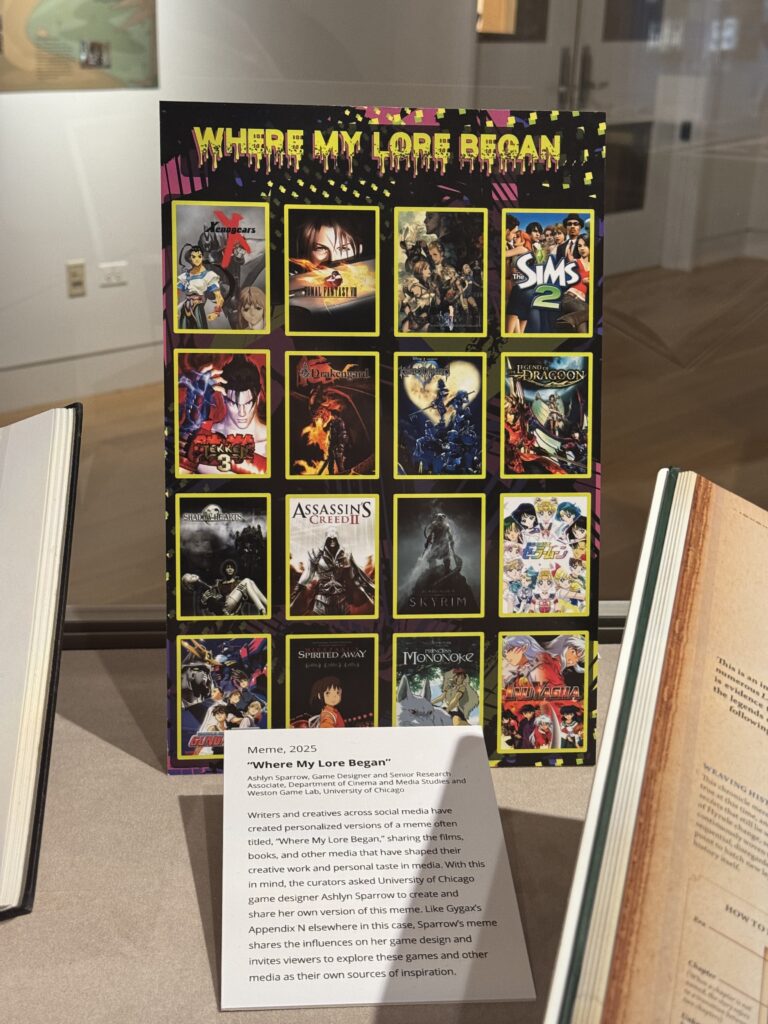
The exhibit was quite impressive. I also was so happy we got to see Ashlyn’s meme (pictured above)—it was on the acknowledgements board and I was preparing to send her a message over Discord before I saw it in the exhibit. Overall, the exhibit is completely worth a visit if you are curious about fantasy, video games, or even broader world creation.


That’s interesting what you said about struggling with fantasy that is similar to the real world, because for me, I usually prefer the opposite. I think that to fit into pre-existing guidelines rather than completely make your own world is fascinating and can make rich and more direct commentary about our current world. My favorite book series, His Dark Materials had a map in the museum collection. In this series, Oxford exists as an alternate magical universe that coexists with our universe and many others. Because it has become more common in recent years to create fantasy worlds based off of real places (for example, games like Grand Theft Auto and anime like JuJutsu Kaisen), media-tourism has rapidly increased.