As stated in the title, this is a spiritual sequel post to my previous post putting Ori and the Blind Forest (2015) and Hollow Knight (2017) in conversation with each other. It studied how each game fit into the metroidvania genre, and how they lived as parallel deviations from the genre, pushing it forward in different, interesting ways. This post will study how, in putting the two in conversation with each other, each of the games’ sequels influenced each other as they were developed.
Five years after the success of Ori and the Blind Forest, Moon Studios released their second title, Ori and the Will of the Wisps (2020). It takes place following the events of Blind Forest, following a similar artstyle and gameplay feel, but everything is bigger. The levels are fuller, the areas are richer, the soundtrack is longer. Ori is more powerful, the abilities are more varied, and the enemies are more complicated. While Blind Forest is said to be beatable in 9-13 hours (according to howlongtobeat.com), Will of the Wisps is marked at 12-18 hours. If average playtime is a metric to how much more game there is, Will of the Wisps seems to be about 35% bigger.
Interestingly, Will of the Wisps seems to take a lot of inspiration from Hollow Knight in pacing for this increased playtime. Of course, 12-18 hours is not at all near Hollow Knight‘s 27-64 hours, but it is still substantially bigger than its predecessor, and thus its progression has been updated to fit that longer progression. The first large change is to the basic resources, Life Cells and Energy Cells. In Blind Forest, each Cell pickup added one to the maximum Life/Energy, whereas in Will of the Wisps, each requires two Cells to increase the maximum, doubling the amount needed to collect to reach the same amount as in Blind Forest. This mirrors Hollow Knight‘s style, to a smaller extent. In Hollow Knight, Masks (the game’s health system) require four Mask Shards to complete a Mask, and Soul capacity (similar to Blind Forest‘s Energy) is increased by gathering three Vessel Shards.
Additionally, Will of the Wisps‘s ability progression looks much more similar to Hollow Knight‘s, following the model of separate unlockable abilities (in this game called Spirit Shards) that can be equipped into a limited number of slots, very similar to Hollow Knight‘s Charm system. In my previous discussion, I noted that this progression system allowed for more interesting and varied pickups, as opposed to collecting generic Ability Points pickup that take out the surprise of picking up new abilities. This works fine in a game as short as Blind Forest, but with Will of the Wisps being longer, this change to be more similar to a charm system is welcome for its variety.
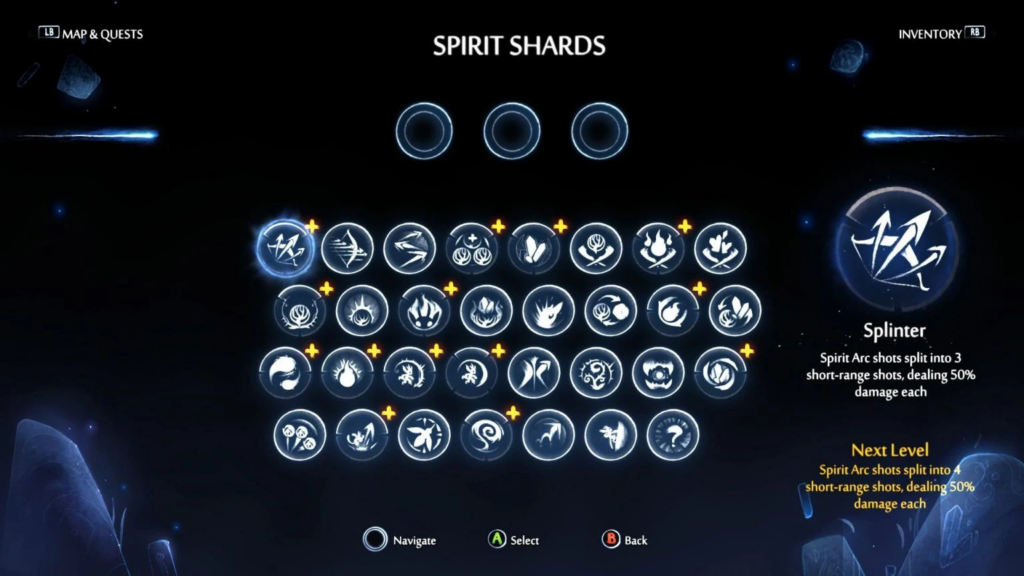
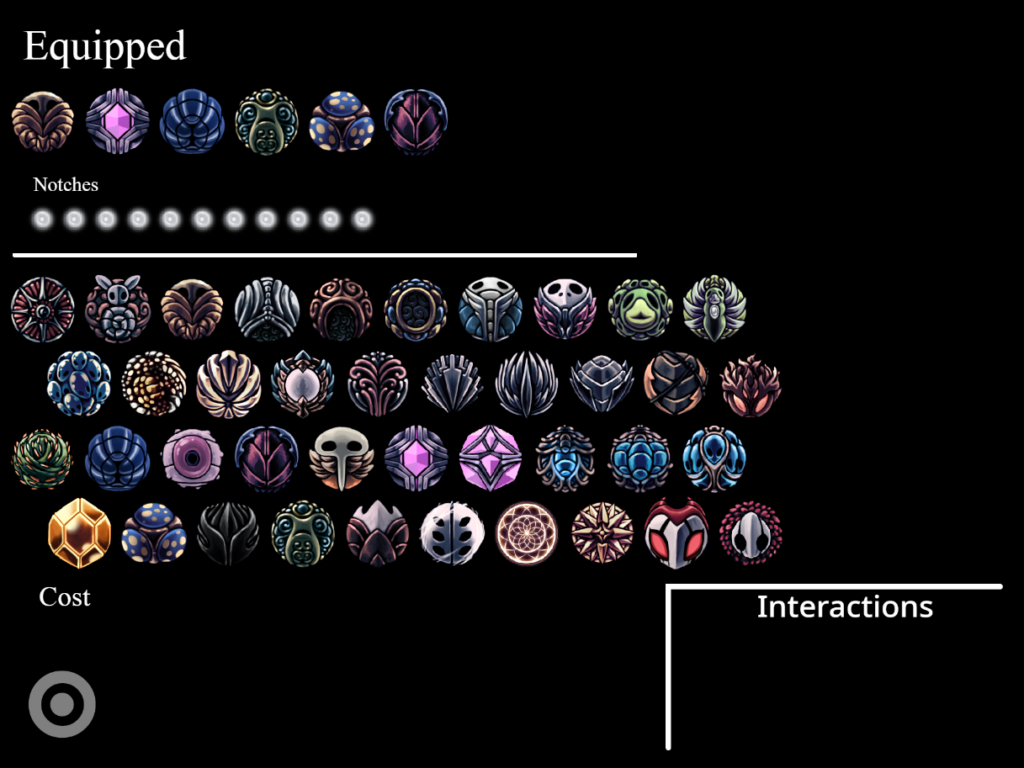
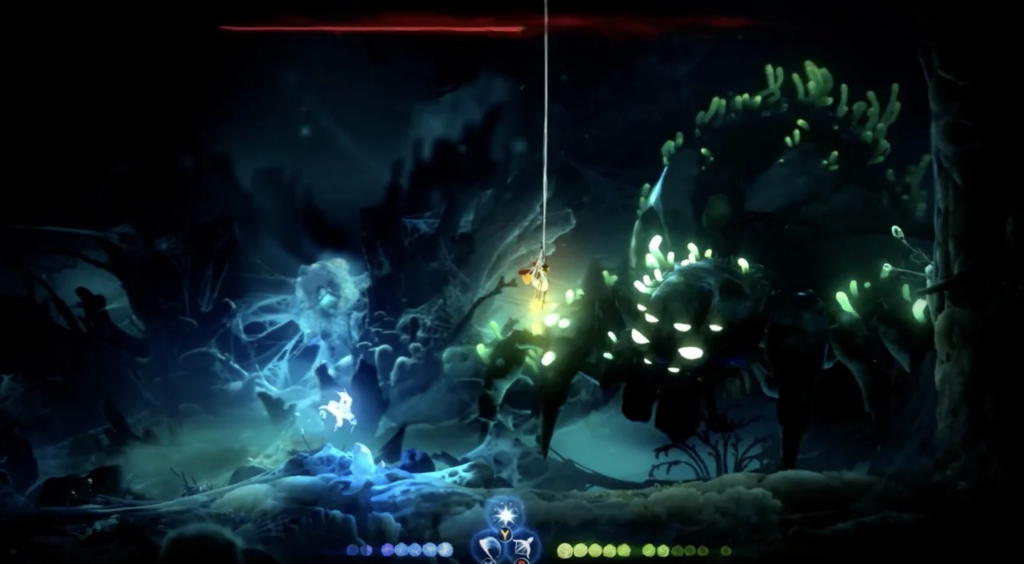
The inspiration makes its way into gameplay, too. Will of the Wisps has more of a focus on combat encounters, still following the Ori fashion of facing foes that are much bigger than Ori. Some encounters are still focused on running away, but there are true boss battles in Will of the Wisps in the very classic fashion, with health bars to be depleted and such. While it would be foolish to say this was taken as inspiration from Hollow Knight specifically, it is notable that Will of the Wisps moves closer to Hollow Knight than its predecessor was.
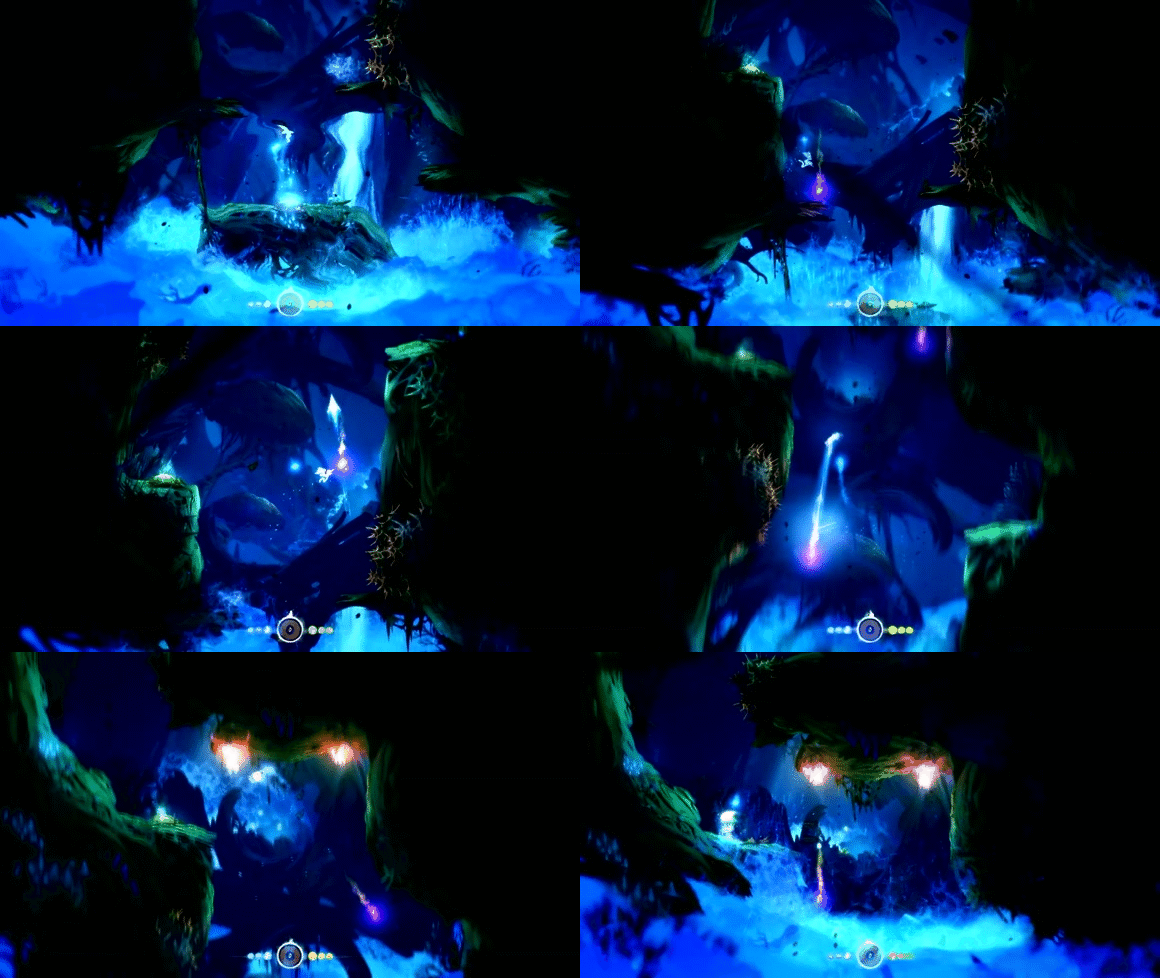
Will of the Wisps makes its own ventures separate from Hollow Knight, as well. Generally, the Ori games focus more on platforming, while Hollow Knight focuses more on combat. As a result, Will of the Wisps introduces Timed Trials, timed platforming challenges that require the player to move through an arena in a certain amount of time. Doing so rewards the player with Shard Slots, giving players the ability to equip more Spirit Shards. Hollow Knight does not have any similar timed trial in any substantial sense.
Five years after the release of Ori and the Will of the Wisps, it was Hollow Knight‘s turn to introduce its sequel. In September of 2025, Team Cherry released Hollow Knight: Silksong, introducing players to the kingdom of Pharloom, setting a new character, Hornet, as the protagonist. Similarly to the evolution between Ori games, Silksong is bigger in every capacity. The rooms are larger, there are more enemies, a new quest system, more customization options, more areas, diverse dialogue, the list goes on.
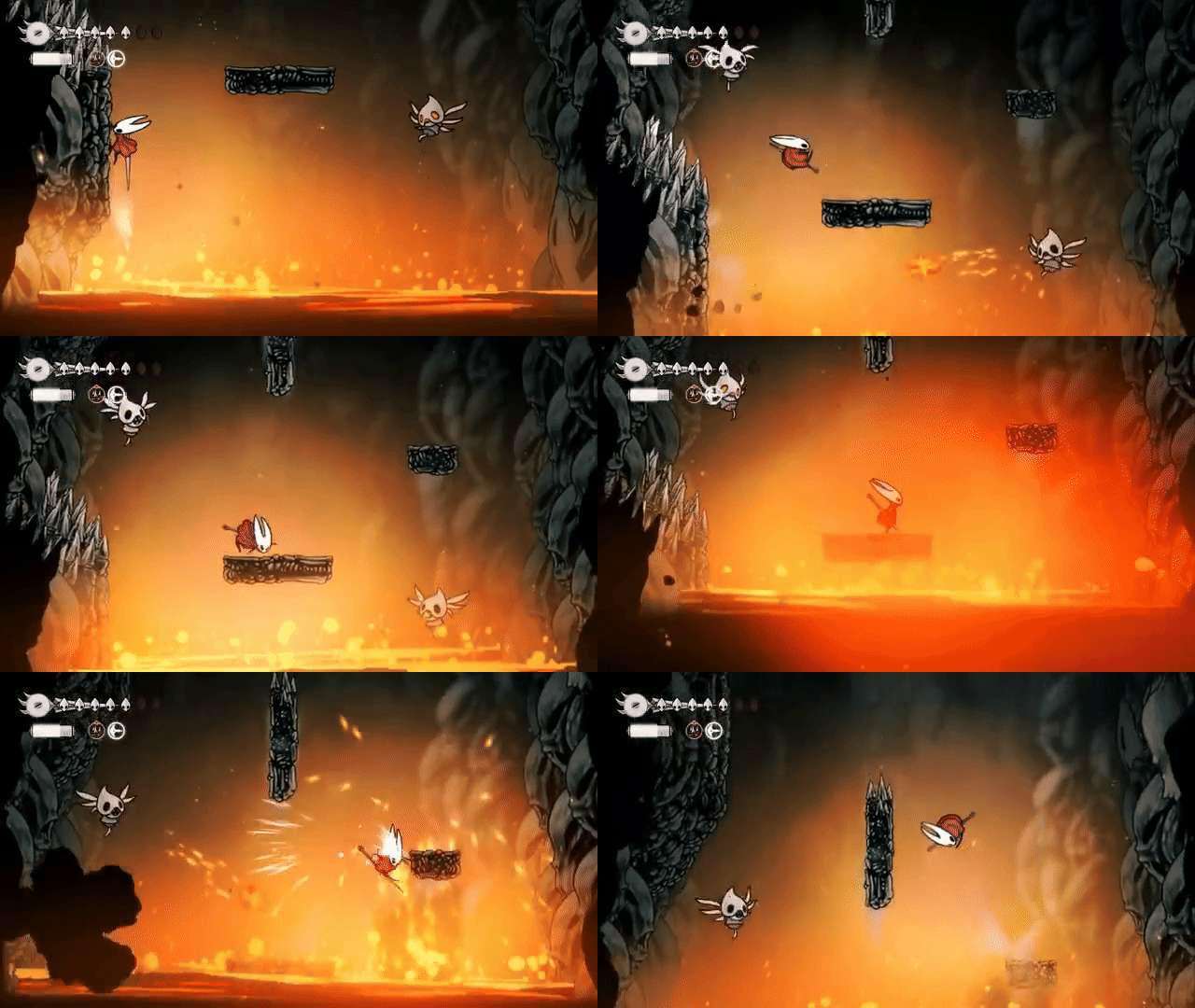
Inspiration from Ori and the Blind Forest can also be observed within Silksong. Most notably, there are two sequences within Silksong that are completely the same style as many of the large challenges within Blind Forest. The sequence boils down to escaping out of a pit while liquid slowly rises, threatening to destroy the player if they fall into it. Multiple of these sequences exist within Blind Forest, and Silksong seems to inspire this style of level, once in an optional area within the Far Fields area, where lava rises up in the Skull Cave after defeating a small gauntlet of enemies. The other is near the beginning of Act 3, where lava rises up as the player attempts to escape the Abyss, teaching them how to use their newly-unlocked Silk Soar ability. Having played both games, I was incredibly excited to see this style of level in Silksong, because I enjoyed them so much in Ori.
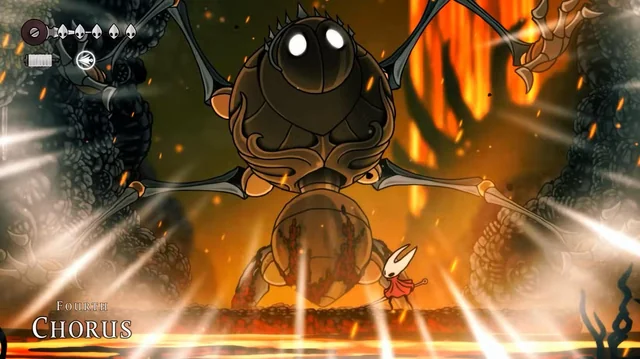
Silksong seems to also include more focus on platforming sections, with Mount Fay as an area being completely platforming focused. There is also an ability present in Silksong, the Drifter’s Cloak, which allows the player to slow their fall significantly for more precise in-air movement. This mirrors Ori and the Will of the Wisps‘s Kuro’s Feather ability, which has the same effect. This is a fairly novel movement type for a 2D platformer, so it is unreasonable to assume that this ability was inspired by Ori specifically, but I figure is notable regardless. One early Silksong boss, Fourth Chorus, seems to pull from Ori‘s sense of scale, being a large enemy which sits in the background and takes up much of the screen, pushing Hornet to feeling smaller than the world she is surrounded by. One other small similarity comes in an area available in Silksong‘s act 3, where Hornet can meet a bug named Sprintmaster Swift, who challenges Hornet to a series of timed trials. These are not in the same vein, nor do they serve the same purpose as Will of the Wisps‘s timed trials, but nevertheless seems significant. As a final observation, almost all of these comparisons, the Drifter’s Cloak, Sprintmaster Swift, Fourth Chorus, and the escape from the Skull Cave, occur in the Far Fields area of the game, which is probably coincidence more than anything else, but I think is a fun remark.
In my first post, I observed how Ori and the Blind Forest and Hollow Knight grew parallel to each other in the metroidvania genre, taking the genre’s concept and pushing it in two different, valid directions. In this one, I would say that that observation continues to be true, with each one feeling like they learned from mistakes and problem areas in their own first installments, while also looking at other takes on the genre and pulling from what seemed to work well from those. Observing a genre evolve, then, seems a worthwhile tool for game designers to have a handle on when designing a game that will slot into a genre. How can this potential new game fall into line with others? How can it break conventions? What sets it apart? As many cases are, seeing how the market moves and taking inspiration from different sources allows for fresh reimaginations of things that people already enjoy. And isn’t that, at its core, what a game designer is looking to accomplish?
Moon Studios has confirmed that Ori and the Will of the Wisps will be the final game in the Ori franchise, but Team Cherry has said they would like to continue exploring the worlds of Hollow Knight, so certainly we will see them once again push the envelope of the metroidvania whenever their third installment comes out… in a decade or so. Until then, though, there are plenty of other worlds inspired by these games I have looked at to expand on the genre. I suppose we will simply have to play other games… oh, what a terrible, cruel world.
Written by Echo Ziemba