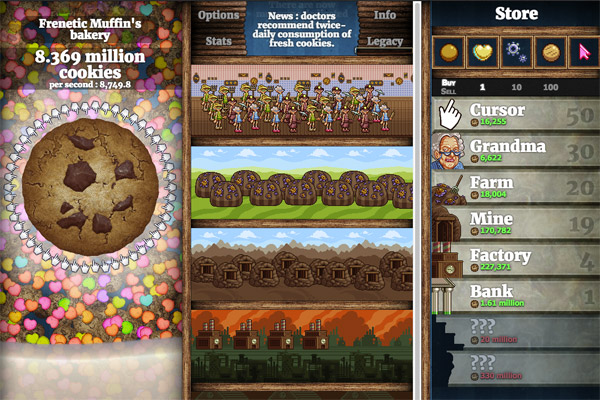
Cookie Clicker is a strange game. After getting many cursors, grandmas, farms, mines, factories, and banks, and generating so many cookies, I was getting bored, ready to quit the game. The thing is, I didn’t have the heart to close the tab. Instead, I let the game run in the background and I moved on to other work. I would check on my cookie empire every half an hour. Occasionally when I checked on the tab, I spent more than a few minutes staring at the screen, buying and selling things here and there. It was boring but addictive. That’s the strange power of idle games.
Video games often ask players to do many tasks in order to get a reward. In the case of many video games, these tasks are enjoyable because it requires a certain skill set the player needs to master over time. When the player finally overcomes the difficulty, they would feel a sense of accomplishment, and the joy lies in here. In the case of idle games, these tasks are often repetitive, boring, and meaningless, yet many people still stick to the game. I don’t find playing idle games enjoyable, but they are addictive. Why are these tasks so tempting? Why are idle games so popular?
I think it is the sense of productivity idle games create without asking anything from players other than simple clicks. Success is easy: tasks don’t require time or effort since everything is automated. In the real world of hustling and competing, idle games provide a temporary escape from pressure. They simulate progress, numbers go up, factories expand, upgrades unlock, and all the player has to do is return occasionally to collect what has passively accumulated. This false productivity feels satisfying. We get to experience growth without actually investing skill, struggle, or emotional energy. In a strange way, idle games give players permission to feel successful without earning that success.
But this illusion of effortlessness also creates concerns about addiction and wasted time. When progress happens automatically, the cost of staying with the game feels low. Like how I kept a tab open “just in case,” this is an act of convincing myself that I’m not actively playing. Yet the player keeps checking, clicking, upgrading, waiting, or simply staring at the screen. The game gradually occupies mental space, not through challenge, but through anticipation. Minutes turn into hours of passive attention. There is no dramatic payoff, no final level, no meaningful narrative, but quitting feels like abandoning something that is accumulating value. The cost of time spent becomes a reason to keep going. Idle games, then, raise an uncomfortable question: what does it mean to invest so much time into something that rewards you with nothing but bigger numbers?
So, I don’t think it’s a good idea for me to play Cookie Clicker again.


I totally agree with your blog post. While I am not nearly as susceptible to idle games as I used to be, I stayed away from Cookie Clicker for risk of some habit being formed. You did a good job contrasting traditionally difficult games with idle games by examining why people play them and what their payoff is. I wanted to build on that and add cozy games to the mix. I would not say that they are idle games, for instance “A Short Hike” is almost pure exploration. However, the lack of stakes, pressure, and consequences mean that you do not feel the same reward for beating a challenge or completing a task. And yet, these games are played quite a lot. I imagine the motivation is very similar to reading cozy books: an immersion into a different world and a break from the pressures. Cozy games offer a true break, whereas idle games simply mask your needs by giving you a quick productivity hit. Perhaps that can be used as a differentiator.