Blue Prince (2025) is, without a doubt, the most clever puzzle game I have ever played. At its core, it is a tile-placement, roguelike puzzle game with a strong narrative, cell shaded art, and a droning, lonely saxophone-forward soundtrack. In the game, you play as Simon P. Jones, heir to your great uncle’s estate, but there is a twist: you need to find the 46th room in a 45 room house, which you draft every day. There is so much to uncover within this game, and inherently as a puzzle game there is much room for spoiling, so I will be very careful with what I say here. This post will discuss one small mechanic within the game, and will reference other parts of the game that could be considered spoilers, such as some aspects of the game world’s countries. Regardless, spoiler warning for everything ahead.
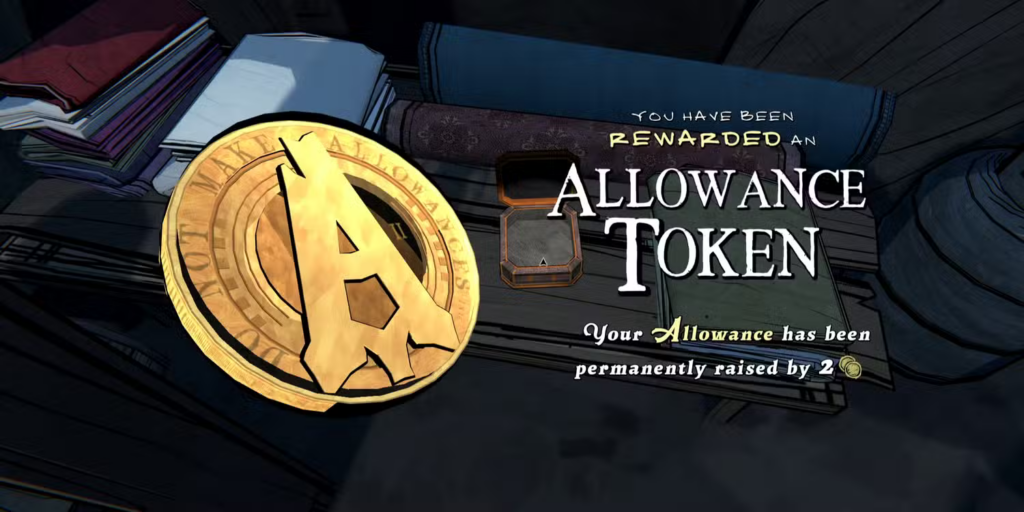
There is a lot to say about Blue Prince, but the small aspect I will be focusing on for this post is the Mora Jai puzzle boxes. These boxes, with 3×3 tiles on their lids, are found throughout the estate in various locations. Most, when opened, have an Allowance token inside, allowing the player to start their next day with two coins for each Allowance token they have gathered. Some boxes have other things in them as well, such as clues to other puzzles or small pieces of lore. Once completed, the boxes do not return on subsequent days.
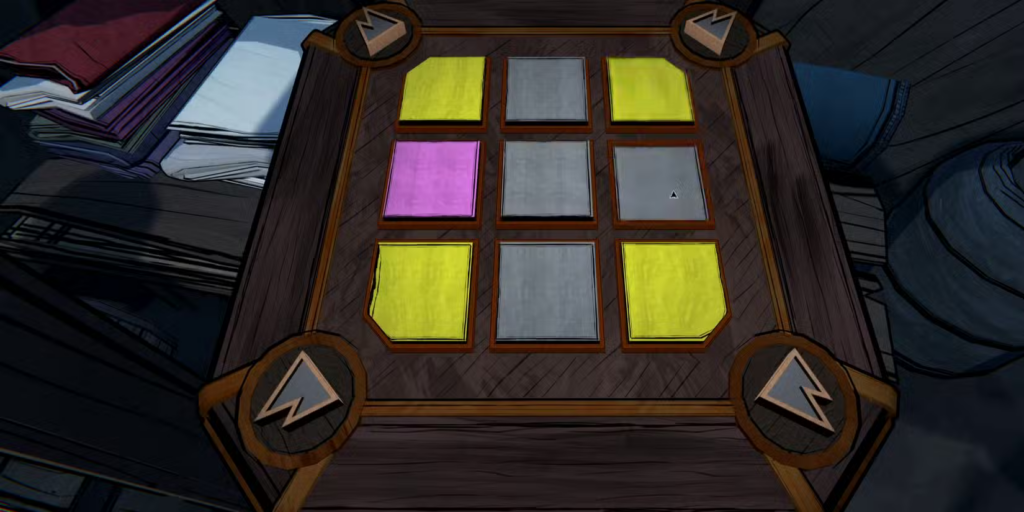
The Mora Jai box is labelled as such because it was produced in Mora Jai, one of the game’s nations. Something to know about Blue Prince‘s nations: each of the seven nations has a specific sigil, as well as a dominant color that defines them. These colors and sigils are disclosed in various areas of the game, and collecting and defining them is part of the game’s overarching puzzle. The puzzle box consists of two parts, a 3×3 grid of tiles in the middle, and a shaped button on each corner. The tiles on the grid are different colors, with each color having their own ability. The goal of the game is to get each corner of the grid to match the color of the button on the corner.
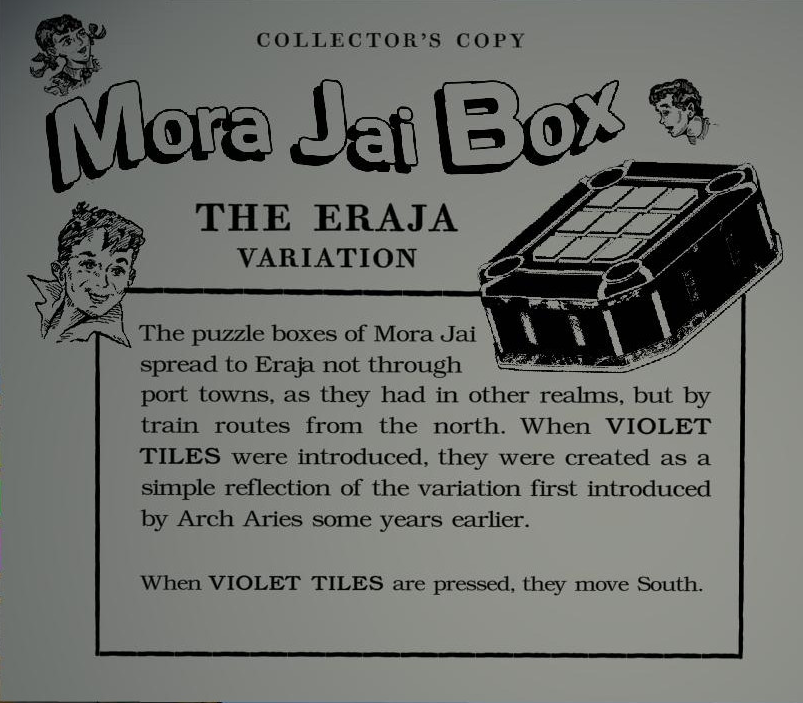
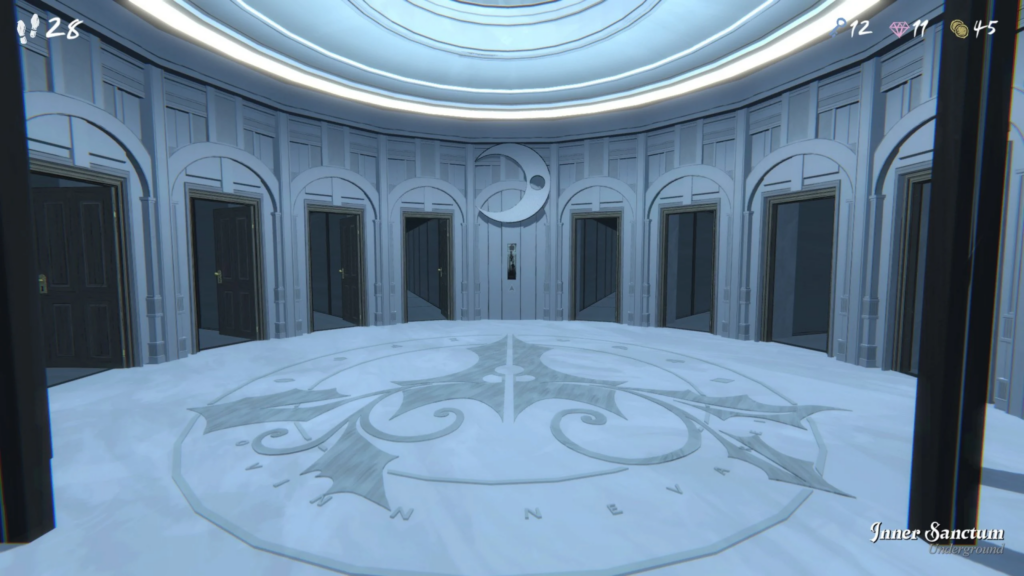
While players can run into some puzzle boxes by accident toward the beginning of the game, most of their first encounters with the boxes will be in the Inner Sanctum, a room beneath the manor discovered after a certain point in the game. The Inner Sanctum requires 8 keys for 8 doors, each door marked with one of the realms’ sigils. (But wait! didn’t you say there were only 7 realms?) Yes, a small plot point is that the nation our estate is in was hostilely taken over some time ago and was renamed from Orinda Aries to Fenn Aries. Each nation has a different color and sigil, so both are included seperately in the Sanctum. When unlocked, you are tasked with forming the correct rune for the realm, based on a series of guidelines, and when correct, a bridge extends, with some small bits of lore on one side, and a Mora Jai puzzle box with an advertisement note explaining the variant for that nation. For example, the Mora Jai Box Eraja Variant explains that because Eraja got their first puzzle boxes from trains moving south, their violet tiles reflect the boxes moving south into Eraja.
This is where the boxes get interesting. Each box’s color mechanic has a direct tie to the nation it comes from, which means that each time the player solves a Mora Jai box, they are recalling and are reminded of broad info from each nation. Orange Corrarica tiles change to be the color of whatever most surrounds them, as if chosen by comittee. Black Orinda Aries tiles move their entire row to the right, as if on train rails. Pink Verra tiles represent the sacred circle that Verra worships by moving all tiles surrounding them clockwise around the pressed tile. Red Fenn Aries tiles flaunt their victory over black Orinda Aries tiles by turning all black tiles on the grid red. Each color has its own unique mechanic, and it is tied to their lore.
This framing makes something more innocuous and difficult to establish in the minds of players within the vast lore of Blue Prince to be more centered in a way that feels natural, is always encouraged for the reward it gives, and is a break from the larger puzzle of the game to vary the game loop. They, as well as the other minigames present in the Parlor and Billiard Room (as well as Guess Bedroom if you choose that upgrade), are a fantastic inclusion that welcomes and incentivizes stepping back from the larger mystery of the game and just doing a little puzzle while still interacting with the rules that the game has introduced to you. Then, when the rules you are interacting with are presented in a different context, that jump in logic is almost seamless.
Written by Echo Ziemba