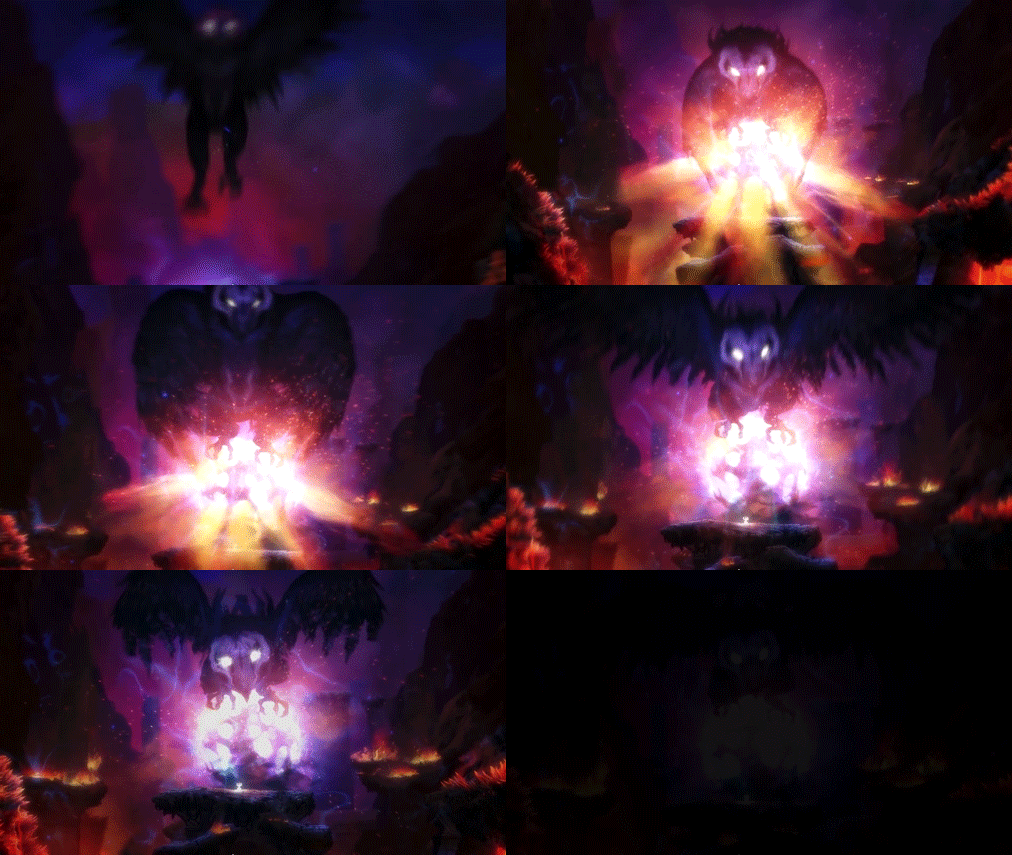
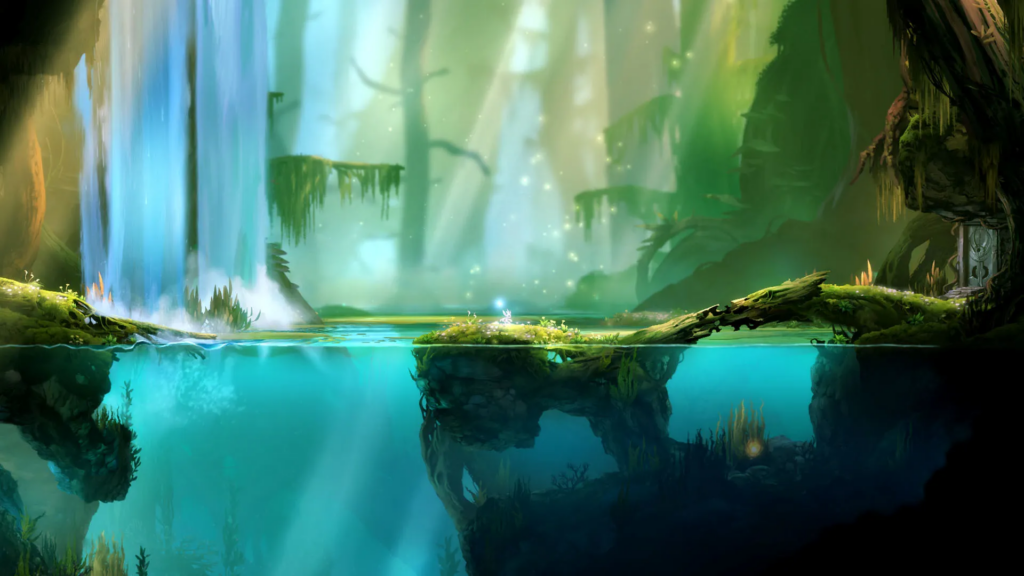
In 2015, Moon Studios released a new game in the metroidvania genre, a genre that gets its title from genre definers Super Metroid (1994) and Castlevania: Symphony of the Night (1997), and is based in nonlinear exploration that focuses on gathering abilities that unlock new areas of a sprawling map. Moon Studios’s first adaptation of this genre came in 2015, with Ori and the Blind Forest, a game published by Microsoft Studios and credited for its beautiful graphics, gorgeous symphonic score, amazing character design, and flowing movement. It was treated as a reintroduction of the genre for many who were unfamiliar and others who had fallen out of touch, and in its style seemed to emphasize the artistry of the regions the player moved through, often zooming far out, putting Ori very small within the shot to capture the entirety of the environment the player moved through, emphasized by swelling music. It won awards for its art direction, animation, and music composition, earning it a lasting name within the Metroidvania space.
Keeping the ball rolling within metroidvanias, in 2017 indie developer Team Cherry released a game full to the brim with bugs—Hollow Knight, introducing players to the world of Hallownest, a solemn world of anthropomorphic bugs, and a story focused on a crumbling kingdom. Similarly to Ori, it was regarded for its artistic focus, as well as its orchestral music, though the two are very different. While Ori‘s art is styled with an approach closer to artistic realism, with rendered shadows, lens flares, and depth within its backgrounds, Hollow Knight uses hand drawn animation for a more stylized approach; the characters obviously have bug-like qualities but are very interpretively reimagined to fit the tone that Hollow Knight art director Ari Gibson was shooting for. While Ori focuses its style on natural beauty, Hollow Knight looks to gothic and dark fantasy themes for its styles, using a much more muted color palette. Similarly, while both games have orchestral scores, Ori composer Gareth Coker uses low brass instruments and choral sounds for its core, while Hollow Knight composer Christopher Larkin leans much heavier into stringed, bowed instruments, capturing a sound that feels similarly classical and dark. Ori and the Blind Forest places Ori small in the frame, emphasizing how big the world around them is, while Hollow Knight often has the Knight crawling through cramped spaces, emphasizing the run-down and unkempt nature of the world of Hallownest.
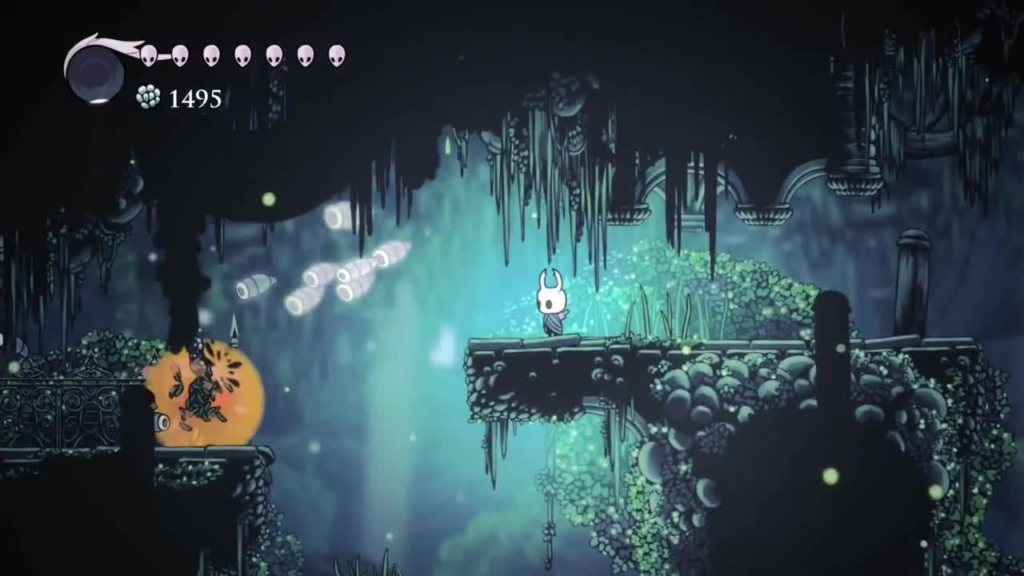
The two games felt natural to put in conversation with each other as separate but similar facets of the metroidvania genre. Ori focused heavily on escaping dangerous situations, while Hollow Knight asked the player to face them head-on, having much more focus on boss battles and deadly encounters with dangerous foes. Both games focus on the restoration of a place that has fallen into chaos, in Ori because of the Spirit Tree’s core being taken by the game’s antagonist, while Hollow Knight‘s titular character is found out to be an imperfect vessel for containing the Infection, a disease that possesses the minds of the bugs of Hallownest.
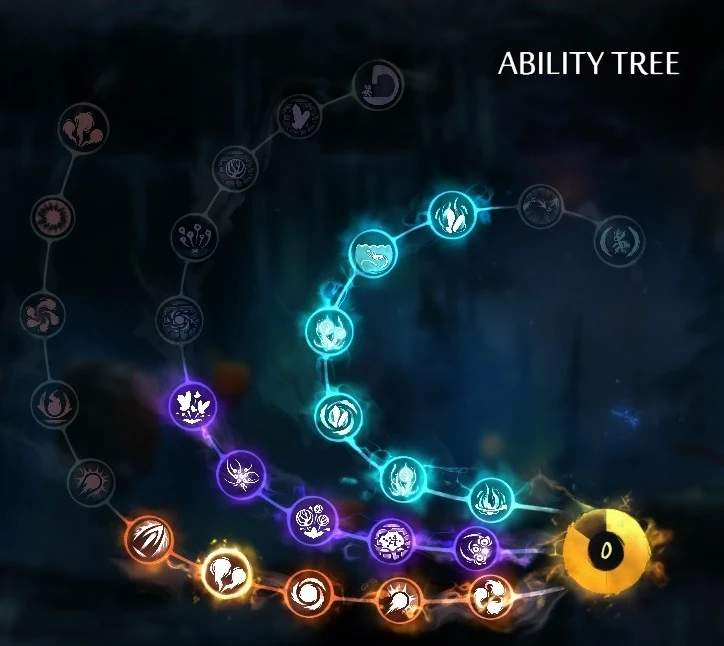
Shortly after the game’s release, Ori and the Blind Forest director Thomas Mahler jumped into a forum discussion on NeoGAF comparing the two games, expressing criticism for Hollow Knight‘s pacing, saying “I like big games as much as the next guy, but if your game is big, you still need to pace it correctly.[…] Even on Ori, I always felt that the time it took to gain the DoubleJump was a little too long […] But here, I feel like I’m traversing soooo much and very rarely get new stuff, so I’m much more encouraged to put the controller away since it always feels like there’s probably nothing new within the next area anyway.” After another poster expressed that they thought Hollow Knight‘s pacing was better than Ori‘s, Mahler responded with surprise, comparing the two titles again, saying, “In Ori, you got a new ability every 20-25 minutes or so and you also had the Ability Tree – Here, the Charms don’t really add all that much to the gameplay itself and it takes forever to get new abilities.”
His criticism is certainly fair; according to howlongtobeat.com, Ori and the Blind Forest is said to take 9-13 hours to complete, while Hollow Knight is slated at a much longer 27-64 hours. In order for the games to both feel equally progressive throughout, Ori‘s new ability window necessarily had to be shorter to match pacing needs. This can be easily seen with comparing Ori‘s Energy Cells and Life Cells to Hollow Knight‘s Vessel Fragments and Mask Fragments: each of Ori‘s basic resource pickups automatically increase their respective statistic, rapidly increasing Ori’s ability to survive hard hits and move through the world. Conversely, Hollow Knight‘s progression is a lot slower, requiring four Mask Shards to gain a single extra mask (masks are the health markers in Hollow Knight) and three Vessel Shards to gain an extra Soul Vessel, which hold Soul, Hollow Knight‘s ability cost. Additionally, while Ori‘s ability customization options are more customizable, being an ability tree that Ability Points found out in the world can be put into, Hollow Knight‘s leads to more varied loot, with its charm system making every pickup a gamble as to what new ability you might be getting.
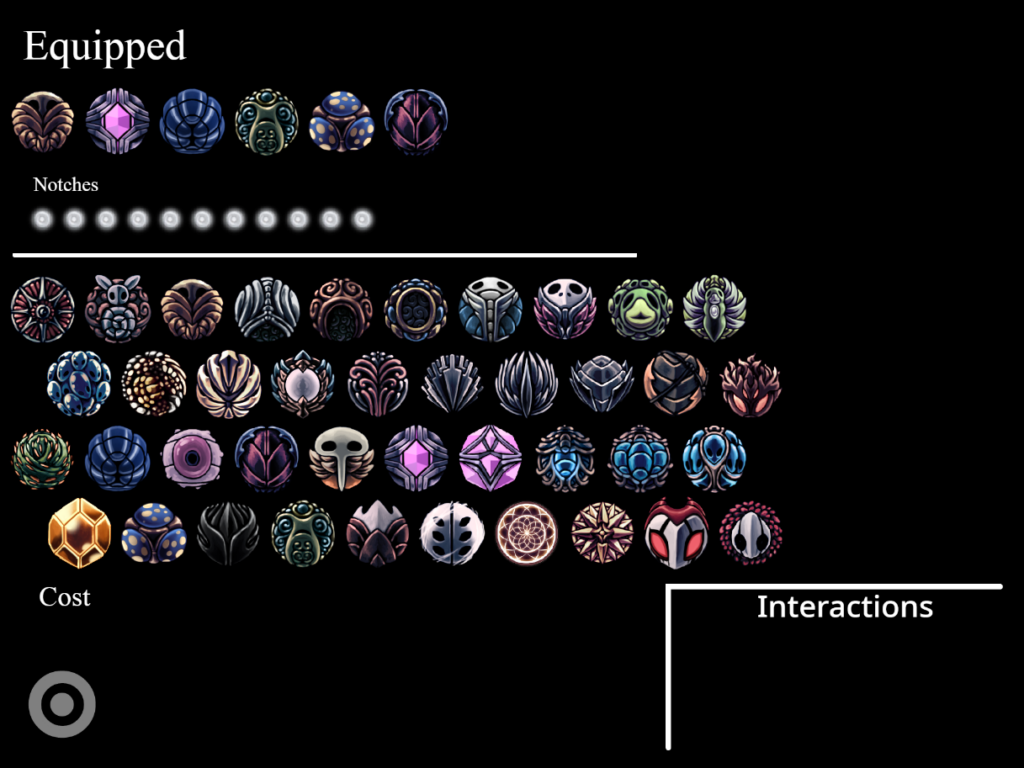
In the same NeoGAF forum, Ari Gibson responded to Mahler’s criticisms, saying, “Cheers Thomas. William and I are pretty big fans of getting lost in worlds, so we pretty much set out to create one that allows you to do just that. […] Ultimately 60% of Hollow Knight is optional content anyways. […] Many of the areas never need to be entered. […] Pacing as a result is definitely more languid, though we try and spice it up with different enemies and areas, and an evolving array of moves, charms and charm combos.” Mahler responded, “Interesting thoughts! Even though I may sound a bit critical, keep in mind that I’ve been doing nothing today other than playing Hollow Knight, so while I’m skeptical of certain choices you guys made here (mostly pacing related), it still has its hooks deep in me and I’ll definitely try to finish it ASAP.”
Studying these two games as a pair allows insight as to how each studio decided to push the metroidvania genre forward, and their remarks shared on NeoGAF provide a sense for the mentality that went into both games, bringing out in the open the different design decisions for conversation.
So how did each studio take criticism, feedback, and other games in the space into consideration while making their sequels, Ori and the Will of the Wisps (2020) and Hollow Knight: Silksong (2025)? Well, that’s a discussion for another time.
Written by Echo Ziemba