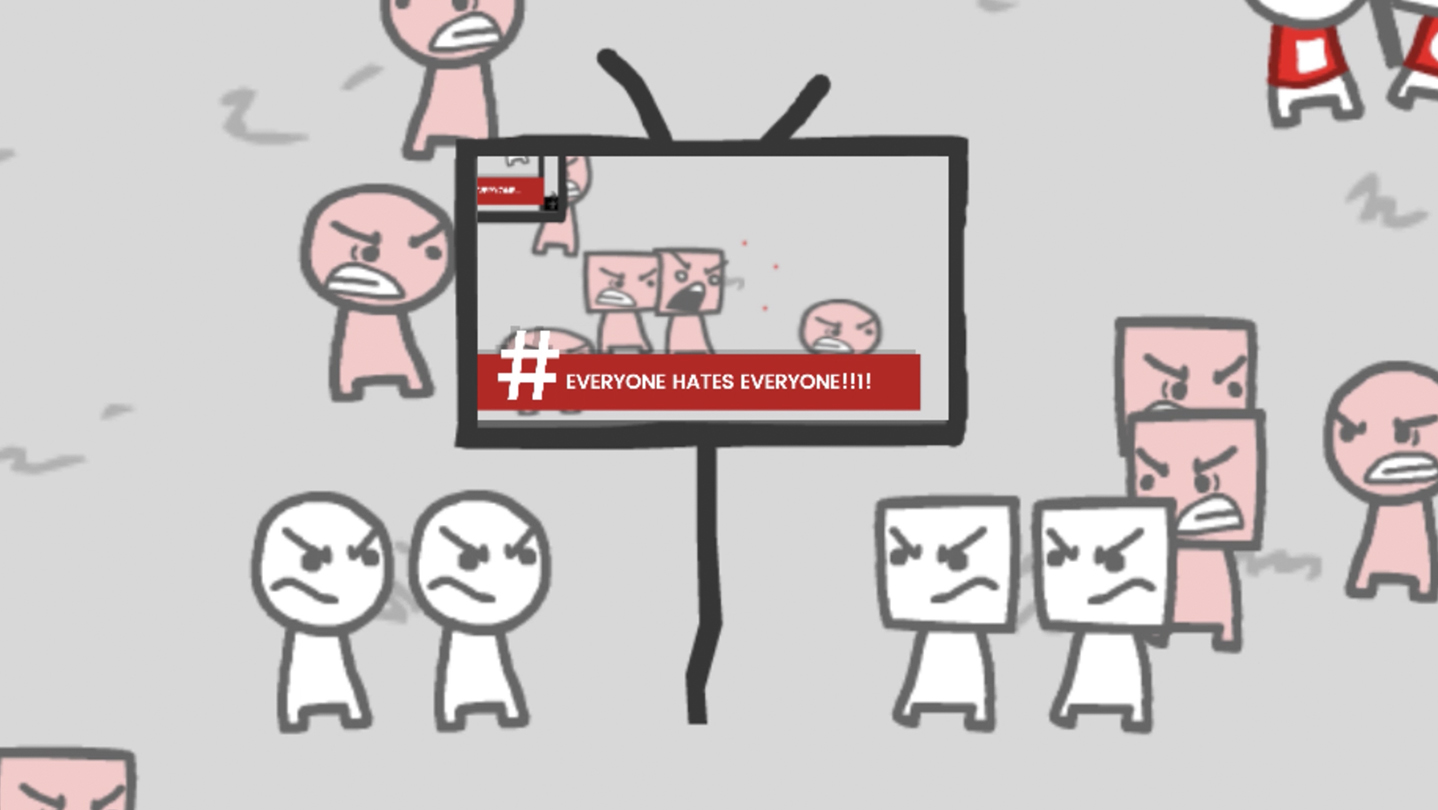
We Become What We Behold utilizes deceptively simple and cartoonish graphics for a game that discusses the power of media to manufacture narratives that stoke violence. The characters within the games are cutesy figures with square or circle heads rendered in a simple 2-D style. Even the game’s color scheme – monochromatic grays – is rather ordinary, seemingly at odds with its subject matter.
In my own initial playthrough of the game, I found this contrast jarring. Not to mention, the unserious, oftentimes snarky tone of the commentary given when snapping photos for the media (i.e. “ya gotta catch them doing *something* interesting) even as the violence between circles and squares escalated seemed out of place. It seemed disrespectful for the commentary to adopt an attitude of mild annoyance and nonchalance regardless of the circumstances.
However, upon further reflection, I realized that this perceived insensitivity was not a flaw of the game, but rather its objective. In depicting the media outlet the player acts as an agent for as wholly unserious and apathetic towards the real lives of the individuals its capturing, We Become What We Behold imparts commentary on the media ecosystem at large, depicting it as wholly driven by the need for sensationalized content and polarizing narratives. It’s the precise discomfort we feel witnessing the contrast each time we take snapshots of the surrounding circle and square population that alerts us to the kind of emotional distance required to perpetuate dangerous narratives for the sake of attention and profit.
The artstyle, too, is not cartoonish for the sake of making light or extracting sadistic joy from simulating the suffering of innocents at the hands of divisive media narratives, but simple in a way that isolates the issue’s most important dimension – that it happens to ordinary, unassuming people. Outside the shape of their heads, the circles and squares have no distinguishable differences; they walk around in the same manner and – as its revealed when you capture a picture of the monocled circle with a top hat – are just as susceptible as one another towards the trends and ideologies pushed by the media screen.
However, it still can be said that the game’s distillation of the issue of media polarization doesn’t address some key factors for how the issue plays out in the present day context. For one, it fails to capture how discrimination based on race, class, and gender complicate which groups are targeted for negative narratives. Circles and squares are treated as equally susceptible to the fearmongering of the media screen, which necessarily makes their differences seem arbitrary or unimportant, when in reality differences in identity and background carry significant weight when it comes to intergroup violence. Historical narratives, stereotypes, and discriminatory institutional standards all impact a group’s status within society and the opportunities they’re afforded. As such, holding media outlets accountable for the divisions they stoke should not be considered in isolation of the origins of the ideas they champion.
Still, We Become What We Behold carries a potent message for the viewer in spite of its inability to capture important nuances of our media ecosystem. The game’s ending sequence is particularly strong, as the gradual zoom out to a computer screen as the onscreen slaughter continues demonstrates its meta-awareness of its medium: an online game being played on a screen. In making the player distinctly aware of this fact, the game invites them to recognize that the game, too, exists in an online world. Viewing the screen containing the media screen of the game forces the player to contemplate what “snapshots” they’ve absorbed passively and without question. Just as the game points out how the aesthetics of media are calculated and not just for show, it extends this awareness to its own visual design, inviting players to be wary of all forms of information they consume.


This was such an interesting take! I hadn’t thought about the commentary voice as part of the critique, but you’re right, the mismatch between tone and violence makes the whole thing feel unsettling in a way that works. And I appreciated your point about how the circle/square metaphor smooths out real differences that matter. It made me think about how simplification is both the game’s strength and its limitation.
Thanks for this post! I really appreciated that you complicated our in-class discussion about this game being representative of American media. I agree that the game could better reflect how deeply racialized modern media coverage is. Maybe it would work by depicting the circles as more violent in the media headlines but showing that the violence and instigation across the whole screen was actually equal. The biases of the media are an incredible factor in their sensationalized headlines, so I do agree that it would be very valuable to incorporate this into the game. Time for We Become What We Behold 2.0.
I appreciate your critique about the game flattening social differences in real life. It’s true that media narratives don’t impact each group equally, and the game could acknowledge this fact. I do think the simplicity here is intentional and effective in making the mechanism of media sensationalism easier to understand.