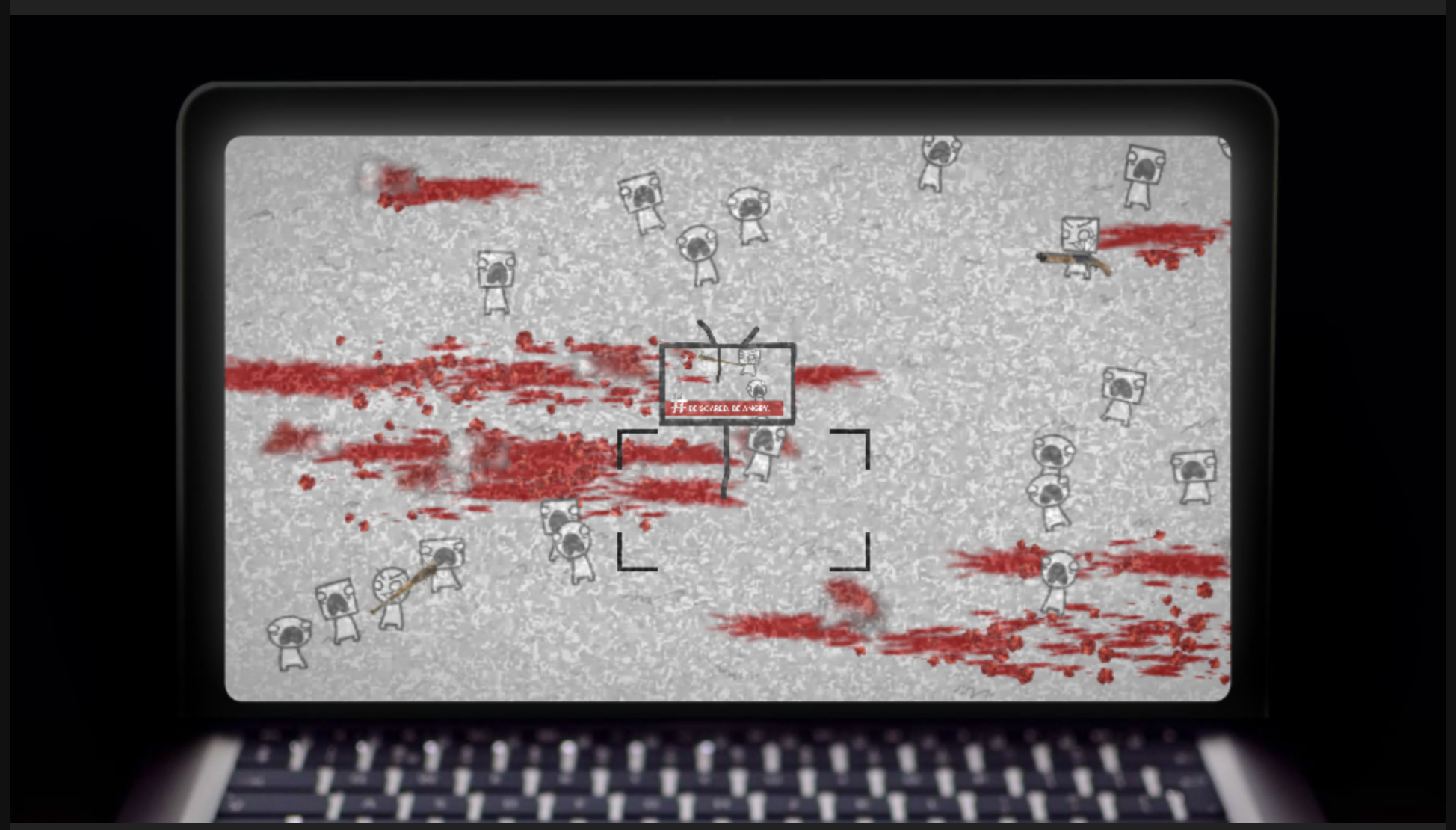
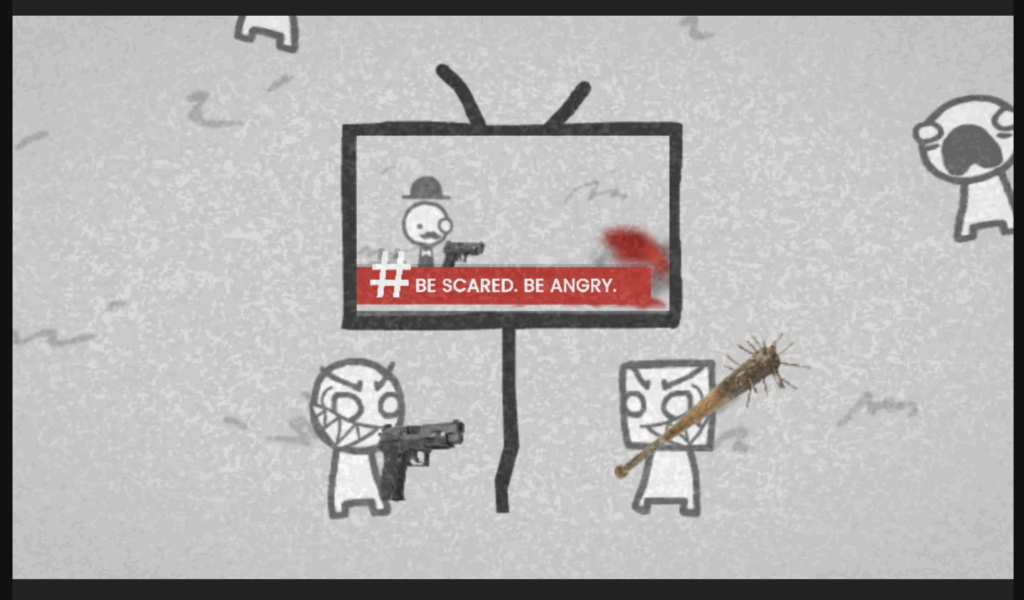
We Become What We Behold is a deeply unsettling game. It starts cute but devolves into violence and hate. It’s absurd, it’s scary, and it’s real. The simple art style, whimsical animations, and unassuming sprites create an illusion of peace and the player thinks that we are playing an easy going game with low stakes. Soon enough however, news trends sharing the hottest hat fashion becomes institutionalized and mass produced hate. The player, playing as the hand of the media, has no choice but to progress the game by spreading hate. In what may seem, on the surface level, as a superficial difference between sprites – circles and squares – becomes a violent hatred between people.
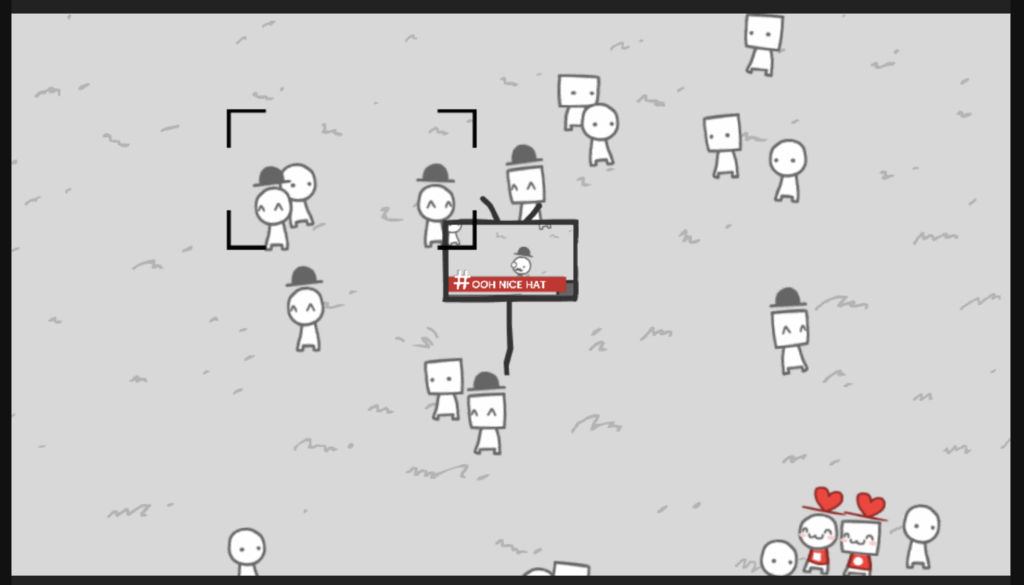
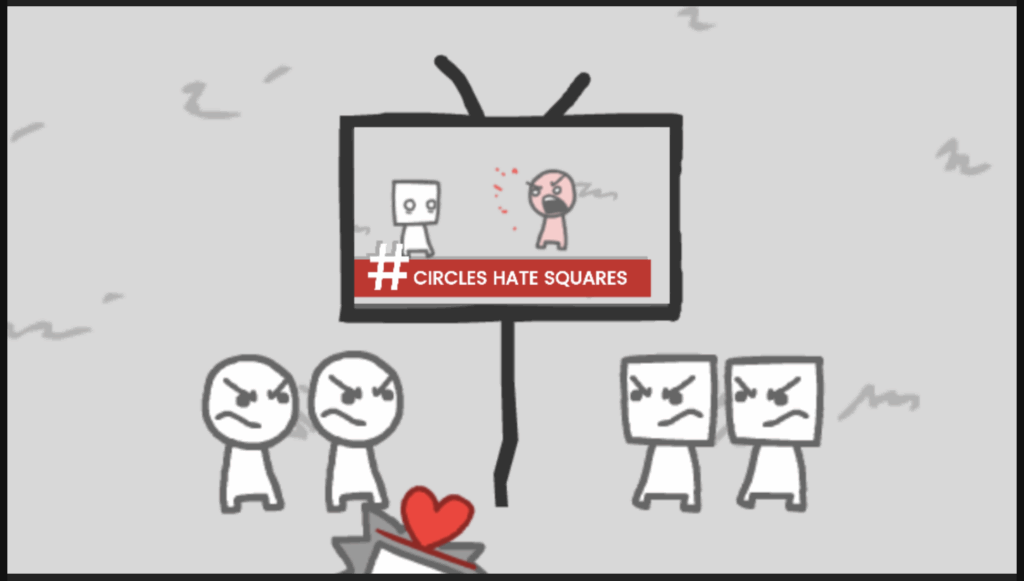
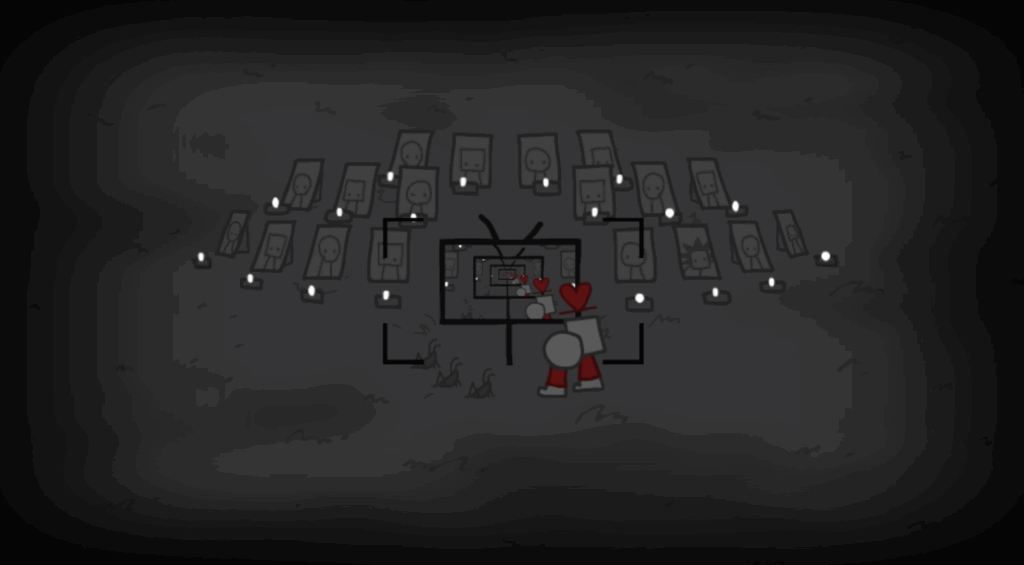
The game devolves rapidly into violence and hate, and very quickly the player is forced to question their role in the ensuing unrest. Your cursor as the eye of the camera hovers omnipresent throughout the game. The player is a tool used to perpetuate anger and the vitriol, and no matter how many times you take photos of the peaceful relationships between circles and squares, or protests calling for peace, the hashtag headline on screen berates you to return to capturing and sharing the violence. The game says quite explicitly to the player that “peace is boring, violence goes viral.”
In the over-exaggerated and dramatized microcosm of the screen within the game, the fear mongering tendencies of the media is a forced reflection that players must reckon with. In an age of social media, everyone has a chance at becoming famous. What matters in the media becomes less the whole truth and more of what is the marketable half truth. From the scale of government operated or state-owned media and public broadcasting institutions to the instagram account of a single person, we each play a role in the spread and perpetuation of hate. The phrase “you are what you eat” becomes all the more apparent in todays climate – not just in terms of what food we are eating. With media consumption, the side of the internet in your device becomes what you experience as general consensus. It is easy to assume that what you are reading on your Twitter timeline is the reality behind everyone’s experience. Our need to conform to the rest of our peers creates an echo chamber in which we truly believe in the media we consume, whether we realize it or not. You are what you eat because we become what we behold – we rely so heavily on others’ perceptions and what the invisible hand of the media is telling us others’ perceptions are that we forget to consciously reflect. It’s easy to be spoon-fed content and told how to feel. That’s what Nicky Case is trying to tell the player in We Become What We Behold.
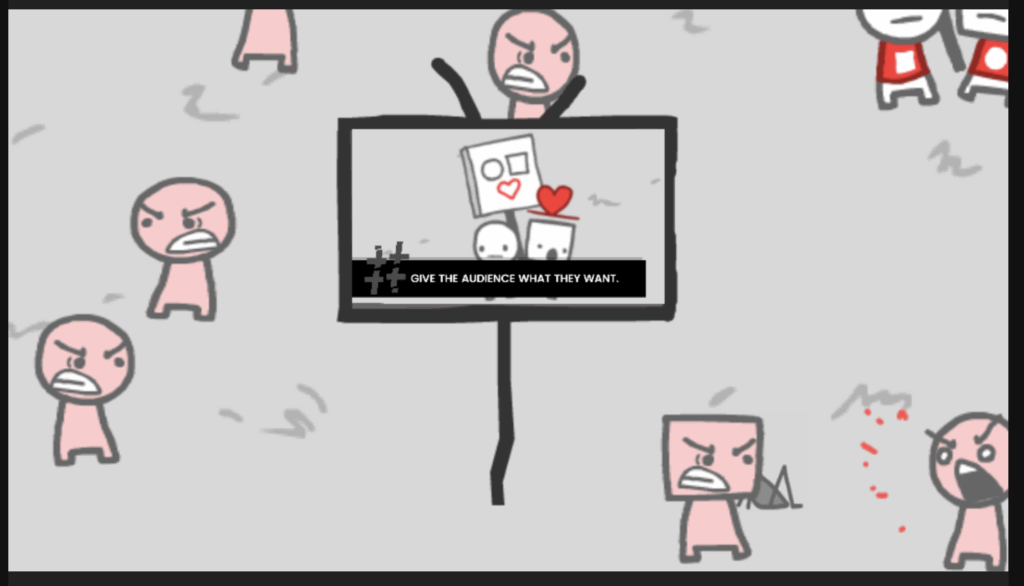
Your attention becomes such a valued commodity in our modern world that people will do anything to monopolize it. AI slop and other forms of bot generated rage bait dangle carrots of instant gratification and stimulation over our already overstimulated and burnt out attention spans. In such a world, the dead internet theory seems all the more plausible – by manipulating the content we consume, algorithms and those who control said algorithms manipulate public opinion, perception, and experience.
Last spring, I took the MADD course Conscious Media Practices in the Age of Brain Rot with Chris Collins. The anxiety over what we consume is more heightened now than ever before, and the first step towards fixing our media diet is to understand and recognize the problem. Media practices and creative critique found in games like We Become What We Behold have the unique capability of pushing a more visceral reflection. The player is unable to be passive, and must play the active role of perpetuating violence, hate, and gore. Eric Zimmerman explains this as gaming literacy; games hold the capacity of opening up an inner “magic circle” to address meanings that exist and arise outside of the context of the game, like any other piece of literature or media. What makes games different, like what we have discussed previously, is the transformation of the audience from a passive consumer into an active participant. The consequences and deliberations within the game are felt by the player in real time, and ultimately lead to a more visceral reflection back on the self.


I really loved your line, “The phrase “you are what you eat” becomes all the more apparent in todays climate – not just in terms of what food we are eating.” and I agree with what you’re saying. What we consume online affects us whether we know it or not, I can feel it based on what kind of reels I’m consuming on Instagram and how it affects my perception of life even though I’m the one actually experiencing it. I think in We Become What We Behold, it’s really interesting how all the circles and squares live in a small rectangle of space, they can plausibly see what’s happening around them, and yet the thing that really influences their decisions is whatever is on the small rectangle screen. Although, I guess you could say the same thing about us.
I found your commentary about how our modern-day attention economy capitalizes on our limited attention spans through instant gratification to be very insightful. As much as people are self-aware of their media consumption and can make light of how easily they fall victim to online ragebait or sensationalized information, the awareness means nothing if we still passively participate in the attention economy. I think this idea ties really well into your points about the We Become What We Behold medium, and how by forcing the player into being an agent of the media outlet through active choice, the game prompts the player to reflect more deeply on their own media consumption practices — in a way that goes beyond just the practices themselves and into the larger, insidious institutional forces that control the spread of ideologies. However, to some extent, the straightforwardness and explicitness of this message may turn some people away from such considerations as opposed to if the game took on a more embedded approach.
I enjoyed your commentary, especially the line “It’s easy to be spoon-fed content and told how to feel,” since it reminded me of the accounts on X that had their locations revealed recently. Unsurprisingly, “democrat” and “republican” accounts turned out to be fake, with many being based in Africa, Asia, and Eastern Europe. However, what was most interesting about this case was how fake many of the profile pictures looked as if they were AI-generated. If context can be manipulated as in, We Become What We Behold, the thought of manipulating reality is even more terrifying. Who will ever know who is saying what in the future…