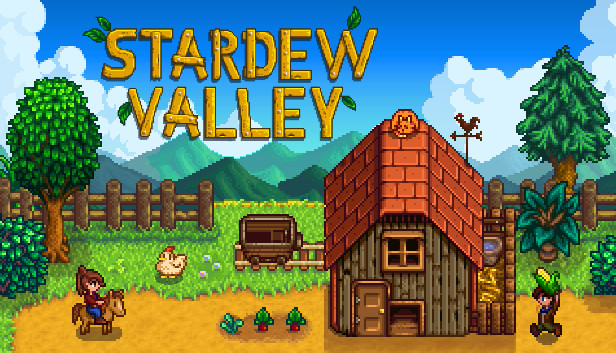
Stardew Valley is one of my favorite video games—both to play and to watch other people play. The game has come up in class, but for those who don’t know, Stardew Valley is a farming simulator based around the general goal of completing one of two main paths: completing the Community Center or completing Joja Mart. The community center is a dilapidated building next to Pelican Town (where the player’s farm is located), and completing it requires players to gather a variety of items to complete bundles and restore the center. Joja Mart is essentially a superstore owned by Joja Corporation, a megacorp that intends to capitalize on Pelican Town and seize its land for their own means of production.
If a player chooses to take the community center path, they must gather everything from a variety of fish to mined minerals to farmed goods. To acquire seeds and other resources for the bundles, players on the community center path must purchase goods from Pierre, who runs a general store in town. The Joja path requires players to make money and pay for “community development” projects that progress the game, and goods are typically purchased from Joja Mart rather than Pierre’s general store.
The game opens with a scene of the player’s character working at Joja Corp. They are clearly miserable and burnt out, and choose to move to their deceased grandfather’s farm to find happiness. I have never selected the Joja Mart path, because it so clearly represents traditional, “soul-sucking” capitalism bent on making money at the expense of people and the environment. The community center and Pierre’s general store were the obvious choice—labor I enjoy (collecting items) for the good of the community, rather than contributing to a megacorp. So, I amassed all of the goods that I needed for the center, and then some. I set up an ancient fruit greenhouse to make wine and jam to sell for thousands of gold; I bred a dozen pigs so that they could dig up truffles to turn into oil for more gold; and I crafted tea tree saplings by the bushel to sell, because they were more profitable as saplings than planted.
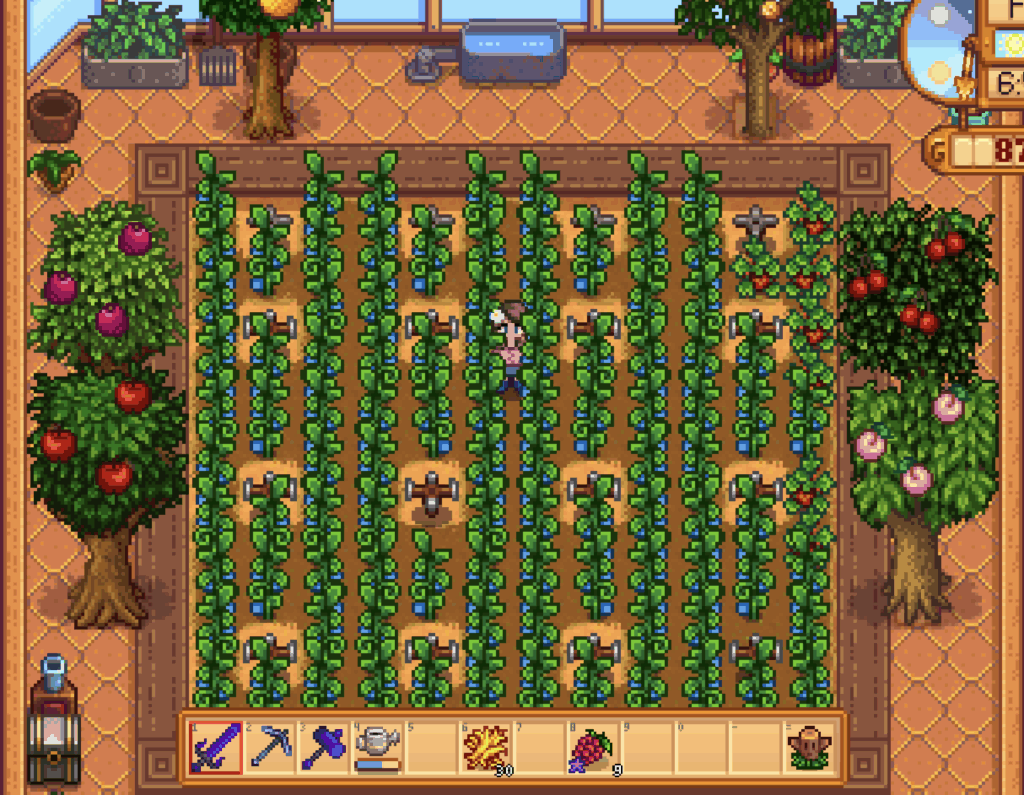
While Stardew Valley does necessitate labor, the way I was laboring had turned into the very thing I had set out against. My goal had become making money. Stardew Valley was supposed to be about “playbor”—enjoyment of labor—by cultivating crops and animals, building relationships with the community members, and completing the community center along the way. Once I realized that my money-oriented goal had slashed my enjoyment of the game, I started a new world, where I focused on playing slowly and focusing on “whistling while I worked,” and found that I enjoyed that process much more. And that world is still going! Stardew Valley is a real testament to the idea that labor can be enjoyable, yet people can still make it much more severe than is necessary.


I think you pointed out something really interesting—sometimes we can get so focused on being efficient and good on a technical level that we limit our own enjoyment of games. I had a really similar experience with Stardew Valley at first. I was so overwhelmed with not having the money or items that I saw online that the game stopped being about fun and felt more like a chore. Putting the guides down and taking things slow was the only way I could play again.
This was an interesting read, especially because it reminded me of a conversation with a friend I had once where I asked him about his experience playing Stardew Valley and he told me he started every game by trying to ‘minmax’ and hoeing the dirt to maximise chances of gaining clay which could be used or sold. For me, this idea took a lot of the fun out of Stardew Valley; I have a couple of friends that have their own strategies for starting the game. I usually just go ham chopping trees because the action itself brings me joy. The idea of playbour is interesting; I wonder at what point an action or motivation moves from playbour into being monetarily / progress motivated.
The way you described how you ended up where you had originally tried to diverge from is a really good example of the slippery slope that comes with labor in video games. While I have never played Stardew Valley, I have absolutely fallen down the pipeline of not wanting to do the, as you put it, soul-sucking tasks to inevitably doing said tasks because I had lost track of what I actually wanted to do. I am glad that you realized what you weren’t having fun in your gameplay before you gave up the game entirely, but I also think that starting a new world so you could play how you actually wanted to also represents an element of the transition from typical ‘labor’ into ‘playbor’: the idea of starting over so you can actually enjoy the effort you are putting in.