Neoliberalism can be defined as a political and economic ideology that advocates for free-market capitalism. As discussed in class, famous proponents of neoliberalism include the Iron Lady Margaret Thatcher and Ronal Reagan. For Thatcher, her goal was to privatise previously public companies and reduce the power of trade unions. She was also the main proponent of the wildly unpopular poll tax, a tax that charged each individual a lump sum regardless of income (as opposed to a progressive tax that charges everyone an equal proportion of their income).
In contrast, Tom Nook—one of the first characters you meet in Animal Crossing: New Horizons (ACNH)—promises zero interest on the loan he provides you.
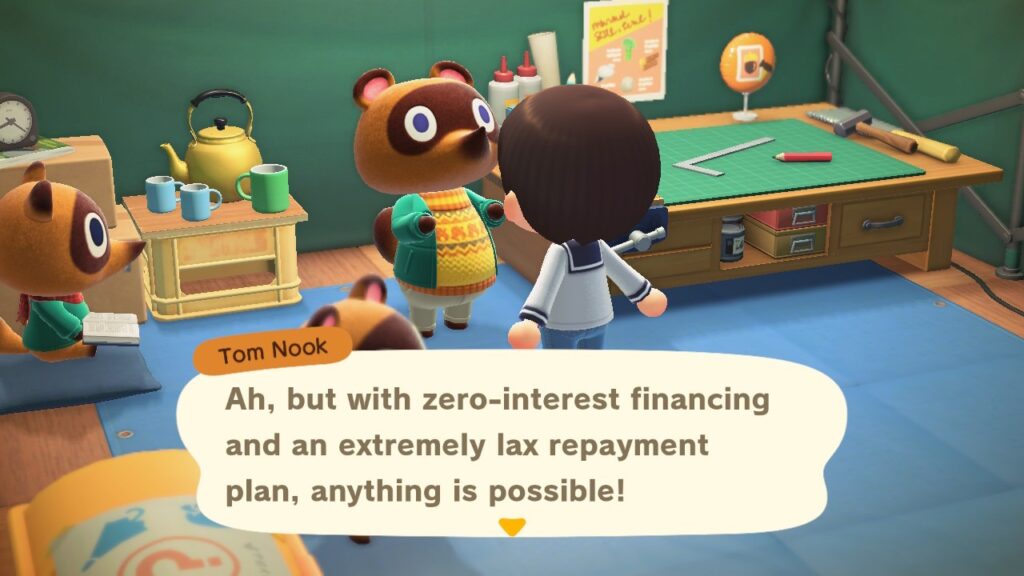
This might seem like a great deal until you realise the size of the loan he expects you to pay off.
Animal Crossing Wiki
In the first week of ACNH, arguably the easiest way to obtain bells (the main mode of currency in the game) is mass-deforestation and fruit collection. After paying off your debt from a tent you didn’t even ask for using Nook Miles (which can be obtained through… deforestation and fruit collection, to name but a few nature-destroying activities), you are then confronted with the fact that unless you pay Tom Nook the exorbitant sum of 98K bells, you cannot upgrade your tent into a house.
This system of loans and payments continues throughout the game. As shown above, players need a whopping grand total of nearly 9M bells to fully pay off every single iteration of their home. There is no option to go it alone and, say, build your own house in ACNH, because that is simply not the purpose of the game. It is not trying to say anything about capitalism; the main purpose of the game is to enable players to explore and have fun—not to make a point about capitalism. However, considering the neoliberalism discussions we had in class, it could be interesting to see a version of ACNH where the player must contend with Tom Nook’s monopoly and aim to destroy his 100% market share.
By contrast, in Stardew Valley, you have the choice of supporting a local business, or traveling a little further to shop at JojaMart—the game’s big box retailer that usurps the little guy. While slightly on the nose, Stardew Valley does a good job of exemplifying the costs of modern day capitalism (which, arguably, is the follow-on from neoliberalism). The game gives a nod to the Walmart Effect; the concept that, when a Walmart opens up a new location, the smaller supermarkets in that location go bust because they cannot compete with Walmart’s lower prices.
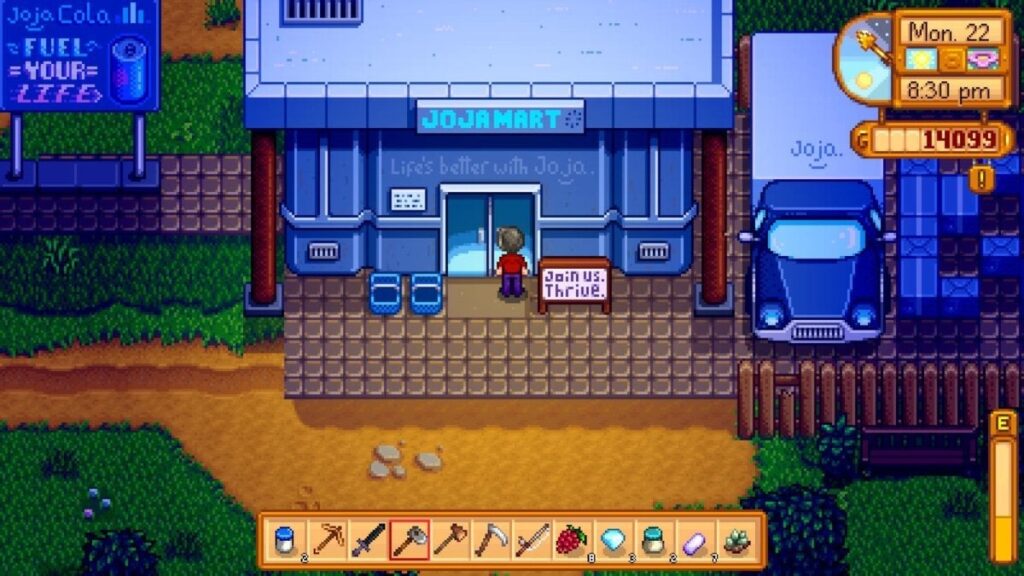
https://www.ign.com/wikis/stardew-valley/Joja_Mart
At the crux of this arc, the player is tasked with choosing between Pierre’s or JojaMart. This choice represents a choice between socialism and capitalism. Will the player support the local businesses and community or go for the cheaper, more convenient option?
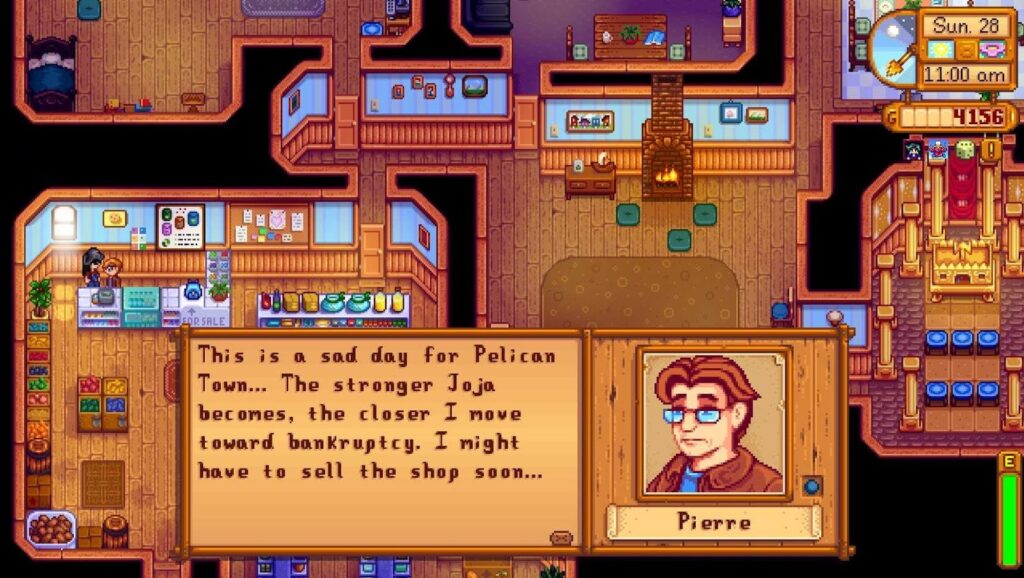
https://www.thegamer.com/stardew-valley-joja-route-community-center-jojamart-prices/
Neoliberalism advocates for free trade markets. When considering the above two games, Stardew Valley is a better example of free trade in that you have more than one option when trying to purchase goods. Animal Crossing is essentially a monopoly; the player can only purchase specific items from one vendor. At the beginning of the game, the only way to purchase any good is through Tom Nook. Conversely, you are able to purchase goods from either JojaMart or Pierre’s in Stardew Valley (though this does have narrative ties as opposed to Animal Crossing, where it is purely a function of the game and does not have a narrative purpose other than to annoy the player).


i’m SO glad someone wrote about these two giants of the cozy game genre with regard to neoliberalism because the gameplay loop of animal crossing, stardew valley, coral island, [insert cozy farming sim here] really does replicate neoliberalism pretty well. there’s been a decent amount of writing about this topic as well, and i wanted to share an article that i came across a couple years ago that discusses this with regard to the rise of the cottagecore aesthetic. the article is called “The Rise of the Cottagecore Game: The Modernity of Digital Gaming and Content Consumption” by Seunghyun Shin and it was published in acta ludologica, a pretty cool journal that talks about games and digital games. here’s the link: https://actaludologica.com/the-rise-of-the-cottagecore-game-the-modernity-of-digital-gaming-and-content-consumption/
yooo thank you so much for the link!! i’ll def take a read :)) i was just thinking about how SDV and ACNH kind of interplay with one another and how their narratives surrounding capitalism are quite separate yet intertwined!
I really appreciated this analysis of these two games. I’m suck hundreds of hours into both, but honestly it was hard for me to put into words why Stardew appealed to me again and again whereas my Animal Crossing villagers haven’t seen me in 5 years.
I think one of the differences is also the character writing in both games. Animal crossing is not about people or characters. The animals barely have a personality anymore, instead they become another kind of collectible decoration, which feels super bleak.
Stardew on the other hand has characters that you can either love or hate. I think that’s a huge part of the appeal, and probably why the fanbase hates how marriage flattens characters in the game.