For those who don’t know me, I’m Audrey, a BizCon MADD double major, and despite choosing to take Critical Video Game Studies, I have very limited experience with videogames.
While many of my classmates were familiar with Cookie Clicker and its popularity, I had never even heard of it before. Considering that this week’s focus is “Labor and Neoliberalism” I was looking forward to viewing this game with a focus on how it might critique current forms of neoliberal capitalism. In short, I felt fairly disappointed, not because it doesn’t critique neoliberal capitalism, but because it is rather shallow with its critique.
Let me start with a recent event that might illustrate my thoughts a bit more. As many of you might have seen in the news, the United States Government has stopped minting the penny, mainly because it costs more than 3 cents to make one. I’ve seen a decent amount of negative reactions from people dramatically complaining about how the death of the penny is symbolic for the death of the American Dream. While you could make an argument for this, I believe that there are more solid recent events that better illustrate wealth inequality and governmental corruption, mainly because inflation in itself is not bad.
What do you mean by this Audrey? Do you really enjoy paying higher prices for things over time? Well of course not! I wish I could still buy a $5 footlong sandwich at Subway, but even though the price has changed since 2014, several other important things have changed too. First, the purchasing power of a dollar has decreased as more money is put into circulation. According to the Bureau of Labor Statistics, $1.00 in 2014 has the same purchasing power as $1.36 in today’s currency. Therefore, a 2014 $5.00 footlong (we’ll exclude tax for this calculation) should be purchasable for $6.79 today. However, if any of you have been to Subway, this price is sadly far off. The cheapest anyone can buy a footlong for in the United States is about $15.00.
So what’s gone wrong? Inflation, and even high rates of inflation aren’t inherently bad (other than maybe the instability it provides). For example, maybe inflation was 10% one year, but maybe median salary increased by 15%. Inflation is a very normal economic process as a result of many things, including increasing demand, more money being circulated, and low interest rates that encourage loans and investments.
Inflation is bad, however, when it rises faster than the average cost of living or salaries. The world is becoming more productive, but much of the fruits of people’s labors are going to the top 1%. Now this is where I find Cookie Clicker falls short.
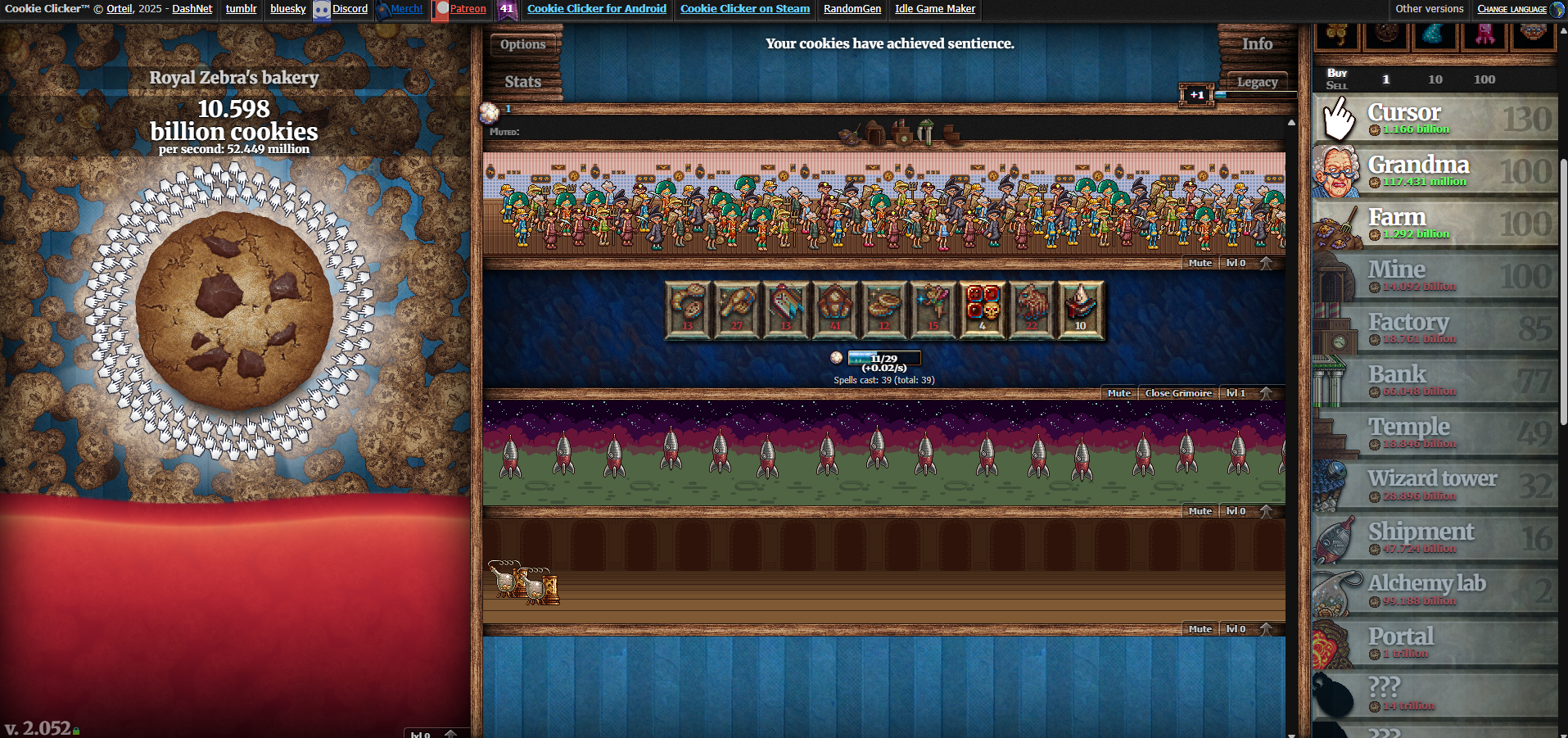
In Cookie Clicker, you bake more and more cookies until eventually, cookies overtake gold and money as a form of currency. As I was playing the game, I was really annoyed at how much the prices of things increased. A cursor original cost 15 cookies, but after owning 130 cursors the next one costs $1.166 billion cookies. There isn’t a sense that the game gets easier as you go, because even if you get more buildings or more power-ups, everything just costs more since you are basically just buying things to produce more currency.
I feel like there could have been a lot more avenues explored rather than just touched upon. The News panel did a good job of opening up avenues for the player to think a bit more about bigger implications of the game and how it relates to the world. Here are a few economic gems I screenshotted:



Maybe it’s meant to be reflective of the apathetic mental state that CEO’s and world leaders have, but playing Cookie Clicker, I didn’t ever feel like I was in the top 1% or have much of sense of responsibility for anyone’s wellbeing. I couldn’t actually buy anything with my cookies, except more investments, and the workers never felt like more than graphics on a screen. Eventually, I got pretty bored of playing.
It would have been interesting to see more of the Grandmas’ or other workers’ perspectives, since the player literally buys Grandmas; instead of showing this through the news, I’d rather it have been show more through actual gameplay. For example, maybe your Grandmas go on strike unless you pay them more, so you have to decide if you sell off all your Grandmas or give them a raise. I would have loved to see gameplay that makes the player feel more responsibility or guilt for their ownership of everything. There’s no taxes, no options to donate, no options to better or worsen people’s quality of life. The game for me is really just buy, buy, buy and produce, produce, produce. However, maybe that is the point. These are just negative cycles of production without thought, and it’s up to the player to eventually just stop the cycle by closing the game.
I definitely went on a tangent here, and maybe pennies and Subway sandwiches weren’t the best illustrative examples, but I hope they helped you understand my though process. Let me know your thoughts and if there are any ways you would have changed Cookie Clicker!


I agree with you that the game becomes pretty boring after a certain point. I think the game is supposed to be reflective of the need to continue accumulating wealth for no good reason and the disconnect owners have with the labor of their workers. After a certain point, the primary motivation for wealth accumulation is greed. You can’t even see all the factories, grandmas, and mines you’ve bought because there is no space on the screen, so what really is the point?
I do agree with your point on the increasing level of prices being outrageous and sometimes unplayable. I would argue that its inclusion would serve as a kind of satire on the pursuit of profits and increased efficiency at any cost that companies are starting to pursue. As more profits are accumulated, people may start to lose sense of reasonable choices like not spending more than 1000 billion dollars on another cursor in favor of the incentive of getting just a little more profits or a little more work done, with some real life examples being the switch between computer softwares that would require loads of new training and personnel all for a little better workflow efficiency or mass layoffs of old workers in favor of new ones with less wage requirements.
I was also thinking about this game in terms of production cycles through capitalism. I agree that you can make some sense of what the game is trying to make you feel, but I think your point about the mechanics lending themselves to a shallow message or critique is spot on. If this game was trying to be affective in any way possible, I think the dullness of the mechanics dampen that incredibly. If the true point of the game is to be critiquing labor power or the accumulation of wealth, it certainly fails to capture the necessity, or desire to stay in these production cycles because the player really has no incentive to keep playing.
I also find the game a bit boring after playing it for a while. I agree that the game doesn’t make me feel like the top 1%. You are accumulating resources, but not really influential in any other ways, which makes the critique feel shallow. It would be interesting to play Cookie Clicker from the grandmas’ perspectives.