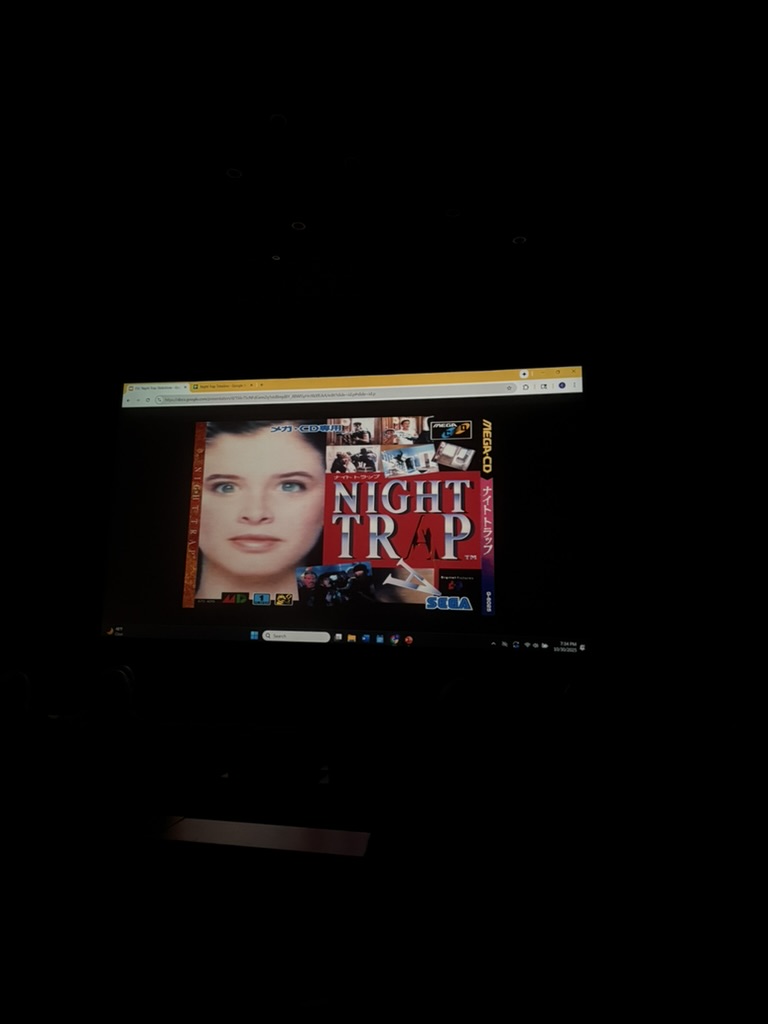
I almost didn’t go to the Night Trap playthrough. Horror games aren’t really my thing, and when I heard it was about vampires attacking teenage girls at a slumber party, I figured it’d be campy at best and creepy at worst. But it was Halloween week, my friends were going, and I thought, why not? At the very least, I’d get to see what all the early 90s moral panic was about.
Turns out, it was way more interesting than I expected.
I’m Your Man, or: Why Haven’t I Seen This Before?
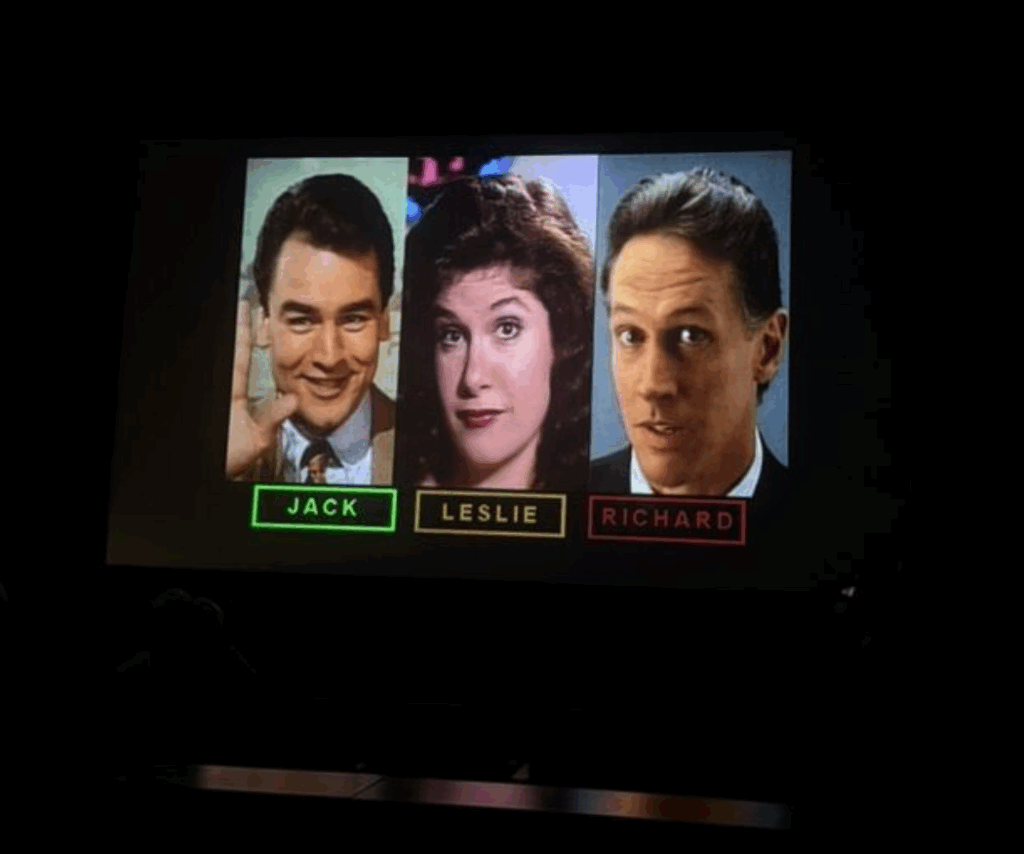
Still from the interactive film I’m Your Man (1992), screened by Bret Hart before the Night Trap playthrough. Audience members voted between Jack, Leslie, and Richard by a show of hands. Photo by Jihu Park.
Before Night Trap, graduate student Bret Hart introduced us to a 1992 interactive movie called I’m Your Man. Apparently, it was one of the first films where audiences could vote on what happened next using buttons at their seats. We didn’t have buttons, so we raised our hands instead. Jack, Leslie, or Richard? The chaos that followed was hilarious. People shouted over each other, changed their votes mid-way, and half the time no one knew which option had actually won.
Hart explained that back in the ’90s, this kind of interactivity terrified filmmakers. What if audiences stopped watching films altogether and only wanted to play them? Sitting there, that fear felt almost cute now. We interact with everything, from Netflix menus to TikTok filters. Still, there was something radical about that moment. A whole room of students making collective decisions about a story we didn’t control. Before the main event even started, we were already part of a weird, shared performance.
The Setup Is… Uncomfortable
When Night Trap finally loaded, I wasn’t ready for how wholesome it looked. Pastel kitchens, big hair, over-smiling actors—it felt more like Full House than a horror game. Then someone explained the premise: you “protect” a group of teenage girls at a slumber party by watching them through security cameras and activating traps to catch masked intruders called “Augers.”
Sounds heroic, right? Except to save them, you have to constantly watch them. The whole game is built on surveillance. Ashlyn Sparrow, one of the presenters, pointed out how the bright and sitcom like domestic setting makes that voyeurism even creepier. And she was right. One second you’re watching girls do karaoke in the bedroom, and the next, a hooded figure sneaks into the hallway.
Someone behind me whispered, “This feels like Scooby-Doo for perverts,” and everyone laughed, but honestly, they weren’t wrong. The game turns you into both savior and voyeur. You can’t protect without watching, and you can’t watch without intruding. It’s funny, but also deeply weird.
Built to Fail
Before we started playing, Chris Carloy projected a giant timing grid onto the screen. Each room of the house mapped out in fifteen-second intervals. Red meant “enemy appears,” green meant “story scene,” yellow meant “immediate game over.” It looked more like a war plan than a video game guide.
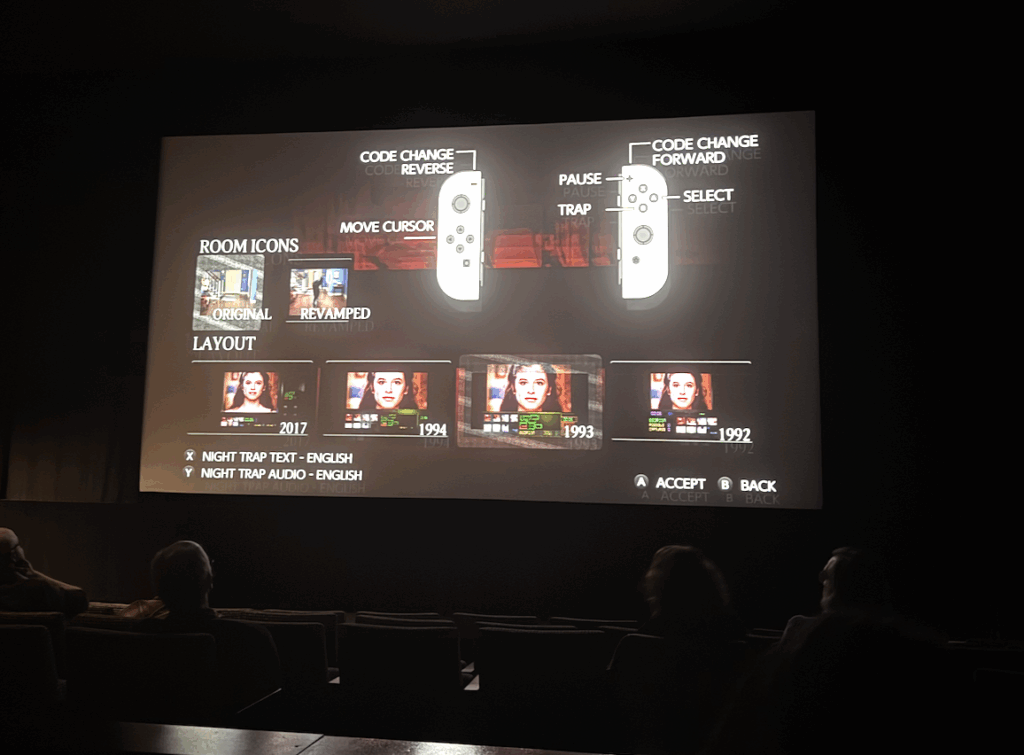
Chris Carloy demonstrates Night Trap’s interface and layout options before the group playthrough at Logan Center. Photo by Jihu Park.
That’s when I realized: Night Trap is designed for failure.
Our first player lasted maybe three minutes before getting a game over. The next one made it to four. Each time, the audience got louder, calling out room switches, cheering successful traps, groaning at mistakes. It felt more like watching a sports game than a horror film.
Sparrow said something that stuck with me: “Night Trap isn’t really about winning but about noticing.” Every failure teaches you the rhythm. When do enemies appear? When does the color code change? Should you follow the plot or hunt the monsters? The game punishes you for watching the story but rewards you for abandoning it.
It’s this perfect little paradox, a game about attention that constantly overwhelms it. You can’t look at everything, yet you can’t look away. Honestly, it felt like an early metaphor for the way we live online now, juggling too many screens and trying not to miss the important part.
The Real Game Was Us
By the third attempt, something shifted. Everyone knew the beats. People started predicting lines, singing along to the ridiculously catchy theme song (which I’m embarrassed to admit is still stuck in my head), and yelling “TRAP THEM!” in unison.
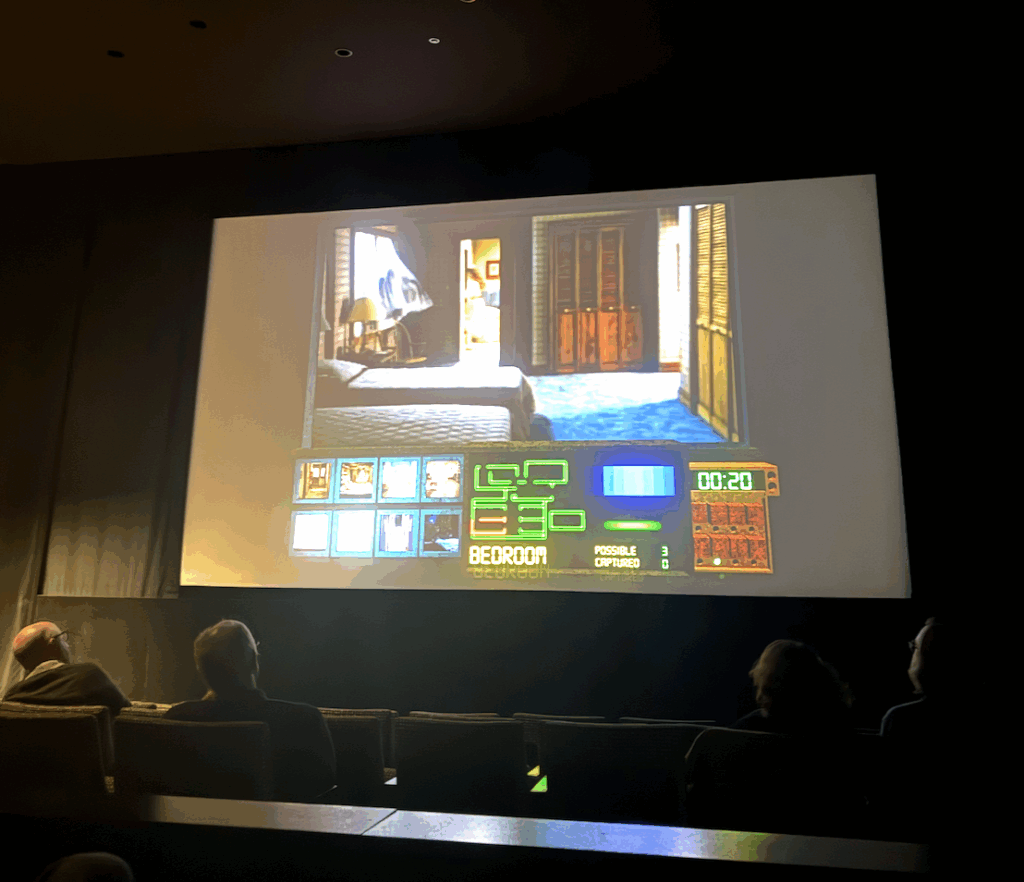
Players monitored the bedroom camera feed, timing their traps as intruders approached. Photo by Jihu Park.
The “interactive” part wasn’t really on the screen anymore. It was in the audience. We became one collective player, reacting together. What had once been denounced in 1993 Senate hearings as a threat to moral decency now played out as absurdist performance art. What used to scare parents now just made a room full of students laugh.
That’s what cultural distance does; it turns panic into play. But our laughter didn’t feel dismissive. It felt communal. For a couple of hours, we weren’t just watching an old FMV game; we were rediscovering how watching itself could be a shared act.
After the Trap
When the lights came back on, I realized that the real focus of the night was not the game, but us. We leaned forward when the camera switched rooms. We whispered strategies. We became the surveillance system we were supposed to be analyzing.
Walking out of Logan Center, I caught my reflection in the glass door; just a small, flickering figure surrounded by darkness. Night Trap had ended, but that feeling of being both watcher and watched lingered. Maybe that’s what makes it so strangely timeless. It traps us with the characters.
Also, that theme song? Still haunting me!
Works Cited
Bejan, Bob, director. I’m Your Man. Interfilm, 1992.
Night Trap. Digital Pictures. Sega CD, 1992; remastered by Screaming Villains, Nintendo Switch, 2017.
United States, Congress, Senate, Committee on Governmental Affairs. Video Game Violence: Hearing before the Committee on Governmental Affairs. 9 Dec. 1993. U.S. Government Printing Office, 1994.
Film Studies Center. “Night Trap: A Live Playthrough.” The University of Chicago, 30 Oct. 2025.