Telltale’s games have always gripped me with their premise. A story where I can make choices in it and they actually mattered sounded fascinating, and when I got my first one, Minecraft Story Mode, I loved it, especially when I would later hop on Youtube to see how all the people I enjoyed watching chose differently from me.
Since that time, Telltale has shut down, but their style of games hasn’t gone away. AdHoc studios, with a large amount of staff who had previously worked at Telltale, recently released their game Dispatch for computers and consoles. I had been interested for a while, and I scooped it up.
The game was released not long before our discussions of agency in gaming in class, and those discussions made me question something about this genre of games. The games pride themselves on the agency they give players in the story, but does having a story require limiting the amount of agency they can give players?
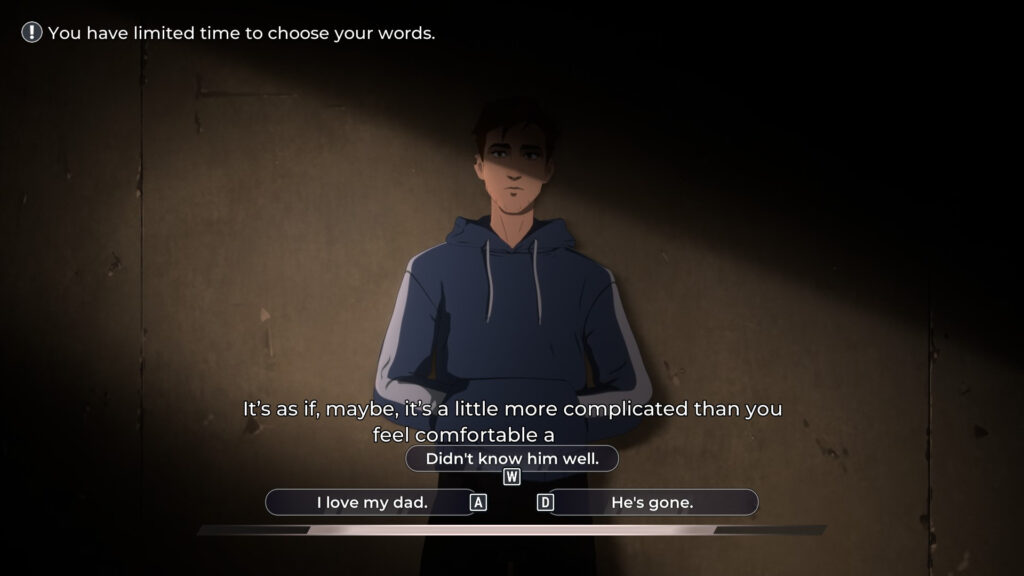
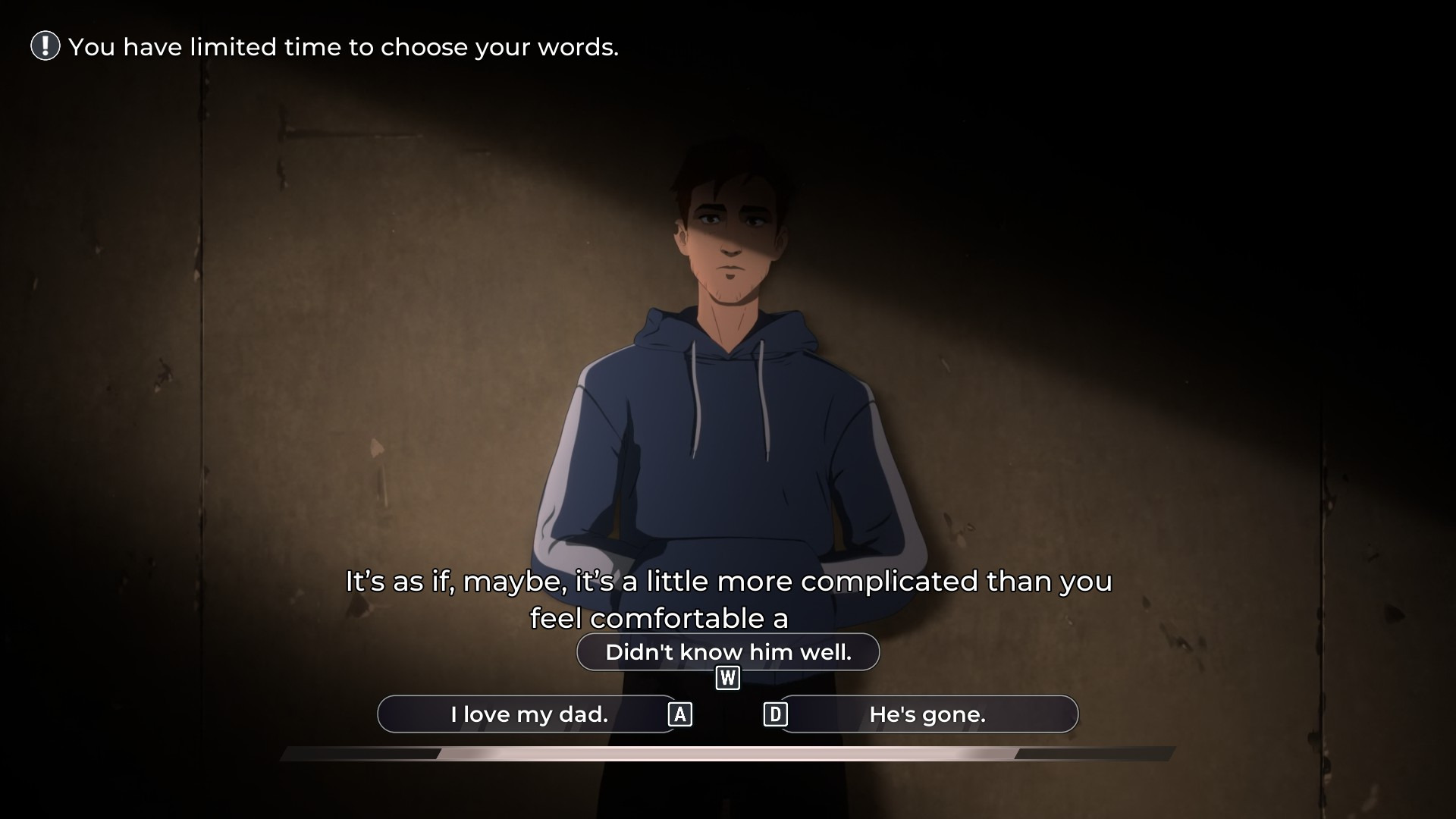
It struck me when I looked back at the first choice you’re able to make in the game. You’re given three options to define the protagonist’s relationship with his late father. There are two things I noted. For one, there is no option to say anything negative about his father. For another, this opening choice completely lacks consequence besides another character’s next line of dialogue, something similar with quite a few other choices.
Later on, there is the option of whether or not to drop a character the protagonist has kidnapped off of a balcony. No matter what, though, the character will not die, as they’re needed for later scenes in the story, and it again just changes a later exchange. It feels like it would have an impact, but it has none.
It feels like part of a necessary give and take. In a game like Minecraft, you have full control of the story, but that’s because there is so little provided by the game itself. In story driven games, though, you sacrifice a bit of agency for a well crafted story. Ultimately, the promotion that made me interested in Telltale’s games originally wasn’t necessarily for people who play games to be interested in another game, but for people who don’t play video games to finally be interested in one.


If we approach agency in a broad sense, than no. In a story driven game, every decision you make is part of a branching pathway that has already been decided by those that make the games, and these decisions are often designed to be small deviations from that pathway. Of course in some of these games you are able to get different endings, but even then your decisions are fueled towards reaching one of few outcomes that has already been predetermined. However, I don’t like talking about games in such a way where agency is defined as the ability to do anything or have complete free reign. Games are systems constrained by rules, and as such most games require the restriction of what the player is able to do. However, I do think that story-driven games can provide the player with much more of a more limited type of agency. While your decisions may lead to little overall consequence, each player is still able to make any combination of these decisions, creating a unique play experience compared to others that may have played the game. In this way, you have a high level of agency in the sense that the game allows the player to have a unique individual experience formed by their own decisions.
Hi, I definitely agree that story-based games don’t allow for a lot of player agency. Even with a choice system, those choices often don’t do much in the long-term because of the limited number of endings. I see what the comment above is saying in that these types of games can be seen as having high levels of agency because of the experience formed by one’s own decisions, but I’d like to push back on that a little bit. If different decisions don’t have much of an impact, is there really much agency? I’m thinking about real life outside of games at the moment. If someone is given a lot of options and they more or less result in the same thing, I don’t think we would consider that person as having much agency. The options just seem sort of futile. Going back to story-based games, I think the lack of nuance in the endings often makes the options feel futile and like there is a lack of agency. It’s not necessarily a bad thing; games just operate differently than life. However, it does make me wonder what we can do realistically to increase agency in story-based games and whether it’s even worth it.
One of Telltale’s games I found to be one of their best is the Game of Thrones one. Everything about it, especially the first few episodes, was thrilling and fantastical, much like how Game of Thrones was viewed when it first started airing on television. Just like every other great Telltale game, each of your decisions matters and has overarching consequences either in the now or in the future. However, mirroring the show it was based on, the later episodes of the game simply went off a cliff in terms of everything, especially the story. As the ending of the story basically slaps you on your face, making it seem like every choice you made and didn’t make just didn’t matter. So in that sense, the game made it seem like you never had agency because nothing you did mattered. But I wouldn’t say that story-driven games are the same in the fact that the player dont have a lot of agency, I think a good indication of a good storydriven game is giving the player satisfaction in their decision making even if there are a limited/restricted amount of endings of a given game, I feel like the GOT telltale game is a worst case scenario where due to just bad writing the player is left unsatisfied making it the restrcited agency part more apparent
I discussed this in my own blog post with DBH, another story-driven game, and my response to your question is that: no, a story does not limit the amount of agency a player has. In real life, people don’t actually have true free will to do anything they want; they have a limited amount of choices based on what they are able to do in the moment. For example, a person cannot jump 10 feet into the air by themselves just because they want to. In Dispatch, despite not affecting the overall flow of the story, the amount of choices given is a form of agency given to the player.