When you first boot up Save the Date, it looks like a lighthearted dating simulation. The premise is simply going on a dinner date with Felicia, and your job is to make choices that will hopefully lead to a good evening.
Each run through the game begins the same way, First Felicia invites you to dinner, then you decide what to say, what to eat, how to steer the conversation. But inevitably, something strange happens, whether that is an accident, a disaster, or a sudden end. Then you restart, try again, and the cycle repeats. The game’s core mechanic isn’t about “winning the girl” but about uncovering meaning through these failures. Every attempt reveals a little more about the flow of the game, and soon you’re not just saving a date you’re saving the Date (Get it? Get it…? I wish I came up with this pun!).
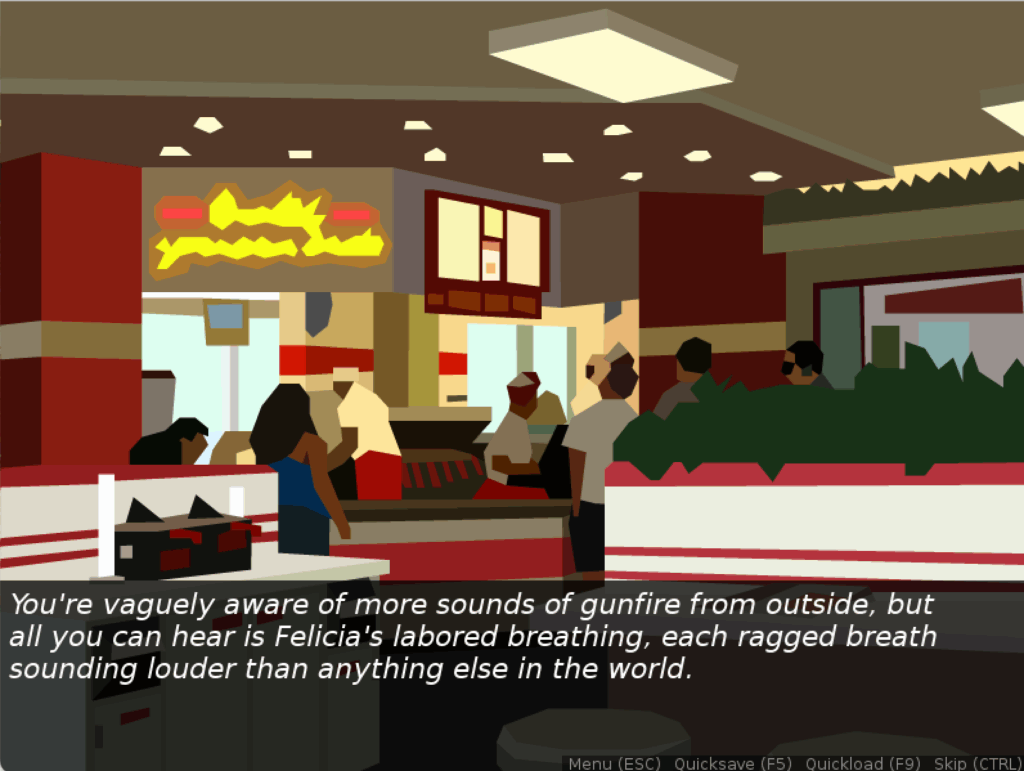
Do our decisions matter?
While these type of simulation games may typically offer the fantasy that one can pick the right words or actions to unlock a happy ending، that is not the case with this game. This is not so much to say that life is meaningless so much as to insist on being self reflective, and by stripping away the illusion of agency, the game draws attention to the mechanics of interactive storytelling. Just as a reader cannot affect the ending of a novel (no matter how much they may try to predict what happens, or pray that the their favorite character may succeed), the player here confronts the limits of authorship in a medium often marketed as empowering. The date becomes less a moment in time and more a symbol of the human desire to control outcomes that are, in truth, uncontrollable.
Is it always about winning?
Games, acting as a parallel or allegory to life, need not always be about mastery or victory. Sometimes discomfort, randomness, and unpredictability are what makes something interesting. And thats it, nothing more nothing less.


1. I would love to know who did come up with that pun, and
2. While I agree with a lot of your post, I think one thing people miss is that there is a somewhat happy ending–if you never go on a date at all. While you may not be together, both the protagonist and Felicia are alive and well, and the game presents it as the best possible ending given the circumstances.
I enjoyed your comparison to novels. It’s amusing how, once we gain a sense of choice, we often aren’t satisfied with the options available. Do we even want a happy ending, or do we just want more control? I wonder how the concept of Save the Date could be modified with an inevitable ending that isn’t death; maybe Felicia is a bad girlfriend, but no matter what, we can’t break up with her. Would people still have the same reactions to the game?
I agree with your point about games not always being about winning. I think the dissatisfaction that comes from being unable to save your date is the idea that “completing a game” means to find an ending where every loose thread is tied. Nobody likes not knowing something because that leads to a loss of control, which goes back to your point about how the date becomes a symbol of the human desire to control uncontrollable outcomes.
I find it really interesting how you compare this game to novels because, while novels and this game have fixed endings, I feel like there is more freedom for choice in Save The Date. You usually can’t make choices in books, other than to put them down. With this game, you choose to get to know Felicia on a deeper level. Even if she dies in the end, even if you both die, no one confronts their death alone. I feel like the choice to fight to save Felicia (and learning more about her in turn) makes the overall message of the game something along the lines of “take advantage of time while you have it.”
I explored something similar about agency in my midterm video essay on Mouthwashing! I agree with your point that winning is not always the intended goal of gaming, but I do think that games with restricted agency and a focus on narrative, such as Save The Date and Mouthwashing, do differ significantly from novels in the sense that players can still interact with the medium, as much as the choices that are made are predetermined and coalesce to an inevitable ending. For instance, in Mouthwashing, although the narrative doesn’t progress unless you perform each prescribed task as Jimmy and Curly, the act of doing the tasks you’re compelled to do is more meaningful than simply experiencing the linear progression of the story as you would a narrative novel, as the mechanic of “doing” forces you to confront the moral implications of such actions. In the same way, like you mention, interactive choice in Save The Date is more a reflection on how our desire to manipulate circumstances are not as foolproof in achieving our intended results as we might want them to be.