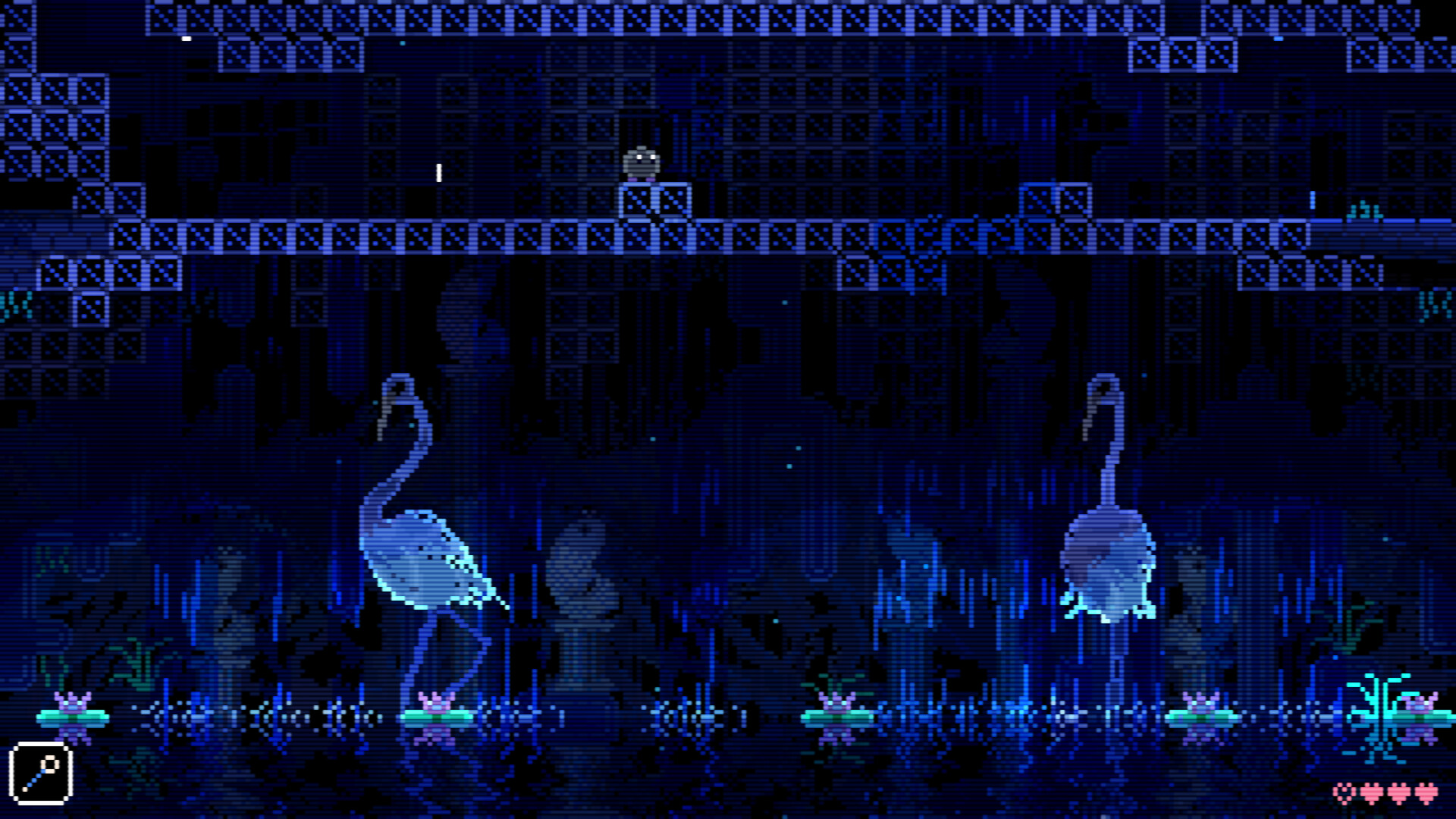
Ever played a game where the only instruction is a single prompt and the rest is an open world you have to navigate by pure guessing? That feeling of being lost without help or a clear tutorial keeps lots of players turning away, a problem most AAA studios try to circumvent by trapping players in long and repetitive tutorial sequences that lead to a decrease in immersion.
Billy Basso’s Animal Well flips that frustration into an engaging discovery loop. By layering classic Metroidvania tropes—a progressive tool system for combat and exploration and visual cues for problem solving—Animal Well teaches mechanics without a tutorial.
At the very start of Animal Well you run into a purple cube‑shaped ghost blocking a tight corridor. The only hint you get for overcoming this obstacle is the prompt “Pick Firecracker” from an earlier room. When you pull it out and set it off, the ghost melts away, proving that the item can defeat this simple obstacle. It’s the same kind of “shoot once, see what happens” intro you get in the classic 1986 Metroid, where you learn to blast enemies with a arm blaster. Both games throw a single, unmistakable cue at you and let the action speak for itself, so you’re teaching the mechanic without a tutorial overlay. By discovering the effect through direct interaction, the game immediately engages your curiosity and builds an intuitive sense of what the tool can do.
The way Animal Well introduces new tools mirrors the system in Castlevania: Symphony of the Night (1997) and Castlevania: Dawn of Sorrow (2003). Early on, the bubble wand shows up and lets you double‑jump; you figure that out just by trying to reach a higher platform. The disc, which pops up next, can distract groups of animals that block your path. Then the yoyo lets you swing over gaps and pull far‑away switches. Each item is first encountered in a context that makes its use clear right away, so you’re encouraged to experiment while you progress through the map. The immediate payoff of these self‑demonstrating tools keeps the learning curve smooth and encourages a feeling of agency that makes the gameplay more engaging.
Visual hints are a big part of the learning loop, and they’re just as effective in Animal Well as they are in titles like Tunic (2020), The Witness (2016), and Fez (2012). In the Well, glowing buttons tell you which objects can be activated and animated sprites show when an item is ready to use—for example, a flickering flame that says a firecracker will get rid of a ghost. You don’t read a step‑by‑step guide; you just see and test, like in Tunic, where little light changes let you know a new item is nearby, or in The Witness, where subtle pattern changes hint at how to solve a puzzle. The cues line up with the game’s mechanics, so once you figure out how it works the next time you’ll know exactly what to do. By letting the environment itself explain the mechanics, the game removes friction and keeps players fully immersed in the experience.
Finally, the game’s loop—discover, acquire a tool, unlock a secret—acts as a quiet, implicit tutor. After you solve a puzzle and get new equipment, locked sections of the Well open up, just like in Metroid and Castlevania where each power‑up reveals new paths. It keeps the player guessing, but the map grows as you expand your kit, so you’re learning what tools do by experience. The game never spells out the rule; instead, it shows you how the pieces fit together after you’ve tried a few times. This pattern of experiential learning, combined with clear visual feedback, creates a deeply intuitive and rewarding gameplay experience that feels both familiar and uniquely compelling.
In essence, Animal Well demonstrates that a game can be tutor‑free yet pedagogically sound by harnessing old tropes in a fresh context: provide a problem, hand you a simple tool, show a visual hint, let you experiment, and reward the outcome. The result is a learning experience that feels natural, keeps players engaged, and turns every playthrough into a new discovery.


This was very much my experience in ‘Animal Well’ as well. It’s systems are so simple to get the hang of but have such great complexity under the surface, with the double bubble jump being an obvious example. I could see this sort of “natural tutorialization” being harder in games with more complex mechanics, i.e. combos in fighting or action games, but in the case of ‘Animal Well,’ it works exceedingly well. It also ties into the visuals and “story” of the game nicely, since you’re given so little to go off of and have to figure things out through your own deductions.