
The Ace Attorney series, while satirical at heart, engages in a critical discussion of the flaws and imperfections of the court system as a whole. In particular, this discussion stems from how control is present throughout the series.
Most Ace Attorney games deploy gameplay in three phases. First, the player investigates crime scenes through a point-and-click adventure game. The main character Phoenix and his assistant Maya discuss the object and any significance it might hold. That information then gets put into a database. Second, the player can talk to other characters in the game. This occurs both in pre-determined conversation topics, unlocked after fulfilling certain flags, and in the ability to present evidence to trigger responses. Third, in court, the player must match their evidence to conflicting testimony and prove the contradiction. Shockingly, no witnesses are ever held in contempt of court for perjury.

Essentially, what a player controls in these games is how information is wielded — when, where, and who you present information to. These distinctions ultimately determine how the truth is shaped, discovered, and perceived. The use of data and evidence being how the player interacts with the narrative stands out from most games that focus on combat, or games that sometimes focus on resource management. Thus, the Ace Attorney series is perfect to discuss control and data, since it is so contingent on the use (and sometimes, misuse) of data.
In the series’ first title, the eponymous Phoenix Wright: Ace Attorney, the main theme of the game is presumed guilt. Every client you defend is truly innocent, but is accused because the preliminary evidence implicates them. Every piece of information/data found is important and used to control the narrative of the crime (and consequently, expose the truth). Narratively, the prosecutors and police in this game do everything in their power to limit Phoenix’s ability to access data — withholding essentially evidence from him, and preventing from entering crime scenes, and even stealing evidence from you. Thus, being able to use the prosecution’s own evidence to poke holes in their theory allows the player to take the very means used against a client and transform it from something used to sentence someone to a tool that can save someone.

However, as the series progresses, the player’s control over information becomes more complex. While the majority of Phoenix Wright: Ace Attorney – Justice for All essentially builds on the theme of the first game, it is in the final case where this game’s theme is finally realized. In the penultimate case of Justice for All, “Farewell, My Turnabout”, the player/Phoenix receive all the information and know the truth behind the murder about 3/4ths of the way into the case. The issue is that presenting the truth comes with a consequence: getting your rightfully accused defendant declared guilty will cause an assassin to kill Maya, whereas getting your client not guilty falsely imprisons Adrian Andrews for the crime.

Instead of control simply pertaining to presenting information in unique ways to lead the truth, control here becomes a choice. Specifically, the player is now given the opportunity to control information to determine the very outcome of the trial, with more to consider than merely bringing the truth to light. By forcing a player to choose how they control information and asking them to deal with the consequences of such control, Justice for All focuses on how we define our personal morals, and how to reconcile our morals with the justice system.
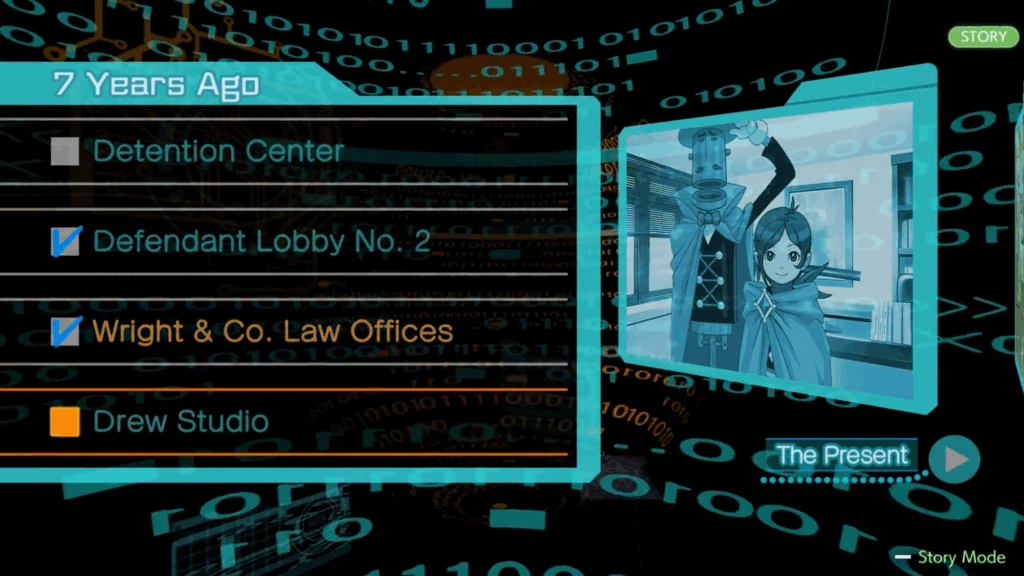
Phoenix Wright: Ace Attorney – Trials and Tribulations is the first game to take a non-linear approach to its timeline — jumping back and forth between the past and the present. Notably, control here comes from understanding the complexities of justice and how those complexities extend beyond time. Focusing on how deception through false personas haunts justice, Trials and Tribulations aims to address how injustice becomes a lingering complication that persists across time. Information about past trials become necessary data points for understanding the conflicts in current trials. Here, controlling information from the past and present is what enables justice to be reached — both retroactively, and in the present.

Further, Trials and Tribulations’ theme of attempting to control one’s image/destiny extends into the mechanics of the game. While every game so far has had the player play as Phoenix, this is the first game where you play as multiple characters (Phoenix, Mia, and Miles). Being able to play as different characters highlights how differently they all describe the evidence and their surroundings. In doing so, the player is able to receive different perspectives that show how each character is trying to define themselves and their sense of justice under a wavering system.
While the Ace Attorney trilogy ends here, I’d like to touch on three more games in the series.
Apollo Justice: Ace Attorney adds new mechanical complexity to how data is collected and understood within the courtroom. This comes in the form of investigation minigames, such as reconfiguring 3D modeled rooms and performing forensics (such as fingerprint analysis and sound recordings), giving the player a new sense of physicality in interpreting the data. This manifests in how the player engages with the game, blowing on the DS screen and twisting knobs in order to reconfigure data. Apollo Justice also integrates the interplay of past and present not just narratively, but mechanically as well. In the penultimate investigation section of “Turnabout Succession”, the player must move between not just different locations, but different time periods as well.
Apollo Justice also presents a new way of understanding the justice system, mainly through its thematic interrogation of the law’s “grey zones”. In fact, the opening case of Apollo Justice has Apollo do morally questionable things in order to catch a killer (albeit unwittingly). The main antagonist of Apollo Justice, Kristoph Gavin, operates chiefly through manipulation — manipulating people and data alike. In doing so, the entire court system becomes corrupted through the belief that “evidence” (forced and manufactured as well) alone contains the truth. It is only through taking back control by completely altering the foundations of the judicial system can Kristoph be taken down. For the first time, the player is asked to truly evaluate the evidence. Is it enough to incriminate Kristoph? What is the role of evidence in the courthouse? What is the purpose of the law?

Additionally, the spinoff Investigations Series (Ace Attorney Investigations: Miles Edgeworth and Ace Attorney Investigations 2: Prosecutor’s Gambit) focuses on the issue of corruption within the justice system. Prominent figures attempt to control the flow of information to conceal their crimes. By weaponizing the justice system itself, even legitimate court proceedings create false verdicts. Thus, control is no longer in the hands of the player or Edgeworth. Instead, this series focuses on how to regain control of a failing system, asking questions like what it means to use the tools of a corrupt system to expose corruption? Most importantly, however, the Investigation Series determines that above all else, accountability within the law regarding its practitioners is a prerequisite to any form of truth being established. Without that trust, people cannot believe in the system — allowing the law to become a weapon.


Justice is an ever changing ideal, and an ideal that must continuously evolve. The Ace Attorney Series allows people to understand the many complexities behind this imperfect system better. But, this series also allows them to see how that imperfect system can, hopefully, become a little more perfect. After all, justice should demand no less from its practitioners and the people.
As the Judge says at the end of Apollo Justice, “The law is the end product of many years of history… the fruit of human knowledge! Like a gem, polished to a gleam through trials… and errors. It is this fruit we receive, and pass on, and face in our time. And it is always changing, growing. Nurturing it is our task as human beings.”


LOVE hearing aimee talk about ace attorney 😀 one thing i’m curious about, though, is the ways in which the ace attorney franchise game-ifies the japanese (and american) justice systems and how some of the more game-y elements interact with how control and data work in the real world. as phoenix, the player is simultaneously feeling the absurdity of the justice system in the games and is hyper-aware of the cruelty behind the absurdity. “farewell, my turnabout” is a really good example of this, i think! especially when you consider all the antagonists/prosecutors who are OBSESSED with “winning”/getting a guilty verdict, or keeping their perfect record, having to both get your client declared guilty while keeping an innocent woman out of jail AND keeping your sidekick alive is, frankly, INSANE. this isn’t a fully formed thought, but it’s just something to think about.
I find this really interesting because of the way you analyze how information is presented in the game. I worked in a courthouse for a judge this summer, and one of the things I was shocked at was how much control outside parties get on the information presented in courts. It’s a really interesting dynamic where those in power, whether it be attorneys or the judge, have the power to decide what information about a case is or is not relevant to the case. It seems like such an odd thing to gamify, but it seems like being the one in control of that information provides perspective on how things actually operate in real judicial systems.
I really love this analysis, and it’s changing the way I see the series. At least in the original trilogy (the only games I’ve played,) it seems like there is a lot of emphasis is placed on characters whenever they lose that sense of control. I’m reminded of the sprite where Edgeworth is leaning on the stand with a look of death in his eyes whenever he’s on the ropes. Also, it seems like each of the truly guilty characters suffers a massive breakdown at the point at which they see that their fate is sealed, and they lose any control they had over the outcome.
(I was going to make a point about how this element of control is played into by the surrealism of the fact that evidence is presented during the trial, which prevents the the defense from being able to mount a defense beforehand; however, I found that the Japanese court system doesn’t require that all evidence be submitted beforehand in a process of Discovery, unlike the American courts, which is neat.)