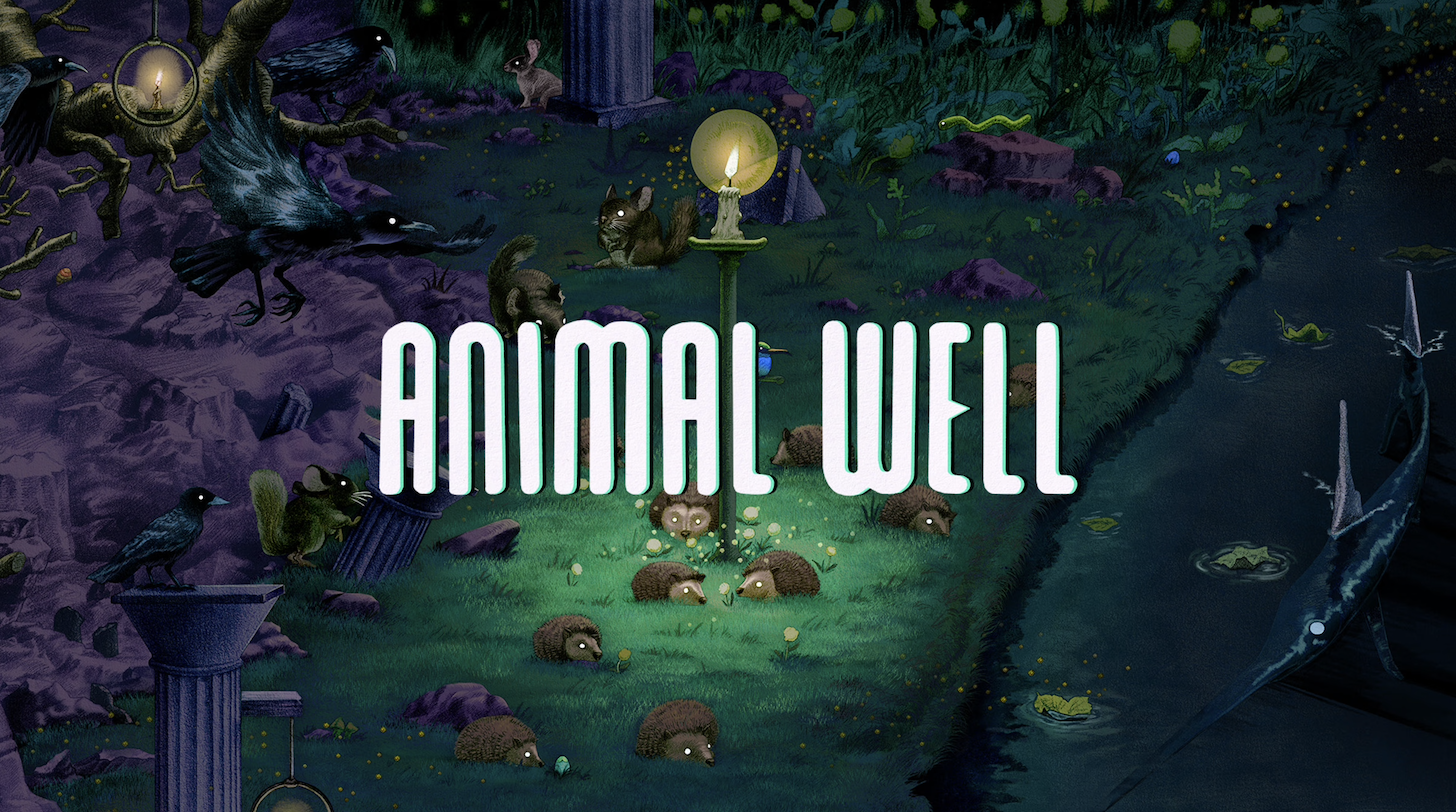
I’ve been sitting with Animal Well for the past week and, honestly, I think I missed the point at first. Like completely.
When we talked about secrecy in class (the three types, Easter eggs, cheats, and diegetic secrets) I kept waiting for the game to reveal itself. Kept thinking “Okay, when does this click?” But that’s exactly the wrong instinct.
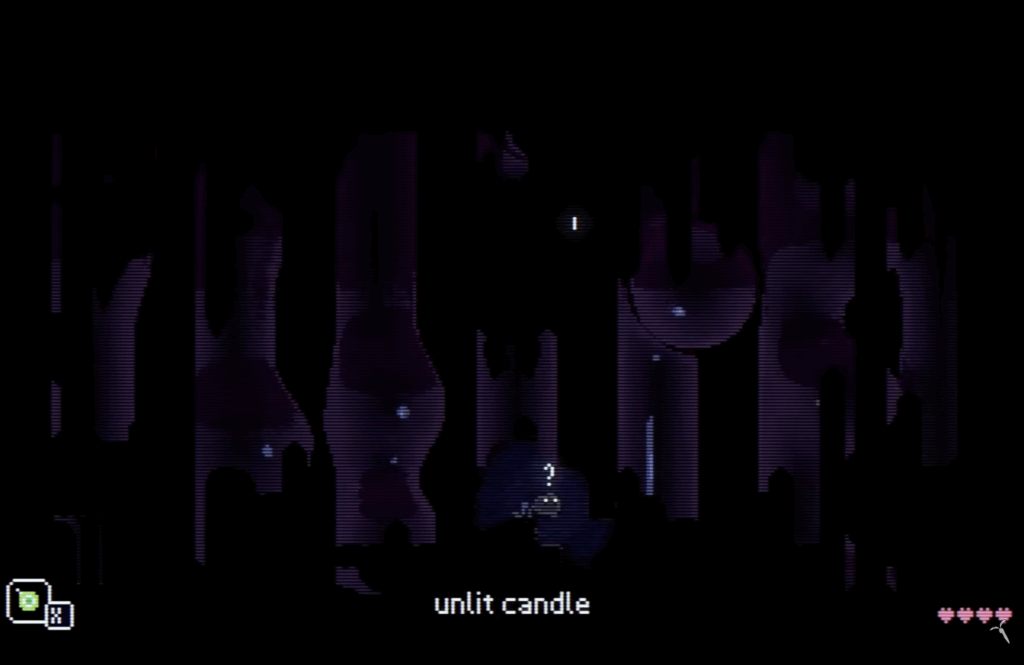
“Unlit Candle.” A quiet moment from Animal Well (Billy Basso, 2024) where uncertainty reads as atmosphere, not obstacle. Screenshot: Shirrako, “ANIMAL WELL – Full Game Walkthrough (No Commentary),” YouTube, 2024.
Peter McDonald’s idea of role-playing as a “mediating concept” keeps echoing for me. His claim that players perform understanding before they actually understand, acting natural while still figuring out the rules, suddenly feels like the only right way to describe Animal Well. The game doesn’t hide information to frustrate you; it’s teaching you to inhabit uncertainty as a play state.
What’s fascinating is how anti-revelatory it is compared to other Metroidvanias. Hollow Knight gives you a map. Dead Cells has visible progression markers. Even Tunic eventually hands you the manual, a kind of wink that says, “See? It all makes sense now.” But Animal Well resists transparency. Its mysteries unfold endlessly rather than resolving neatly. Even after the ending, the game deliberately unsettles closure. Each layer only reveals more whispers, more digital folklore spreading across Discord and Reddit.
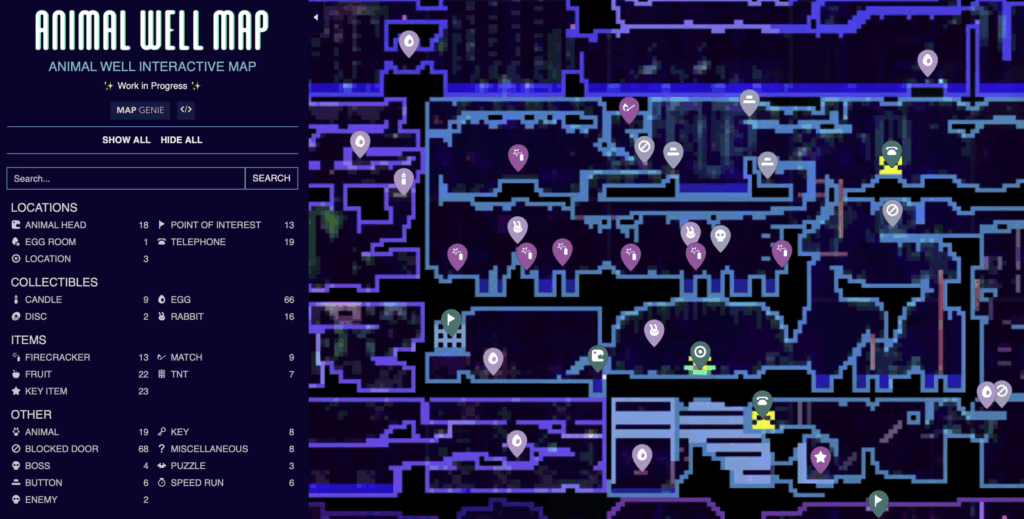
Fan-collaborative interactive map for Animal Well (Billy Basso, 2024), created and shared on PSNProfiles by community member purlinka using MapGenie.io data (May 30, 2024).
Even in section, someone asked me whether Animal Well was too obscure to stay enjoyable. I’ve been thinking about that a lot because the more I play, the more I feel the obscurity isn’t a flaw, it’s the point.
Greg Costikyan writes that uncertainty keeps players engaged, that games rely on it to create tension. Animal Well treats uncertainty differently, as atmosphere not challenge. It’s less about winning and more about learning to dwell in ambiguity.
I keep returning to something Professor Jagoda asked at the end of lecture: How do games transform how we think about secrecy as such in our lives?
I think Animal Well makes secrecy generative instead of extractive. Most games treat secrets as currency. You find them, you get rewarded, and you move on. Here, every discovery multiplies uncertainty. Each Easter egg opens another door, not because it hides something behind it, but because it deepens the experience of not-knowing.
In this sense, Animal Well almost flips Eric Berne’s idea from Games People Play. Berne sees games as transactional—you play to get something, even if it’s emotional validation or social positioning. But Animal Well refuses the transaction entirely. It doesn’t give you anything. It asks you to sit with incompleteness, and to find pleasure in the unease. It’s a kind of intimacy most games don’t risk because you can’t really “win” uncertainty but you can learn to live with it.
What’s stranger, and even beautiful, is how this secrecy becomes collective. While players often collaborated to uncover its secrets, the tone leaned toward curiosity and shared wonder rather than competition. More like a folk tradition forming in real time. People weren’t simply racing to solve the mystery; they were dwelling in it together, performing McDonald’s “act natural” on a massive scale. Everyone was pretending to understand together, and that became the play.
Perhaps that’s what Billy Basso suggested during his talk at the Year of Games Symposium, when he said he wanted players to “trust the game.” Not to trust it would explain itself but to trust its silence was intentional and opacity could be care.
I’m still trying to figure out the “so what.” What does it mean when a game can make secrecy feel communal instead of alienating? When mystery stops being something to solve and becomes something to share? I don’t have the answer yet, but maybe that’s the point. Some games are finished when you stop playing. Animal Well keeps playing long after you leave it.
Works Cited
Basso, Billy. Animal Well. Shared Memory, 2024.
Berne, Eric. Games People Play. Grove Press, 1964.
Costikyan, Greg. Uncertainty in Games. MIT Press, 2013.
Jagoda, Patrick, and Peter McDonald. “Game Mechanics, Experience Design, and Affective Play.”
The Routledge Companion to Media Studies and Digital Humanities, Routledge, 2018, pp. 174–182.
Shirrako. “ANIMAL WELL – Full Game Walkthrough (No Commentary).” YouTube, 2024.
purlinka. “Interactive Map for Animal Well …” PSNProfiles Forum, 30 May 2024.