
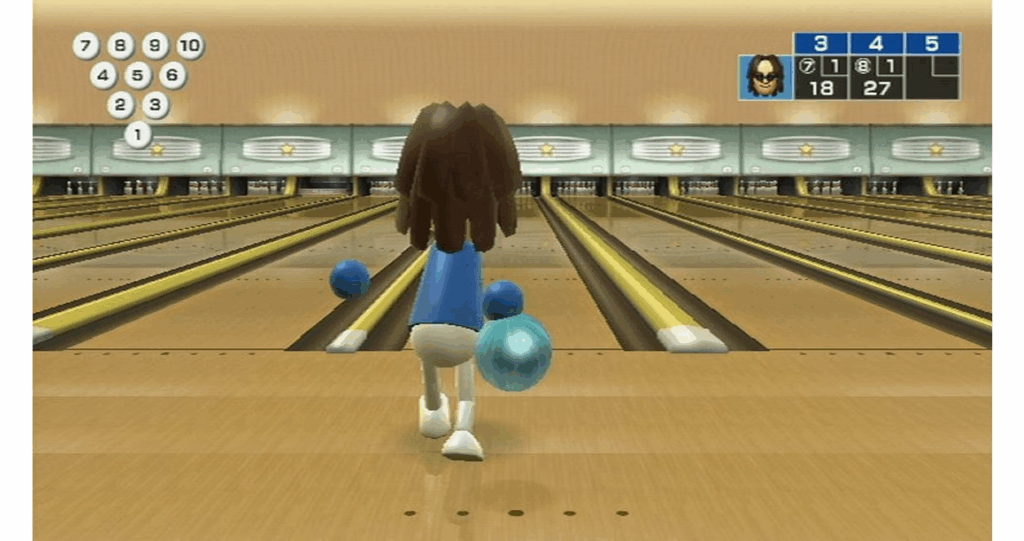
When we think of hard games, we usually think of games like Overwatch or Elden Ring, popular games that players are known to fail at over and over again. We think of those lists of the most difficult games. We don’t really think of casual games as being very difficult. Therefore, I was not expecting Celia Pearce to bring up Wii Sports bowling during the Challenging Play: Puzzles, Performance, Practice panel for the Year of Games Symposium. She mentioned it briefly, how some students she knew complained that their grandmothers had beat them at the game. It really made me reconsider what a hard game actually is.
Source: GameStop
Pearce made some good points about difficulty, about how people should think more broadly as to what is considered challenging. Different demographics of people consider different things to be difficult. It also brings to light accessibility in gaming, which was touched upon near the end of the panel. Sometimes, difficulty becomes an unnecessary burden on the player, especially when it comes to common accessibility issues like font size. It’s important to create what Pearce calls “pleasant friction,” which is the addition of difficulty without compromising playability.
This panel made me think about difficulty in life and its relation to various factors. Like in games, difficulty in life is subjective. What one may find to be easy (eating, walking, getting out of bed, etc.), another person may find to be difficult. Take people with disabilities, for example. A person with a chronic illness may find daily activities to be more difficult. Similarly, a person with depression or ADHD may find “simple” tasks to be daunting because of their state of mind.
This goes back to the reading “Queer female of color: The highest difficulty setting there is? Gaming rhetoric as gender capital,” in which Lisa Nakamura emphasizes the difficulties that queer women of color face in the world and how it extends to the gaming world, where even their gamer status is questioned. The difficulty of being taken seriously is a subjective one that is affected by factors such as race, sexual orientation, and gender.
We often take these words, “easy” and “difficult,” for granted. But Pearce urges us to reconsider and expand our definitions. Not just in games, but also in life. Perhaps if we reshape our views on difficulty, we can stop dehumanizing those who find things more difficult than us. Accommodations, fixes to the game of life, may be easier to achieve with a more expansive outlook. Perhaps we can even achieve more of a “pleasant friction” in life.


I wasn’t able to attend this panel, so thank you for your recap! The idea that what is “hard” to some can be very different to what is “hard” for others seems self-explanatory, but is honestly something I hadn’t put a lot of thought into. It made me think of developing mechanical skills on different devices. For example, I am used to playing on my Macbook, without a mouse (I know this is insane), with the W-A-S-D and arrow keys. Whenever I try to use a game controller, I find it much more difficult to be successful at the game–even if I’ve played it before. Pearce’s concept of “pleasant friction” was also fascinating. It made me think about ProblemAttic, which, obviously, was not a “pleasant friction” game. It was actually borderline unplayable, and literally unplayable for anyone with epilepsy. I do think there can be a lot of merit to games like this, though. ProblemAttic is trying to force feelings of persecution, struggle, and an overarching threat onto the player to convey specific themes of sexual assault and fear. I don’t think this could’ve been achieved as effectively without the mechanics being so difficult to maneuver. So while I appreciate the concept of pleasant friction, I think games sometimes need to have A LOT of friction to achieve their intended goals.