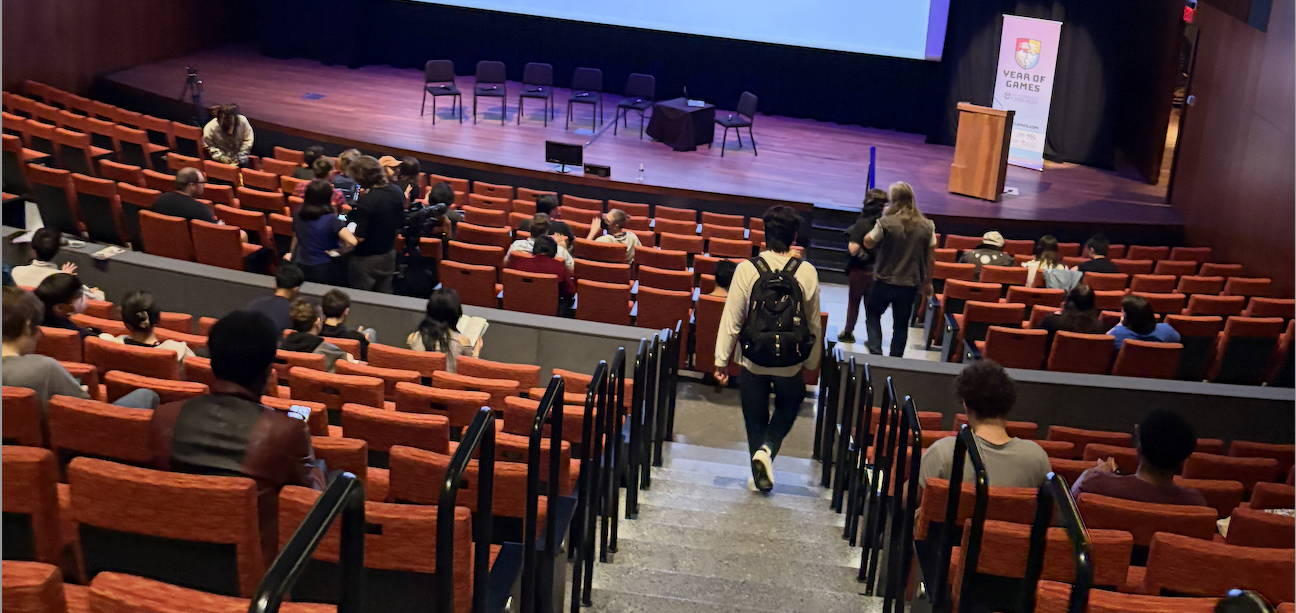
Since the beginning of this course, we have examined how games communicate certain ideas and spread messages within their mechanics, graphics, and features. Attending the Year of Games Symposium, I felt motivated to extend this conversation towards the personal development incited by gaming. In Animal Well, by Billy Basso for example, the game allows us to discover ourselves rather than discover a message in the game.
Animal Well is so…well done because it tells you about yourself. I felt frustrated and creative and angry and impressed with myself rather than the game by playing it. Personal reaction is difficult to generalize as an academic concept, but it is an incredibly impactful aspect of video games. Therefore, this is maybe a more philosophical than analytical take, but examining what a video game teaches us about ourselves adds a little more dimension to them rather than solely focusing on their messages and points of view through choice and mechanics. The way in which video games teach us about ourselves most effectively, in my experience, is through challenge. Listening to Challenging Play at the YoG symposium illustrated how important this factor is in game development; it was fascinating to see how developers consider everything down to human reaction to make their games a lived experience.
The first time I played Animal Well, I found myself quite frustrated –starting by the fact that I suck at platformers. I am not a person who often plays puzzle or map games, I prefer the hack and slash of avoiding introspection, so my first notes on Animal Well were: “okay, this is so beautiful and I like discovering all the passageways… but whats the lore,” and then a couple hours later followed by “WHERE AM I?? WHO AM I??” I was completely lost! The despair that came with that was notable, and when I realized it I recollected myself and changed my view on the puzzles. Animal Well also reminded of the game Fez. The mazelike maps, exquisite pixel art, and puzzles that almost require cheating (in reference to the alphabet in Fez) undo the player, fully immersing them in gameplay. As with the many pathways and secrets in Animal Well, we also discover cubes and even Anticubes in Fez, indicating there is more to the games. This helps us discover our own curiosity (or lack thereof if we don’t care for the additional achievements.) I was lost, but I was lost in the game while I found myself in real life. NOTE: These are just some examples of how games revealed a trait I don’t often percieve within myself, making the games so engaging.
Initially the challenges in Animal Well feel like I must discover a narrative with its own gods and icons, definitely biased from playing Fez when I was a kid and being used to that style. There is definitely lore, I was a bit thrown off by finding Kilroy… but in the end I discovered more in overcoming the difficulty of the game than any message or story i was meant to understand.
Game development as an art medium for personal growth is significant because it is intentionally engineered, especially through the difficulty of puzzles. Basso made his game hard on purpose, and it is mind-blowing how far that goes. The simple act of not figuring something out, and still trying is the true gift of the game. Most of these games force you to change your perspective and motivations with puzzles, in turn affecting our reality.
Regardless if “I adopt the character” of a blob, a guy with 3D hat powers, or a stock-market trader, I leave games knowing more about myself than anything. It was nice to see, during the YoG symposium, that developers are aware of this as well. As Basso said, when asked to answer a question in limited words, “I need more time to think about this” frequently appeared in my reflections on the games discussed, such as Animal Well and UFO 50, and that is what really gives them real-life significance. To quote Fez, “Reality is perception.” How I perceive the difficulty of puzzles in videogames and how I choose to treat it, affects how I approach other challenges in life.