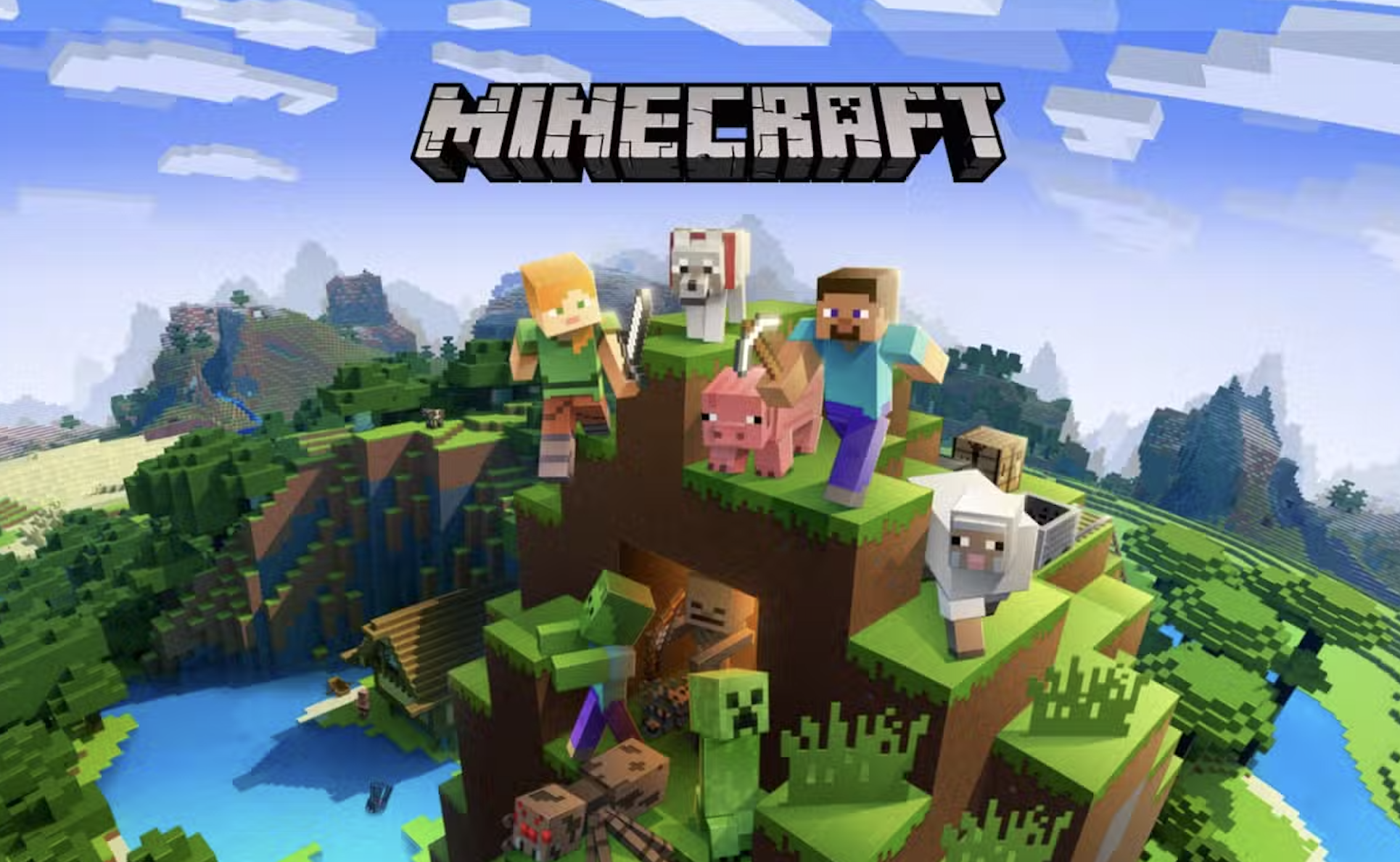
Minecraft Survival mode, a game that I logged hundreds of hours on when I was younger, completely overwhelms me. As does Creative mode. It’s really unfortunate, because I used to love the entire process of the game. I loved mining, building, farming, redstone—truly everything was stimulating and kept me curious. Now, I try to open up the game, and I inevitably close it fifteen minutes later. When this class began, I started to think about why, and I haven’t quite been able to put my finger on it—until this week. While reading Costikyan’s Uncertainty in Games (Playful Thinking) two things occurred to me. First, I think that for me, most of the uncertainty of Minecraft is gone. Second, I think I’ve lost some of my ability to think playfully.
I now play a lot of games that have many of the types of uncertainty that Costikyan discussed in his essay. Stardew Valley, a farming simulator that involves collecting, fighting, and relationship building has schedule uncertainty, hidden information, and performative uncertainty. Bread and Fred, a co-op platformer where two players are tethered together and progress through levels to climb to the top of a mountain, has performative uncertainty, player unpredictability, and some solver’s uncertainty. But Minecraft has all of these elements, too. So what’s my problem?
Minecraft is about exploration and boundless creativity. After 13 years of playing, I feel like I’ve sufficiently explored the game. As mentioned prior, I think I’ve lost some of my ability to think playfully, which means that Minecraft has come closer to “simple play” for me than a “game.”* This realization made me wonder what the biggest uncertainty is in Minecraft, and I think it is creative uncertainty. This concept didn’t come up in the readings or in lecture, but I think it’s an essential element to consider when analyzing uncertainty in games.
I define creative uncertainty as the kind uncertainty that arises when a game leaves creative decisions open-ended to the player. The challenge is not just about mechanical skill or finding information, but about how the player’s own imagination and inventiveness shape the gameplay. In that sense, creative uncertainty might be the most demanding form of play. It requires not just engagement, but a mindset open to aimlessness, experimentation, and failure. In a culture increasingly driven by productivity, goal-setting, and efficiency, that open-ended invitation can feel more daunting than joyful. When I was younger, it was enough to build a lopsided house or a useless rollercoaster. Now, I subconsciously expect a satisfying narrative arc or a finished product. Maybe that’s part of growing up—or at least, growing up in a society that values output over exploration.
Costikyan’s distinction between “simple play” and “games” feels relevant here. He defines a game as play with rules and challenges—something that structures uncertainty in a purposeful way. By that logic, Minecraft may no longer function as a game for me, because I’ve stopped generating my own goals and constraints. I’ve stopped turning play into something rule-bound. But this isn’t a flaw in the game’s design—it is dependent on me. It reveals something broader about the nature of creative uncertainty, and uncertainty in games in general: it doesn’t just depend on uncertainty in the system, but on the player’s willingness to bring their own. Minecraft hasn’t changed, but I have. And with that change, the uncertainty at the heart of the game feels less like an invitation and more like a void.
And to clarify, I think Minecraft is a great game, and doesn’t need to change–especially when my gripe has everything to do with my own experience.
*Costikyan defines “simple play” as play without rules, and a “game” as rules-bound play.


Hi, I find it really interesting that you defined a different type of uncertainty not previously mentioned. When I was reading your definition, I was wondering whether it could fit under a form of uncertainty we already covered. But I don’t think it fits under any of them. For example, I was thinking, could it fit under performative uncertainty? I concluded that it could not because creative uncertainty doesn’t rely on survival skill. It makes sense, that for Minecraft, creative uncertainty prevails when other things become more certain. With all that certainty from having explored everything, all that’s left to make the game more interesting is on the player. And that is when more creativity is needed. I would argue that if you play any game long enough, with the length depending on the game and the player’s skill, you are bound to lose most uncertainty and are then forced to rely on creative uncertainty. And being creative is hard, which is why a lot of us–myself included–would rather switch games. At the same time, I wonder if it’s a good mental exercise to sit with the discomfort of certainty and try to make your own form of uncertainty. Maybe I’ll try that the next time I play Minecraft.
this blog post is so interesting to me because i have NEVER found the appeal of minecraft. like, minecraft is one of, if not the most, sold and/or played game of all time. it’s been used in so many contexts outside of just the joy of the thing. i think every friend i’ve ever had has played minecraft at least once. but not me! even when i was a kid, i didn’t understand why so many people liked minecraft so much. whenever i asked someone, “what is minecraft about?” they would respond, “well, you load up a server with your friends and you build stuff.” well, that’s what you DO, but what is minecraft ABOUT? even when i had little to no experience playing video games, i could articulate their narratives, no matter how primitive. but minecraft has always eluded me: it never gave me anything to grasp onto, no scaffolding with which i could climb up into its story (yes, i know that minecraft has a story mode, and yes i have read The End poem, and yes, it made me cry). all this to say, i don’t know if being a child has anything to do with it. i think that your tastes have developed and changed over time, and those changes have led you away from minecraft, and that’s sad. but i wouldn’t lose hope just yet, you may return to minecraft in the future.