![Buckshot Roulette and the [Fun] of the Unknown](https://criticalvideogamestudies.com/wp-content/uploads/2025/10/ITtWRS.png)
The first time I played Buckshot Roulette, my game ended in less than three turns: I shot a blank at myself, shot myself in the face (not knowing that I could switch who I was shooting at), and then got swiftly ended by my opponent. In fact, it took me a few tries to complete the first round of BR because of how many times I was getting killed while trying to understand the mechanics of the game. Despite this, I kept coming back for more.
I am not a gambler. I don’t like taking risks (on treacherous roads… anyone?) and don’t find myself flirting with chance very often. I am very happy with certainty and leave the risk to the professional athletes that I enjoy watching on TV. Yet, I was entranced by BR and played it until I won the whole thing. What has this class done to me? Only three weeks into the quarter, and I have become comfortable with shooting somebody with a gun (virtually, of course. The idea of holding a real gun terrifies me).
In the reading, Greg Costikyan describes the need for uncertainty in games to capture the audience in a world that aims to reduce uncertainty at all costs. Having read this paper last week, I wasn’t fully sure if I agreed with him. But then I played BR over the weekend, and it finally made sense. The (fictional) threat of life or death, and the control you have over your (and your opponent’s) fate, is as overwhelming and scary as it is motivational.
Having won the game, I don’t necessarily feel the need to go back and try again. In fact, when the “double or nothing” option was presented to me, I swiftly turned off the game and ran away with my $61,000 bounty. However, BR opened my eyes as to why people love games so much: the power over destiny, the chance to do the unexpected, and the ability to live in a better/ different world. I’ve always known about the fear of the unknown, but now, I guess I can see why people also find the unknown so fun.
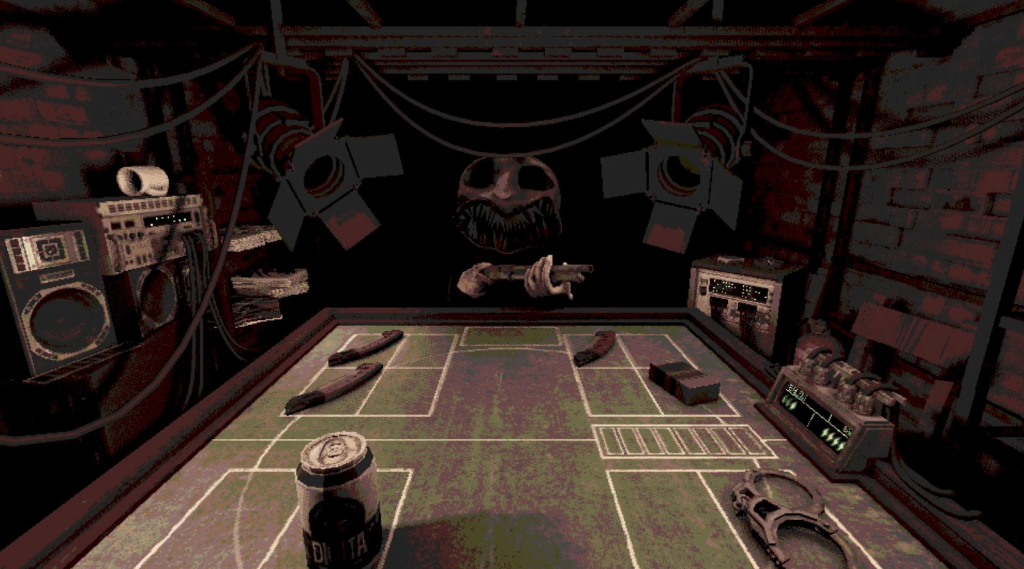


I really resonate with your feeling of the game being entrancing. I think a lot of the elements of the atmosphere of the game also contribute to the thrill of indulging in its stakes. The loud, energetic music, the washed out grunge-y palette, and the warped smile of your opponent are all so exaggeratedly bizarre that you can’t help but persist in spite of the clear uncertainty. The environment is so far removed from any setting or situation we are familiar with that doing something “crazy” (i.e. putting your life on the line to earn copious amounts of cash) feels like the “normal” thing to do. In fact, the more you play, the more that the elements of the game (beer, switchblades, medicine, and inverters) and their respective functions (skipping the shot, sawing off the gun for double fatality, earning or losing two defibrillator charges, changing the type of round of the next bullet in the barrel) just feel like tools for increasing your winning chances, rather than absurd objects with strange or supernatural powers. Overall, I agree that BR really demonstrates how the uncertainty we crave in games contrasts our aversion to uncertainty in our real lives, in addition to how cathartic being able to simulate extreme levels of uncertainty with no consequences can be.
I think it’s interesting how other people seem to have really enjoyed this game despite my extreme aversion to it. Something interesting you mentioned was that it was a safe space for risk, something we also touched upon in class.
I experience a lot of risk in my life, partially from being a college athlete and partially because I’m generally a risk taker in my daily life. I enjoy sparking conversations with strangers, trying new restaurants over tried and true, and volunteering unsure answers in class. As a result, I don’t have a strong desire to gamble or take risky actions in videogames. For me, I prefer enjoying media that contains narratives for escapism or satisfying games about completing tasks (e.g. Animal Well or Solitaire).
I share your aversion to risks, and this game also enticed me with the ability to shoot my opponent. What really got to me was losing and seeing “this seems interesting…” before I got shot in the face. At that point, risk was a secondary thought, and a competitive urge arose. There was definitely a variety of uncertainty, but randomness was the most impactful on the experience. I absolutely felt like I was actively getting screwed over with the items, especially near the final round. Despite getting dealt mediocre items, what made BR enjoyable was the strategy involved to complement randomness. If this game were literally all about chance, then it would not make for a replayable experience. This game reminded me of playing UNO and how intense that can get when you pull the trigger and give a 4+ card to someone; what appears as a good move can quickly become the reason you lose. (I do not play UNO with guns, don’t worry)