
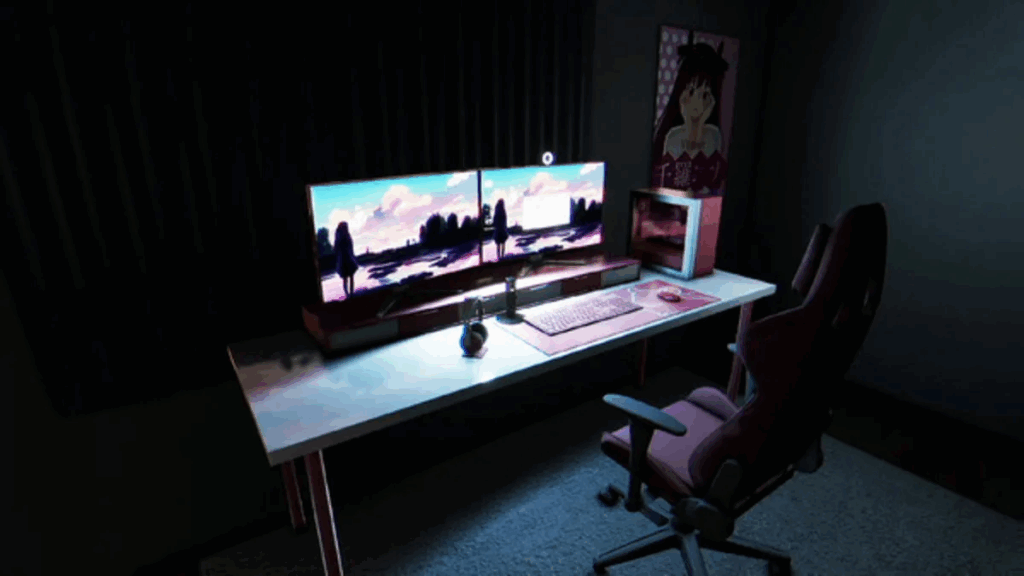
Chilla’s Art is a Japanese indie horror game developer known for their VHS-quality games inspired by ancient folklore and contemporary social issues. In August of 2023, they released Parasocial, a psychological thriller that simulates the real-life threats women in online gaming spaces – particularly female livestreamers – face. The game follows Senra Nina, a faceless streamer whose real identity is revealed against her will when she plays a fan-submitted game on livestream. As Parasocial progresses, Nina’s physical safety and emotional wellbeing deteriorates, as chance encounters with suspicious figures in and around her apartment complex force her to decide which individuals in her life she can trust. Though not inspired by Scalzi’s essay “Straight White Male,” Chilla’s Art translates ideas of gender privilege into Parasocial’s structure, available choices, and outcomes, making apparent the increased “difficulty setting” female gamers face in the public eye compared to their male counterparts.
The game, first and foremost, does a very effective job at casting suspicion on every individual that Nina could potentially reach out to for help. The day after the livestream Nina is doxxed, she encounters a police officer pruning leaves while taking out her trash. He claims to be volunteering, then infers she lives nearby and asks if she lives alone. He implores her to visit the police station nearby where he works should she have any safety concerns. The bizarreness of the location of this encounter, his paltry excuse for why he’s there at all, and attempt to probe into her living situation make his intentions appear insidious.
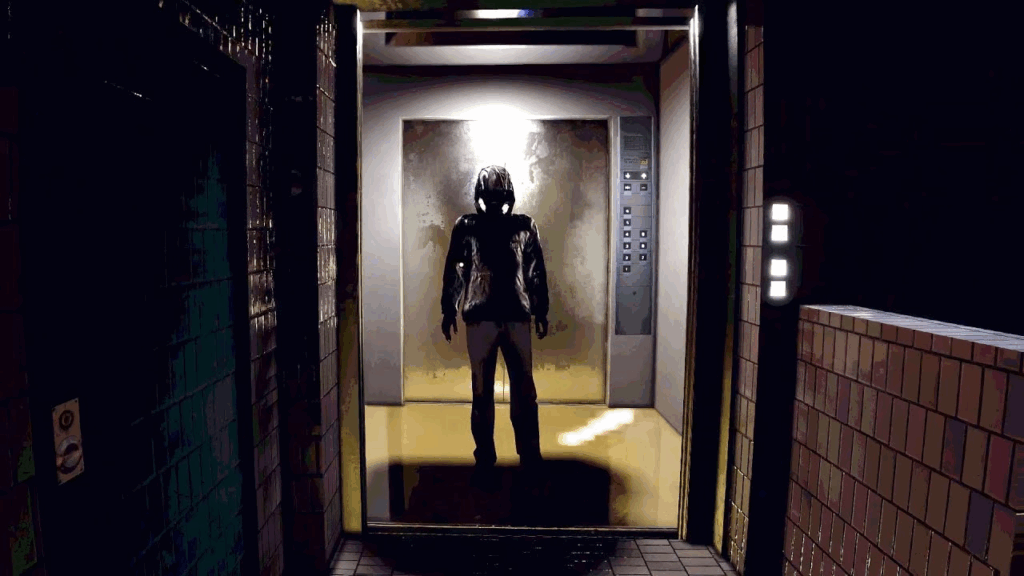
Immediately after this encounter, Nina has two other fear-inducing interactions. First, a shady figure looms nearby as she throws her trash into the dumpster, and as she leaves, rustling noises can be heard, implying that the individual dug out the bag she’d just tossed. In a later cafe-meetup with her friend Asuka, who she confides in about her identity-reveal dilemma, a man in a dark jacket observes their conversation, then sits in a table nearby and can be seen watching footage from one of Nina’s livestreams. As Nina and Asuka’s conversation concludes, he takes a photo of Nina without a word. The same man later follows her into her apartment elevator, riding with her until her floor, where she exits alone.
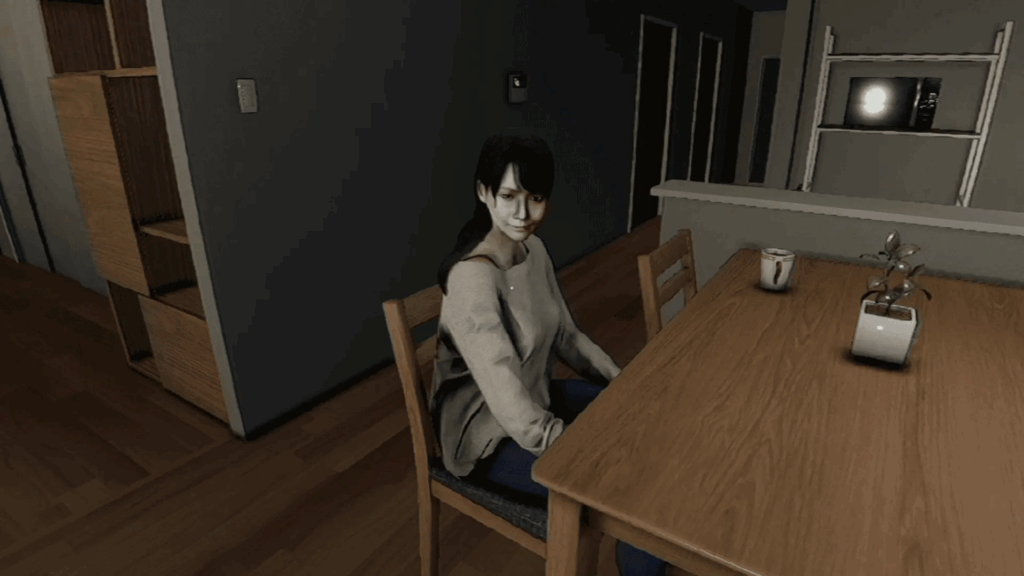
After a sleepless night, Nina wakes up to a note slipped under her door from her building manager, inviting her to “get in touch…if there are any problems.” Calling the number listed on the note, she is immediately asked for her room number, and then told her that if anything happened to her, such as a “stalker incident” they could provide consultation for such matters. Two strange things occur during this interaction: First, when Nina responds with her room number, the manager immediately knows her name. Second, the building manager’s choice of a “stalker incident” as an offhand example of an event worth reporting describes Nina’s earlier alarming encounters perfectly, almost as if she is aware of Nina’s exact circumstances.
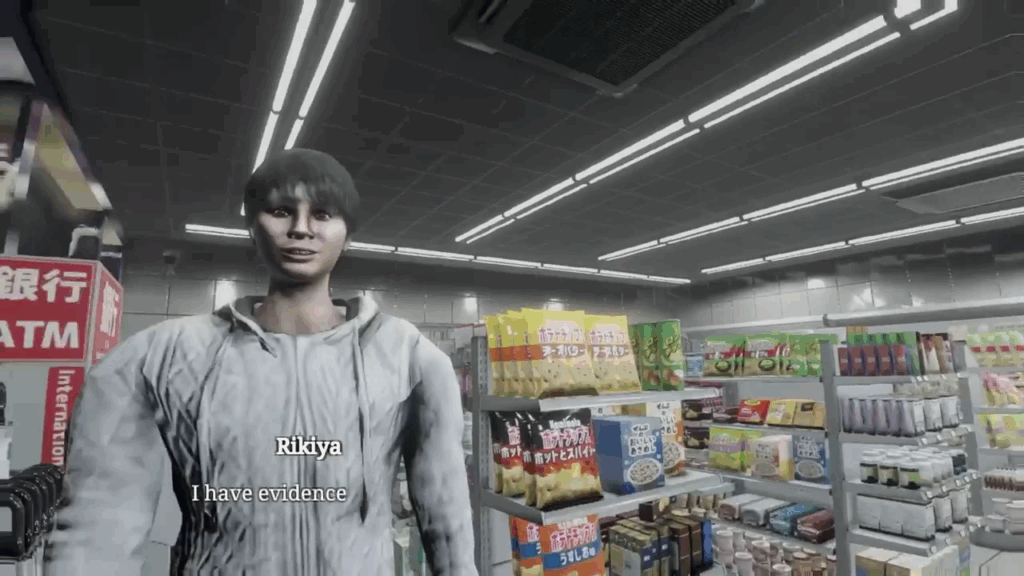
Later, while out buying dinner at a convenience store late at night, Nina runs into her ex-boyfriend Rikiya, who blocks her exit until she listens to him. He claims to have evidence of Asuka being untrustworthy and implores her to reach out to him. Once she returns to her apartment, she unblocks his contact and he immediately inquires about her face reveal and the potential of her being hacked. He sends a photo of the man in the dark jacket talking to Asuka, alleging that he saw them interacting and warning Nina to be wary of her friend. Given Rikiya’s insistent attitude and the fact that his number was blocked before Asuka re-initiated contact, he is not entirely trustworthy. But, his evidence against Asuka also implicates her as a potential suspect involved in Nina’s harassment.
Excluding the stalker, all the individuals Nina can contact for help – the policeman, the building manager, Rikiya, and Asuka – appear, to varying degrees, as potential accomplices to her privacy breach. As it’s revealed in both endings of the game, Asuka is the only individual with good intentions; Rikiya, seeking to win Nina back, had enlisted the help of Kyoa Ashuku (the stalker) to break into her apartment in order for him to “rescue” Nina and regain her trust. Rikiya’s mother masqueraded as the building manager to keep tabs on her address, and Rikiya’s uncle pretended to be a cop in order to prevent Nina from contacting the real authorities.
Even if the player chooses to maintain contact with Asuka and enlist her help as the game progresses, the events still culminate in a dangerous confrontation with Rikiya and his accomplices. This generates an illusion of choice, as no matter how “right” or “safe” the player’s decisions are, they cannot prevent the inevitable escalation taken by Rikiya. As such, the game captures the insidiousness of crimes against women in the modern context (particularly stalking and harassment, which is a salient issue in Japan) by structuring the narrative around an ever-present danger.
To build on Scalzi’s analogy of race and gender to preset character settings in video games, in which he argues that “advantages gradually become invisible as the player becomes immersed in the game,” (Scalzi, 2012) I contend that the inverse is also true: disadvantages gradually become more visible as a player becomes immersed in the game. In Parasocial, we see this through Nina’s lack of true solitude; wherever she is, she is surveilled, be it through the direct presence of another individual, or the sensation of being watched induced by the sporadic appearances of her stalker. The fan who originally sent her the game link that triggered her accidental face reveal and the stalker are one and the same, so even while streaming she is under his watch. In this way, the player is made distinctly aware of the vulnerability of living and navigating spaces alone as a woman.
There are, however, limitations to Parasocial’s depiction of female struggles, the most apparent being that the game is more forgiving than the real-life experiences it is depicting. At any point when the player approaches the wrong individual for help or is caught by the stalker, there is the option to restart to avoid the danger and progress the story. In fact, in the case that the player chooses to trust Rikiya, Nina is later approached by Asuka who shows evidence of his collaboration with Kyoa, alerting her to his intentions and allowing her to achieve the “good ending” of reporting the case to the real authorities. The game only truly ends when Rikiya and his accomplices are apprehended – and although it is a satisfying conclusion – it makes optimistic assumptions about how stalking and harassment cases play out in real life. Not only is it possible for male offenders to escape being caught and prosecuted, but it’s also possible for female victims to be ignored entirely if they do seek justice. Though this discrepancy may be a compromise made to make the game more enjoyable to the player, it still simplifies Parasocial’s depiction of the female struggle by not accounting for institutional biases that pose barriers to legal recourse.
Ultimately, despite its shortcomings, Parasocial still does a phenomenal job using choice and decision making to simulate the paranoia and fear endured by women when their privacy is compromised. Its representation of women’s hardships through a frightening narrative takes a similar approach to Scalzi’s gaming metaphors for white privilege, converting systemic disadvantages from the real world into very apparent difficulties within the game.


I really liked your second to last paragraph about the limitations of Parasocial’s ability to properly depict the struggles that women go through in real life. What you said about the justice system not always working as seamlessly as it does in this game is very true, and to further push your point about the player being able to restart when faced with danger, I also think the ability for players to just leave the game is similar. Players are immersed in Nina’s experiences in Parasocial, but when the game is over they can shed those troubles and return to their normal life. I do agree that games like Parasocial are important in bringing attention to these kind of complex issues, but I wonder if they also do some harm in their simplification of very complex issues and how that can be rectified.
Hi, I really appreciate this analysis of the game Parasocial and its connection to Scalzi’s essay. I always enjoy when horror media represents the plights of marginalized groups of people, and it seems that Parasocial does this well for the most part. While the game is too forgiving in many aspects, I would like to zoom in on the seventh paragraph, where you describe how the game gives the player an “illusion of choice.” This aspect of the game is one that makes the game a little less forgiving. No matter what the player’s decisions are, Nina still faces an escalation in conflict. This makes the game’s representation of stalking and harassment a bit more realistic as there is often a feeling of helplessness in these cases. People like to pin the blame on women when they are victimized, when in reality, there is no right way to act to avoid being attacked. By placing these choices in the player’s hands, they are forced to deal with the weight of making the “correct” decisions while also realizing that they are ultimately futile, which hopefully allows them to understand that the blame should not be placed on the victim. It would be nice to see this sort of helplessness extended throughout the game so that it is less simplified and allows for an even less forgiving gameplay experience.
omg i absolutely love chilla’s art games: they’re always so terrifying and parasocial, i feel is unique among their catalog. the connection to scalzi’s essay is absolutely superb as well, but i want to highlight the last few paragraphs of your post because i totally agree! i think that parasocial is an opportunity to explore this specific gendered experience to a wider audience (especially outside of japan, where the two devs are based), however i do agree that the horror experience is limited by virtue of being a game, a playable experience. and i think this gets at the limit of video games, and further, the limit of “good” video games (to bring it back to conversations about problem attic). if chilla’s art wanted to make an accurate depiction of this kind of gendered violence and fear, i think they would have had to make a bad game: a game that didn’t care about what its player wanted or the forces they exerted on the game world. now that would be a shitty game! but video games have this unique ability to turn experience into abstraction, and despite being a little to the left of the experience it’s trying to depict, we can recognize what it’s doing.
Chilla’s Art is my goat. I think the last few paragraphs are really interesting after this week’s readings relating to roleplaying. Parasocial could serve as a roleplaying ground for people to play through and subsequently come to understand a woman’s experience with stalking and harassment. The ability to restart after death or learn from your mistakes without any deadly consequences makes the game a safe space to test out and understand each option in the game and how it affects your story. As a result, people who play this game can put themselves in a woman’s shoes without having to actually subject themselves to real danger.